
For a wind project buyer, the nacelle is where a large share of long-term operating risk is concentrated. It houses the drivetrain, generator, converter, yaw system, cooling equipment, controls, braking functions, and much of the monitoring architecture needed to turn rotor movement into exportable electricity. A lower turbine purchase price can look attractive at award stage, yet become costly if the nacelle design produces repeated access events, restricted repair options, weak spare-parts support, or prolonged outages after a major component failure.
The procurement question is therefore not simply whether one nacelle configuration is technically acceptable. It is whether the supplier’s design, service model, warranty terms, and repair capacity can support the project’s expected availability and cost profile over the asset life. That assessment needs to begin before contract award, when buyers still have leverage to clarify scope, price risk, data access, and remedies for underperformance.
Why nacelle decisions shape lifecycle cost
Nacelle-related costs extend far beyond the factory price of the turbine. Routine inspection, lubrication, cooling-system work, sensor replacement, electrical troubleshooting, scheduled component exchange, crane mobilization, specialist labor, lost production, and logistics can all enter the operating budget. The consequences are magnified where access is difficult: remote terrain, weak roads, constrained ports, limited lifting windows, high wind conditions, or offshore locations can turn a repair that is technically straightforward into a lengthy outage.
Buyers should separate three cost categories during evaluation. The first is predictable service expenditure: planned visits, consumables, inspections, and standard replacement parts. The second is corrective maintenance exposure, including electrical faults, cooling failures, drivetrain issues, and control-system interventions. The third is low-frequency but high-impact loss: major gearbox, generator, main-shaft, converter, or transformer work that requires heavy-lift equipment and extended downtime.
A bid comparison that only examines turbine price and a headline service rate will miss this distinction. A fixed-price service agreement may provide budget visibility, but buyers still need to understand exclusions, availability assumptions, logistics boundaries, and what happens when a failure is classified outside normal maintenance. Conversely, a cheaper basic warranty may leave the owner exposed exactly when the repair is most disruptive.
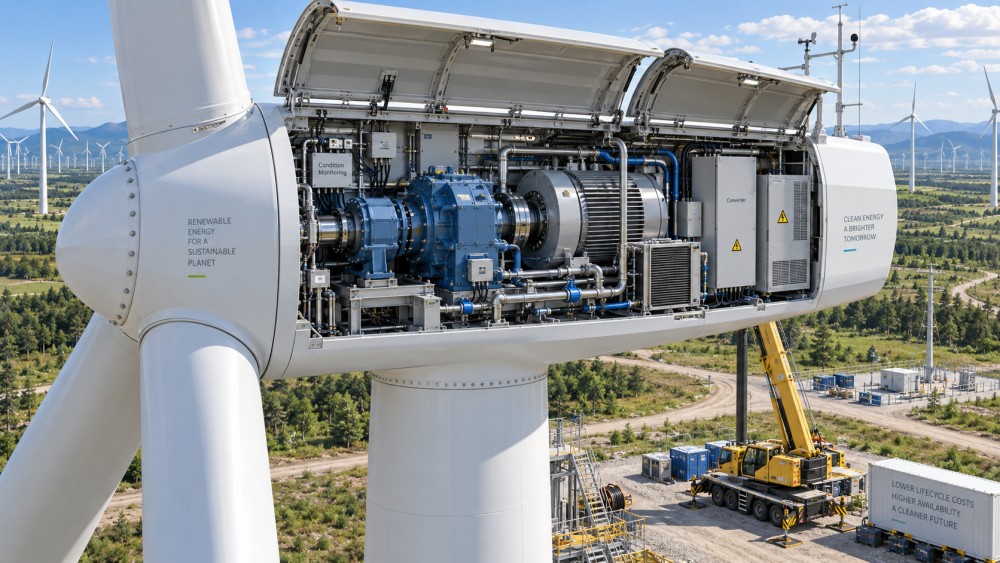
Drivetrain architecture should be evaluated as an operating model
Procurement teams often encounter simplified claims about drivetrain choice. Gearbox-based configurations may be presented as inherently more maintenance-intensive, while direct-drive designs may be framed as automatically lower risk. Neither statement is sufficient for a purchasing decision.
A geared drivetrain introduces gearbox condition, lubrication quality, bearing health, alignment, vibration behavior, and repair access into the lifecycle assessment. It may also benefit from a supply chain with established service practices and component familiarity. Direct-drive arrangements remove the gearbox but place greater importance on generator design, power electronics, thermal management, lifting strategy, and the availability of repair capability for larger electrical components. A medium-speed or hybrid architecture brings a different balance again.
The relevant question is not which architecture has the better label. Buyers should ask how the selected configuration behaves under the site’s wind regime, ambient temperature range, grid conditions, transport constraints, and maintenance access limitations. A nacelle suited to a highly accessible onshore project may create a different operating burden at a remote mountain site or an offshore array.
Evaluation should include the following practical points:
- Which drivetrain and generator components are intended to be repaired in the nacelle, and which require removal or exchange?
- What lifting equipment, internal handling tools, cranes, vessels, or access conditions are assumed for planned and unplanned repairs?
- Are critical components proprietary, and can they be repaired, refurbished, or sourced through approved alternatives after warranty?
- How does the cooling arrangement cope with dust, salt exposure, humidity, temperature extremes, or seasonal operating patterns at the proposed site?
- What failure modes are monitored continuously, and which remain dependent on scheduled inspection or manual diagnosis?
These questions bring the technical review back to cost. A component may have a credible design life, but its economic impact depends on how quickly a developing problem can be detected, whether a repair can be scheduled before failure, and whether the necessary parts and equipment can reach the turbine in time.
Availability commitments need operational definitions
Availability guarantees can create a false sense of protection when contract language is not examined closely. Buyers should establish how availability is measured, what events are excluded, how curtailment is treated, and whether the metric reflects the condition of the turbine or the energy actually lost. A turbine can be considered technically available under one contractual definition while the project owner still experiences material production loss due to grid restrictions, weather limits, access constraints, or unresolved component issues.
For nacelle-related risk, the most important distinction is between a short resettable fault and an outage requiring physical intervention. Control faults may sometimes be cleared remotely; a generator cooling issue, drivetrain alarm, yaw-system defect, or converter failure may require technicians, parts, and potentially lifting equipment. The contract should make clear who bears the cost and schedule consequences at each stage.
Procurement teams should request the service provider’s escalation process for significant nacelle events. That process should identify who diagnoses the issue, how the supplier determines whether a part is covered, where the decision authority sits, what information the owner receives, and what escalation occurs if a repair plan slips. Broad statements about remote monitoring are not enough. The buyer needs to know whether monitoring leads to actionable intervention and whether the owner can see the underlying condition information.
Condition monitoring is valuable only when it changes maintenance decisions
Condition-monitoring systems can help identify abnormal vibration, temperature trends, lubrication concerns, electrical irregularities, and control alarms before they become severe failures. Their value is not the presence of sensors alone. It lies in the quality of diagnostics, the response workflow, and the contractual responsibility to act on early warning.
During procurement, ask whether the supplier provides raw or processed data, alarm history, event logs, and maintenance recommendations to the asset owner. Clarify data ownership and post-warranty access. A project that depends entirely on a supplier-controlled monitoring portal may face a difficult transition if the long-term service agreement ends or changes provider.
Buyers should also distinguish between monitoring that supports broad fleet analytics and monitoring that provides a project-specific repair decision. A useful proposal explains alarm thresholds, review responsibilities, expected reporting, intervention triggers, and how the system connects to spare-parts planning. Without those links, condition monitoring can become a reporting feature rather than a cost-control tool.
Service access can outweigh a modest equipment-price advantage
The nacelle of wind turbine is physically difficult to reach, and this basic fact should influence procurement more than it often does. A maintenance design needs to be assessed together with the site logistics plan. Technicians need safe access to service points. Major components need a defined removal route. Tools, replacement modules, and consumables need practical paths through the tower and nacelle. Where external lifting is needed, the buyer should understand the conditions under which it can be mobilized.
For onshore projects, local crane availability, road geometry, bridge limits, laydown area, weather restrictions, and permits can affect both outage duration and repair price. Offshore projects add vessel availability, port logistics, transfer limits, offshore weather windows, and specialist lifting resources. These are not merely construction-stage issues. They determine whether a nacelle repair can be completed within a manageable operating window.
A useful tender review includes a component-access matrix. It should list the major nacelle assemblies, the expected intervention type, whether repair can be made in place, the required equipment, indicative lead-time dependencies, and the party responsible for organizing access. The purpose is not to predict every failure. It is to expose assumptions that might otherwise remain buried in manuals or service exclusions.
Warranty scope matters more than warranty duration alone
A long warranty period is useful only if the covered events, remedies, response obligations, and financial limits are clear. Buyers should read the warranty alongside the service agreement, technical specifications, commissioning obligations, and availability provisions. These documents often divide responsibility in ways that leave gaps between defect coverage and operational support.
Particular attention should be paid to wear items, consumables, auxiliary systems, software updates, sensors, cooling equipment, electrical assemblies, corrosion-related damage, grid-event impacts, and repairs resulting from site conditions. A nacelle contains numerous subsystems that can affect turbine operation even when the core drivetrain remains intact. If responsibility for those subsystems is unclear, the owner may carry recurring unplanned costs despite believing that the turbine remains under warranty.
Buyers should also assess the remedy. Replacement of a defective part is different from compensation for lost production, crane expense, vessel cost, or extended mobilization. A supplier may accept responsibility for the component while limiting exposure to the larger cost caused by installing it. Contract negotiations should therefore connect defect liability to the access reality of the project.
Another issue is the handover from warranty to long-term operation. Component condition at the end of warranty should not be treated as an administrative matter. The owner should have access to maintenance records, alarm history, outstanding corrective actions, and condition-monitoring trends. An end-of-warranty review can reveal unresolved defects, repeated alarms, or wear patterns before the owner assumes greater cost exposure.
Spare parts and supplier capability are procurement risks, not back-office details
Nacelle availability depends on more than component engineering. It also depends on whether the supplier can diagnose faults, release parts, deploy qualified technicians, support software, and manage the logistics of a major intervention. Buyers should investigate the operating model behind the service proposal rather than relying on broad commitments to “global support” or “local presence.”
Useful evidence includes the proposed regional service organization, escalation contacts, parts-storage approach, technician training requirements, repair-center capability, and the approval process for component refurbishment. The buyer should understand whether critical inventory is reserved for the project, shared across a fleet, or ordered after a confirmed fault. Shared inventory can be efficient, but it can also create contention when similar turbine populations experience the same issue.
Supplier continuity deserves attention as well. Wind assets can operate for decades, while product lines, component suppliers, and service structures may change. Procurement teams should seek practical protections around documentation, software support, data retention, obsolete parts, and technical assistance after the original warranty term. These provisions do not eliminate long-term uncertainty, but they reduce dependence on informal assurances.
Build the bid evaluation around cost scenarios
The strongest procurement process converts nacelle questions into comparable operating scenarios. Rather than asking suppliers to provide a generic maintenance estimate, define a small set of realistic events: a converter replacement, a cooling-system repair, a gearbox or generator intervention, a persistent vibration alarm, and an extended control-system fault. Ask each bidder to explain responsibility, response steps, required access equipment, assumed lead times, exclusions, and the owner’s likely role.
This approach exposes differences that a standard technical compliance table may conceal. One supplier may offer a competitive turbine price but require project-specific lifting arrangements that are outside its scope. Another may carry a higher initial price while providing stronger parts availability, clearer diagnostics, or a more workable major-component plan. The correct choice will depend on site access, financing assumptions, operating strategy, and the owner’s tolerance for variable maintenance expenditure.
For buyers, the nacelle should be assessed as a lifecycle service proposition attached to a machine, not as an isolated equipment package. A credible evaluation links design choices to access, monitoring, contractual remedies, repair logistics, and supplier support. That is where the largest cost surprises tend to emerge, and where disciplined procurement can still influence the outcome.