Distributed Wind Energy Systems: How They Work and Where They Fit
Distributed wind energy systems can supply electricity close to homes, farms, businesses, or communities, but proximity to demand does not make every site suitable. A useful installation needs more than a windy day: it needs a consistent wind resource at turbine height, enough space for safe operation, and an electricity use or export arrangement that makes the generation valuable.
For some sites, wind can complement solar, reduce purchases from the grid, or support a remote power system. For others, a poor wind resource, difficult permitting, or expensive grid connection can outweigh the benefits. Understanding how the system fits the location and the electrical load is the starting point.
What makes a wind system “distributed”?
Distributed wind describes how wind generation is connected and used, rather than a single turbine size or design. A turbine may serve electricity demand on the customer’s side of a meter, supply a nearby distribution network, or provide power to an isolated local grid.
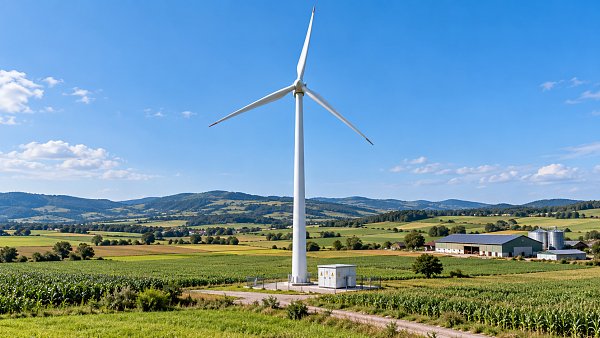
A farm turbine supplying a grain-handling operation is one example. A turbine connected to a community distribution network can also be distributed generation, even when the electricity is shared across multiple users. By contrast, a large wind farm built primarily to deliver bulk power over the transmission network is generally discussed as utility-scale generation.
The distinction matters because the project’s value depends on where the power goes. Electricity used directly on site may avoid a retail electricity purchase. Electricity exported to the grid may receive a different payment or be subject to restrictions. An off-grid project has another priority: keeping generation and demand balanced without relying on the wider grid.
How distributed wind energy systems work
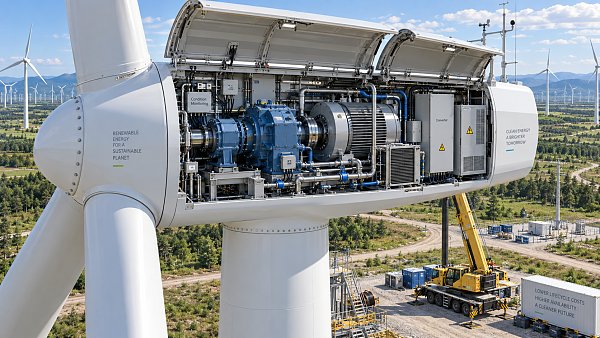
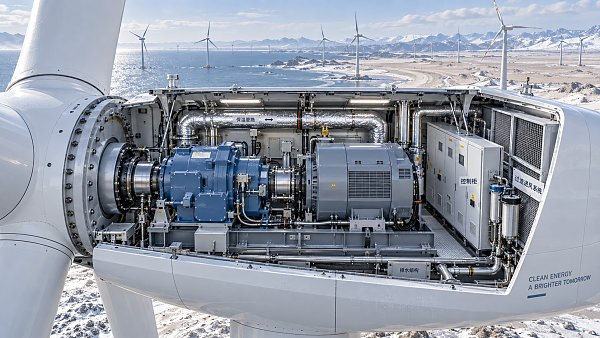
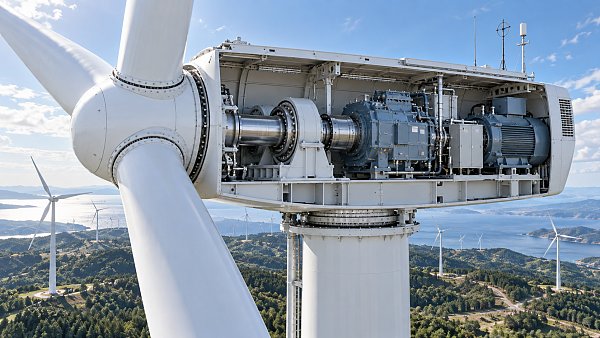
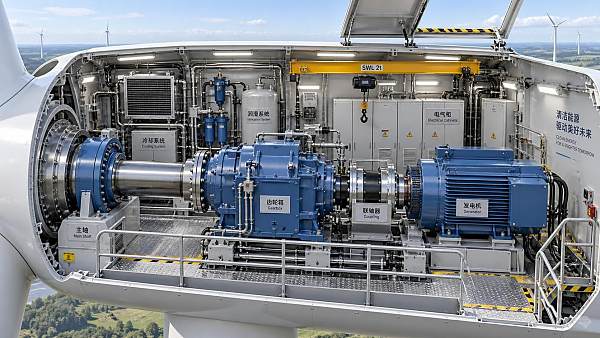
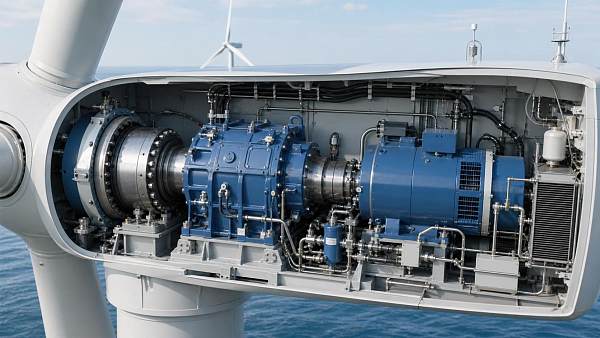
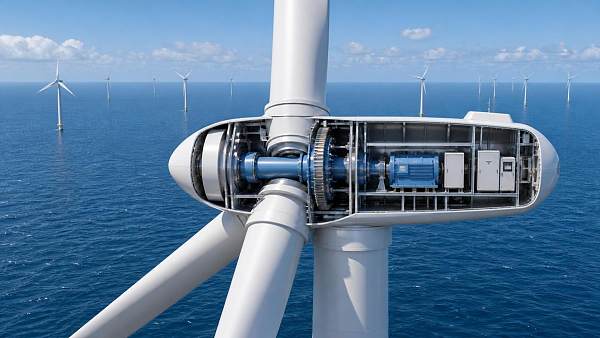
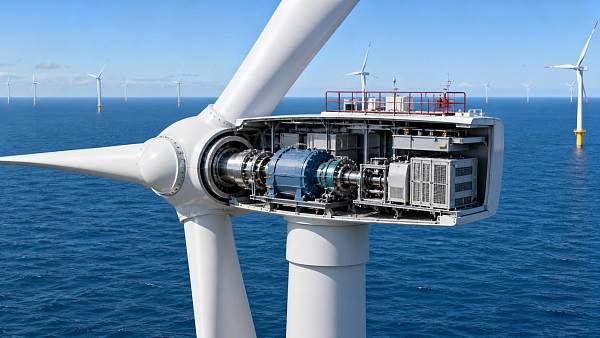
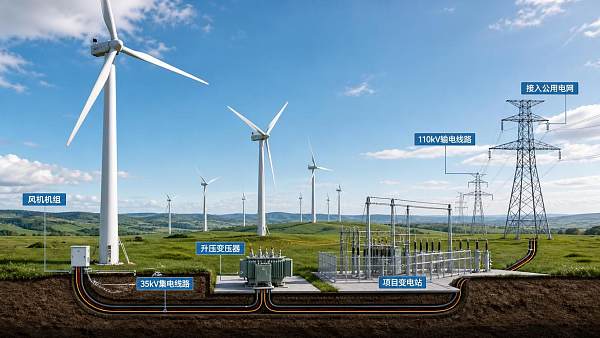
Wind turns the turbine’s rotor, which drives a generator. Power electronics and other electrical equipment then condition the output so it can be used by site equipment, supplied to a local grid, or directed through a storage system. A controller monitors operating conditions and manages functions such as starting, stopping, and protecting the turbine when wind speeds are too high.
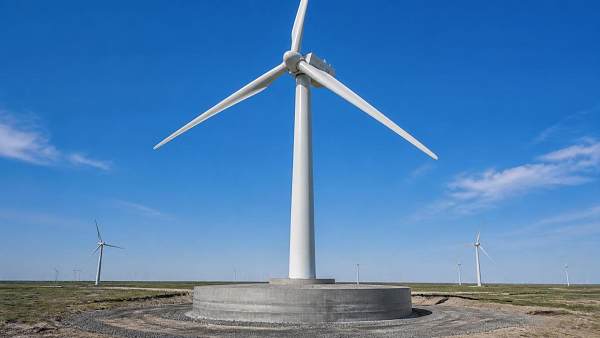
The tower is part of the energy system, not just a support structure. Raising the rotor can place it in stronger, less turbulent wind above nearby obstacles. The appropriate height depends on the site, turbine design, engineering constraints, and local approvals.
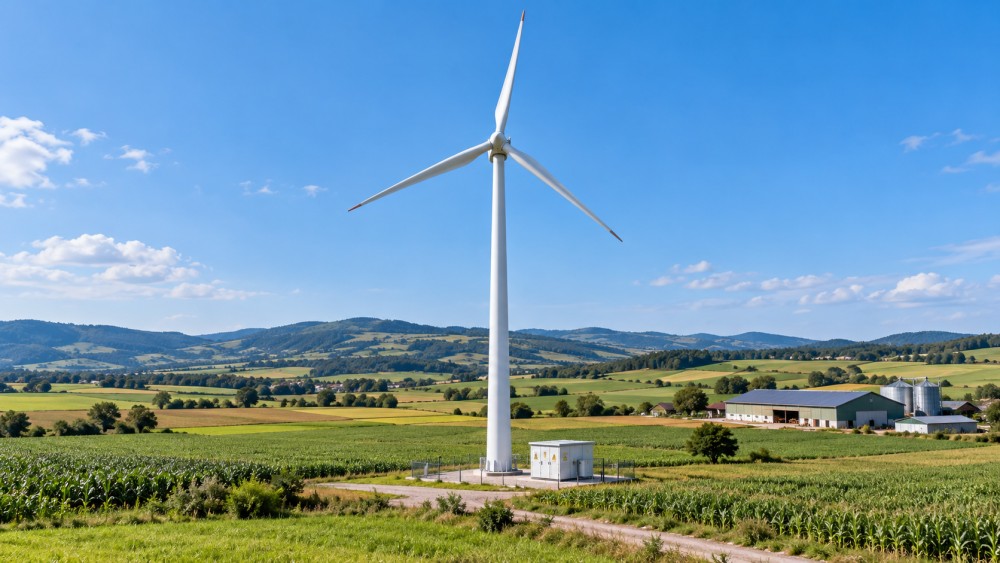
A typical grid-connected installation also includes protection equipment, metering, and a connection to the site’s electrical system. Depending on the design, a transformer or other equipment may be needed to match the connection voltage. If generation exceeds the site’s immediate demand, the surplus may be exported, curtailed, or stored, depending on the equipment and connection agreement.
Wind output changes with wind speed, and a turbine does not produce its rated power continuously. The rated capacity is useful for describing equipment, but it is not an estimate of annual electricity production. A realistic estimate considers the wind distribution at the proposed hub height, turbine power curve, expected downtime, electrical losses, and site conditions.
Where distributed wind can make sense
Farms and rural businesses may have open land, substantial electricity demand, and some distance from neighboring buildings. A turbine can supply operations such as pumping, cooling, processing, or workshops. The fit improves when the strongest wind periods coincide with the facility’s demand, or when surplus generation has a practical use.
Industrial and commercial sites may have steady loads that can use generation as it occurs. However, large buildings and surrounding structures can create turbulent airflow, and available land may be constrained. A high electricity bill alone is not enough to justify a turbine if the wind resource is weak or the site cannot accommodate a suitable tower.
Remote communities and isolated facilities may use wind as part of a local power system alongside solar, batteries, and dispatchable generators. Wind can reduce the amount of fuel needed when conditions are favorable, but the system still needs a way to supply demand during extended low-wind periods. Fuel logistics, maintenance access, and the cost of keeping backup equipment available all influence the decision.
Community or utility distribution projects can place generation near local demand without connecting every turbine directly to an individual customer’s meter. Their feasibility depends on distribution network capacity, local load, ownership arrangements, and how project costs and benefits are allocated.
Wind is often a poor fit for a small, obstructed property surrounded by trees or buildings. Rooftop placement may appear convenient, but turbulent airflow, structural loading, vibration, maintenance access, and limited tower height can make it difficult to achieve worthwhile output. A conventional ground-mounted tower at a better-exposed location, or a different technology altogether, may be more practical.
The wind resource is local, not just regional
A regional wind map can identify areas worth investigating, but it cannot fully describe the airflow at a particular turbine location. Hills, tree lines, buildings, and other obstacles affect both wind speed and turbulence. Conditions at ground level also differ from conditions at the proposed rotor height.
Because the energy available in wind rises sharply as wind speed increases, modest differences in the resource can materially affect expected production. Turbulence matters as well: irregular airflow can reduce energy capture and increase mechanical stress. A site that feels windy near a building is not necessarily a good turbine site.
Early screening may use wind maps and nearby observations. For a project being seriously considered, the assessment should account for the proposed tower height, surrounding terrain and obstacles, and the quality of the available wind data. Larger or more financially sensitive projects may warrant site-specific measurements and a more detailed energy assessment.
Compare turbine proposals using estimated annual energy under the same site assumptions, not just rotor size or rated capacity. A supplier’s output estimate is most useful when it explains the wind inputs, losses, and availability assumptions behind it.
Match generation to the electricity it will serve
Start with electricity bills and, where available, interval consumption data. Annual consumption gives a broad sense of demand, while hourly or shorter-interval data shows when electricity is actually used. That distinction matters because wind generation varies, and a site may produce surplus electricity at times when its own load is low.
For a grid-connected customer, the financial value of each unit of generation can differ according to whether it is consumed on site or exported. Bills may also include fixed charges, demand charges, and time-dependent rates. Wind generation does not necessarily eliminate those charges, and variable output cannot be assumed to reduce the highest demand period.
Export arrangements deserve attention early. A utility may set limits on how much power can flow back onto the network, require upgrades, or apply a compensation method that changes the project economics. If export is restricted, the design may need controls that reduce turbine output when local demand is insufficient.
For an isolated system, the question is different: can the combined generation and storage reliably meet the load? The design must account for periods of low wind, equipment outages, and the starting demands of motors or other large loads. A turbine alone is not a complete reliability strategy.
Wind, solar, and batteries: different roles in one system
Wind and solar can complement one another when their local production patterns differ. Solar follows daylight, while wind can occur at any hour. That does not mean wind will always be available at night or when solar output is low; the relationship depends on the site and season.
A battery can shift some generation to another time, absorb short-term fluctuations, and support certain backup or grid-management functions. It cannot create energy during a prolonged shortfall, and storage adds equipment, losses, and cost. Battery size should follow the intended job, such as limited backup, reducing exports, or supporting an isolated microgrid.
Backup capability also requires the right electrical design. Most ordinary grid-connected generation systems shut down when the grid fails to protect utility workers and equipment. Keeping selected loads energized during an outage requires equipment and controls designed to isolate the site from the grid and operate safely as a separate system. A turbine or battery on its own does not guarantee that capability.
What to examine before committing to a project
A preliminary feasibility review should connect the resource, electrical design, and costs. It does not need to settle every engineering detail, but it should identify the issues that could stop the project or change its economics.
- Site and access: Is there room for the tower, foundations, installation equipment, and maintenance vehicles? Consider neighboring properties, terrain, and underground services.
- Energy estimate: Is expected production based on wind conditions at the proposed hub height and on a documented turbine power curve? Are downtime and system losses included?
- Grid connection: Can the local network accept the proposed capacity and any exports? Identify protection, metering, upgrade, and application requirements with the network operator.
- Permissions and impacts: Review the local approval process and site-specific concerns, which may include noise, visual impact, wildlife, aviation, setbacks, and land use.
- Lifetime costs: Include development, equipment, foundations, installation, electrical works, insurance, inspections, repairs, and eventual removal or replacement.
- Service arrangements: Establish who will maintain the turbine, how faults will be monitored, and how replacement parts and specialist equipment will reach the site.
These factors interact. A taller tower may improve the wind resource but also change foundation, installation, and approval requirements. A larger turbine may produce more electricity but create surplus that has little value or requires a more expensive connection. The best design is the one that works as a complete project, not the one with the highest advertised capacity.
How to compare wind with other options
Compare alternatives against the same objective. If the goal is to lower electricity costs, look at expected energy production, when it can be used, export value, and lifetime costs. If the goal is backup power, examine which loads must operate, for how long, and what happens when wind is unavailable. If the goal is to reduce fuel consumption at a remote site, include generator operation and fuel delivery in the assessment.
Solar may be simpler to integrate at a site with suitable roof or ground space and limited wind exposure. Energy efficiency may reduce demand without adding generation. Wind can be a stronger candidate where the resource is good, the site can accommodate a tower, and generation aligns with valuable electricity use. Combinations can work well, but each additional component should have a defined purpose.
The most useful first step is a basic site screen: gather electricity consumption data, identify a potential turbine location, and examine the wind resource at a plausible tower height. Those inputs give a developer or engineering adviser a basis for deciding whether a detailed design is justified, or whether another approach deserves attention first.
Questions about market trends? Contact Market Scope Live for deeper business insights.
We respect your privacy. Your information is strictly confidential.
Related News
 Wind Power ComponentsDistributed Wind Energy Systems: How They Work and Where They FitDistributed wind energy systems can power farms, businesses, and communities. Discover how they work, where they fit, and what makes a project viable.MORE+
 Wind Power ComponentsTroubleshooting Nacelle Wind Turbine Parts That Cause Unplanned DowntimeTroubleshoot nacelle wind turbine parts with proven checks for gearbox, generator, yaw, hydraulic, and wiring faults to reduce unplanned downtime.MORE+
 Wind Power ComponentsHow to Evaluate Wind Turbine Blades for Fatigue Life, Erosion, and Site LoadsWind turbine blades: learn how to assess fatigue life, leading-edge erosion, lightning exposure, and site-specific loads to improve reliability, energy yield, and lifecycle decisions.MORE+
 Wind Power ComponentsNacelle of Wind Turbine: Lifecycle Cost Drivers Buyers Should EvaluateNacelle of wind turbine lifecycle costs: evaluate drivetrain design, service access, warranty scope, spares, and availability risks before buying.MORE+
 Wind Power ComponentsSelecting a Nacelle in Wind Turbine Projects for Cold, Coastal, and Dusty SitesNacelle in wind turbine selection guide for cold, coastal, and dusty sites—compare sealing, corrosion control, thermal management, filtration, and maintenance access.MORE+
 Wind Power ComponentsNacelle and Hub Interfaces: Alignment Risks That Can Shorten Turbine LifeNacelle and hub alignment risks can accelerate turbine wear. Learn how precise interface control protects drivetrain life, uptime, and project value.MORE+
 Wind Power ComponentsInside a Wind Turbine Nacelle: Which Components Need the Most Maintenance?Inside nacelle wind turbine systems, discover which components demand the most maintenance—from gearboxes to cooling and controls—and protect uptime with smarter inspections.MORE+
 Wind Power ComponentsNacelle Wind Turbine Parts: An Inspection Checklist for Preventing DowntimeNacelle wind turbine parts inspection checklist: detect early faults in drivetrain, cooling, yaw, brakes, and controls to prevent costly downtime.MORE+
 Wind Power ComponentsWhat Is a Nacelle in a Wind Turbine? The Systems That Control Power GenerationWhat is a nacelle in a wind turbine? Explore the drivetrain, controls, pitch, yaw, cooling, and safety systems that shape power output, reliability, and lifecycle costs.MORE+
 Wind Power ComponentsWhat Is a Nacelle on a Wind Turbine? Safe Access Rules for Field OperatorsWhat is a nacelle on a wind turbine? Explore its vital systems, key hazards, and safe access rules that help field operators protect people and turbine uptime.MORE+
 Wind Power ComponentsWhat Is Nacelle in Wind Turbine Design and Why Does It Affect Energy Output?What is nacelle in wind turbine design? Discover how this vital housing supports alignment, cooling, controls, and reliable energy output.MORE+
 Wind Power ComponentsThe Nacelle of a Wind Turbine Explained: Functions, Layout, and Key SystemsNacelle of a wind turbine explained: explore its drivetrain, yaw, pitch, cooling, electrical, and control systems—and see how nacelle design impacts reliability, maintenance, and energy output.MORE+
 Wind Power ComponentsWind Turbine Hub and Nacelle: How Loads Travel from Blades to DrivetrainWind turbine hub and nacelle: discover how blade loads flow through bearings, shafts, gearboxes, and supports to improve drivetrain reliability and maintenance decisions.MORE+
 Wind Power ComponentsInside a Wind Turbine Nacelle: How Drivetrain Layout Affects Maintenance AccessExplore how drivetrain layout inside the nacelle of wind turbine shapes maintenance access, lifting routes, safety, and lifecycle service costs.MORE+
 Wind Power ComponentsWhat is shaping the wind turbine nacelle market today?Wind turbine nacelle market trends: explore turbine scaling, drivetrain choices, reliability, grid compliance, localization, and offshore supply risks shaping smarter investment decisions.MORE+
 Wind Power ComponentsHow to inspect a wind turbine nacelle before commissioningWind turbine nacelle inspection guide: verify mechanical, electrical, safety, fire-protection, and documentation readiness before commissioning.MORE+
 Wind Power ComponentsWhich nacelle of wind turbine design suits offshore projects?Nacelle of wind turbine design for offshore projects: explore drivetrain options, marine protection, maintenance access, and vessel logistics for reliable performance.MORE+
 Wind Power ComponentsWhat should operators check when a wind turbine nacelle overheats?Nacelle wind turbine overheating? Learn the essential checks for cooling, gearbox, generator, and electrical systems to prevent failures and protect uptime.MORE+
 Wind Power ComponentsHow does nacelle cooling protect wind energy turbines?Wind energy nacelle cooling protects turbines from overheating, derating, and costly failures. Discover practical maintenance insights to improve reliability and power availability.MORE+
 Wind Power ComponentsWhat drives wind power nacelle maintenance costs over time?Wind power nacelle maintenance costs evolve with age, failures, access, parts, and downtime. Discover key risks and smarter lifecycle cost controls.MORE+
 Wind Power ComponentsHow does turbine nacelle weight affect foundation design?Turbine nacelle weight affects foundation loads, dynamics, fatigue, soil response, and crane planning. Discover key design factors for reliable wind projects.MORE+
 Wind Power ComponentsWhich nacelle components affect wind turbine reliability most?Nacelle components wind turbine reliability depends on drivetrain, generator, bearings, yaw, cooling, and controls. Explore high-impact risks and smarter maintenance priorities.MORE+
 Wind Power ComponentsHow are the nacelle and hub different in a wind turbine?Nacelle and hub: discover how these vital wind turbine components differ, from blade control and power conversion to maintenance, reliability, and project performance.MORE+
 Wind Power ComponentsWhat does a nacelle in a wind turbine actually do?Discover what a nacelle in wind turbine does, from power conversion and controls to maintenance, reliability, and wind farm economics. Read the full guide.MORE+
 Wind Power ComponentsHow Grid-Connected Wind Energy Systems Work in Utility and Commercial ProjectsGrid connected wind energy systems explained for utility and commercial projects—learn how turbines, substations, controls, and grid compliance shape reliable, bankable performance.MORE+
 Wind Power ComponentsWhat Does a Wind Turbine Nacelle Include and Why Does It Matter in Turbine Design?Wind turbine nacelles include the drivetrain, generator, controls, cooling, and service systems. Learn why nacelle design directly impacts reliability, maintenance cost, and turbine performance.MORE+
 Wind Power ComponentsHow to Evaluate Wind Turbine Gearboxes for Reliability, Load Capacity, and Service LifeWind turbine gearboxes evaluation starts with real duty profiles. Learn how to assess reliability, load capacity, lubrication, and service life for smarter supplier decisions.MORE+
 Wind Power ComponentsHow to Evaluate a Wind Turbine Gearboxes Manufacturer for Quality, Lead Time, and OEM FitWind turbine gearboxes manufacturer selection made simple: learn how to assess quality, lead time, OEM fit, warranty, and total cost to reduce project risk and improve uptime.MORE+
 Wind Power ComponentsHow to Choose a Wind Turbine Gearboxes Supplier for Reliability and Service SupportWind turbine gearboxes supplier selection affects uptime, lifecycle cost, and project risk. Learn how to compare reliability, service support, and delivery strength.MORE+
 Wind Power ComponentsWind Turbine Blades Explained: Materials, Blade Length, and Performance Trade-OffsWind turbine blades explained: compare materials, blade length, and performance trade-offs to improve energy yield, durability, and project ROI in modern wind power.MORE+
 Wind Power ComponentsIndustrial Gearboxes Selection Guide: Torque, Ratio, Duty Cycle, and Mounting BasicsGearboxes selection made practical: learn how torque, ratio, duty cycle, and mounting affect reliability, efficiency, and lifecycle cost in industrial applications.MORE+