
The nacelle is far more than a protective enclosure. It is the turbine's main mechanical, electrical, and control center, directly affecting output, availability, maintenance requirements, and lifecycle cost.
For researchers, project teams, and procurement professionals, understanding nacelle design provides a practical way to assess turbine technology beyond rated capacity and headline energy-yield figures.
A nacelle's components must operate together under changing wind loads, temperature extremes, vibration, humidity, lightning exposure, and grid operating requirements throughout the turbine's service life.
Why the Nacelle Matters to Wind Power Performance
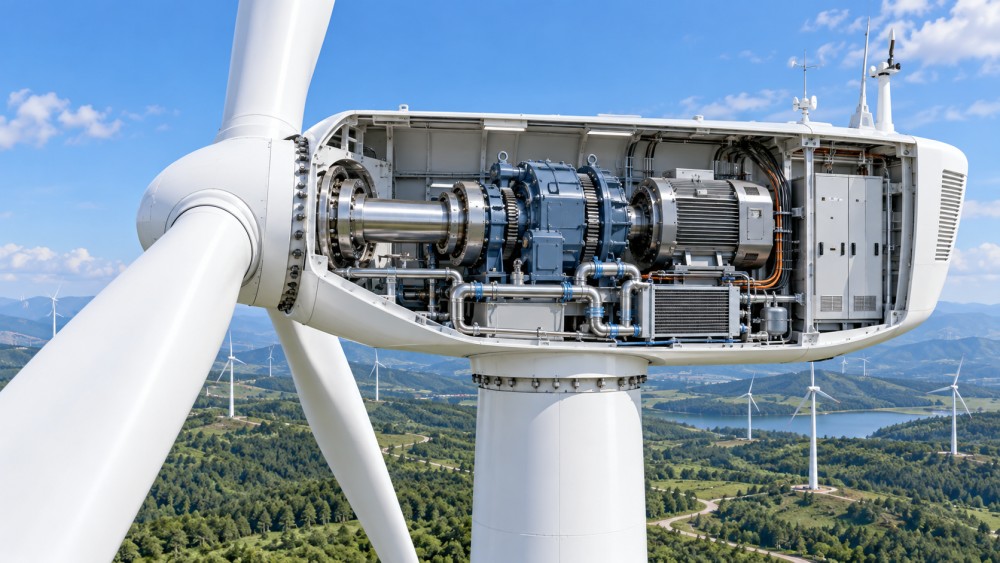
The nacelle sits at the top of a wind turbine tower, immediately behind the rotor hub. Its position allows the drivetrain and controls to receive rotational energy efficiently.
Wind turns the rotor blades, which rotate the main shaft. Inside the nacelle, that rotational motion is converted into electrical energy and conditioned for delivery.
Modern turbines cannot simply spin whenever wind is available. They must control speed, blade angle, direction, temperature, electrical quality, and shutdown behavior continuously.
Those functions are coordinated inside or through the nacelle. As a result, nacelle performance strongly influences how much energy a turbine produces over time.
It also influences availability, meaning the percentage of time a turbine is technically able to generate electricity when wind conditions are suitable.
A turbine with an efficient rotor but unreliable nacelle systems may lose significant production through unplanned outages, reduced operating modes, or repeated maintenance interventions.
For wind project owners, the nacelle is therefore central to both technical due diligence and commercial performance. It affects expected revenue, operating expenditure, and warranty exposure.
What Components Are Inside a Wind Turbine Nacelle?
The exact nacelle layout varies by turbine model, size, and drivetrain architecture. However, most utility-scale turbines contain several core systems performing predictable functions.
The main shaft transfers rotational force from the rotor hub into the drivetrain. It must withstand substantial torque, bending loads, vibration, and changing wind conditions.
Main bearings support the rotating shaft and help manage the loads created by large blades. Bearing condition is closely monitored because failures can be expensive.
Many turbines use a gearbox to increase the relatively slow rotor speed before it reaches the generator. This configuration is common in geared wind turbines.
The generator converts mechanical rotation into electricity. Generator design differs among manufacturers, but it must produce stable power across a broad range of wind speeds.
A brake system provides controlled stopping capability during maintenance, emergency events, extreme winds, or selected fault conditions. Aerodynamic blade control remains the primary stopping method.
Other common nacelle equipment includes transformers, converters, switchgear, hydraulic units, cooling circuits, lubrication systems, sensors, cables, cabinets, and fire-detection equipment.
How the Drivetrain Converts Wind Into Electricity
The drivetrain is the physical pathway that carries energy from the rotating rotor to the generator. Its configuration shapes nacelle weight, maintenance strategy, and failure profile.
In a conventional geared turbine, the rotor turns the low-speed shaft. The gearbox raises rotational speed before transmitting it through a high-speed shaft.
This speed increase allows a comparatively compact generator to produce electricity efficiently. However, the gearbox adds mechanical complexity and requires careful lubrication and condition monitoring.
Direct-drive turbines eliminate the gearbox by using a larger generator connected more directly to the rotor. They reduce some moving parts but may require heavier components.
There is no universally superior architecture. Developers should compare turbine designs based on site conditions, service availability, transport limits, operating history, and contractual guarantees.
Drivetrain decisions are especially important offshore, where repairs require specialized vessels, favorable weather windows, and longer planning cycles than most onshore interventions.
Condition monitoring systems track vibration, oil particles, temperature, rotational speed, and other indicators. These data can identify emerging drivetrain issues before complete failure occurs.
How Nacelle Controls Keep the Turbine Operating Safely
The nacelle contains control systems that make thousands of operating decisions every day. Their goal is to maximize safe production while protecting equipment from damaging loads.
A supervisory controller receives data from wind sensors, rotor sensors, temperature probes, electrical meters, vibration monitors, and grid communication interfaces.
Using this information, the controller determines whether the turbine should start, continue generating, reduce output, change direction, or shut down completely.
Control logic must balance energy capture with equipment protection. A turbine operating aggressively may generate more power temporarily while accelerating fatigue or increasing fault risk.
Grid-connected turbines also follow utility requirements for voltage support, frequency response, fault ride-through, active power control, and reactive power management.
These capabilities have become more important as wind represents a larger share of generation. Grid operators increasingly expect renewable assets to support system stability.
For project teams, reviewing turbine control capabilities is essential during grid connection studies. Nacelle controls must work with plant controllers, substations, and dispatch systems.
Pitch and Yaw Systems: Controlling Blades and Wind Direction
Pitch and yaw systems are among the nacelle's most important control functions. They determine how blades face the wind and how much aerodynamic energy they capture.
The yaw system rotates the nacelle so the rotor faces into the wind. Wind direction sensors provide the input needed for controlled alignment.
Poor yaw alignment reduces energy yield because the rotor does not receive wind at its most effective angle. Persistent misalignment can also increase structural loading.
Yaw drives, motors, gears, brakes, and bearings must withstand repeated movement and large forces. Their service condition affects turbine positioning accuracy and reliability.
The pitch system changes each blade's angle independently or in coordination. It allows the turbine to optimize energy capture below rated wind speed.
Once rated output is reached, blade pitch limits aerodynamic power so the generator and electrical systems remain within their designed operating range.
During an emergency stop, pitch systems feather the blades, reducing lift and slowing the rotor. This makes pitch reliability a critical safety consideration.
Cooling, Lubrication, and Environmental Protection Systems
Nacelle machinery creates heat through friction, electrical conversion, hydraulic activity, and generator operation. Without thermal management, excessive temperatures can reduce component life significantly.
Cooling systems may use air, liquid, heat exchangers, fans, filters, pumps, or integrated circuits. Their design depends on climate, turbine rating, and component arrangement.
High ambient temperatures can reduce output or trigger derating if cooling capacity is insufficient. Cold climates introduce different concerns, including condensation and lubricant viscosity.
Lubrication systems supply oil or grease to gearboxes, bearings, yaw mechanisms, and other moving equipment. Oil quality is a useful indicator of internal wear.
Filtration, oil sampling, leak detection, and scheduled replacement practices help prevent damage. A small lubrication issue can become a major repair if ignored.
The nacelle enclosure also protects sensitive equipment from rain, salt spray, dust, ultraviolet exposure, and airborne contaminants. Offshore environments create especially severe corrosion risks.
Ventilation and humidity management matter because moisture can affect electrical insulation, control cabinets, sensors, and connectors. Environmental protection is part of reliability engineering.
What Nacelle Design Means for Maintenance and Project Risk
For operators, nacelle design matters because many high-value components are difficult to access. Work occurs hundreds of meters above ground in constrained conditions.
Maintenance teams need safe internal access, lifting equipment, service platforms, emergency systems, clear component layouts, and reliable diagnostic information to work efficiently.
Large corrective repairs may require cranes, replacement parts, specialist technicians, road permits, or offshore vessels. Logistics can determine the true financial impact of a failure.
During turbine selection, buyers should assess not only component specifications but also manufacturer service capacity, spare-parts strategy, response commitments, and local technician availability.
Availability guarantees and power-curve warranties provide useful commercial protection, but their value depends on exclusions, measurement methods, force-majeure provisions, and enforcement mechanisms.
Condition-based maintenance can reduce unexpected downtime by using sensor data to prioritize inspections. It is most effective when operators have clear response processes and qualified personnel.
Asset managers should also consider whether operational data remain accessible after warranty periods. Data ownership and interface compatibility influence long-term fleet management options.
How to Evaluate Nacelle Technology During Turbine Selection
Information researchers should begin with the intended project environment. Wind regime, ambient temperature, altitude, grid requirements, transport access, and maintenance conditions all affect suitability.
Compare drivetrain type, generator technology, gearbox design, cooling approach, converter configuration, and expected maintenance intervals. These details reveal practical differences between similar turbine ratings.
Review the turbine's certified power curve, noise characteristics, extreme-load assumptions, and operating temperature range. Nacelle systems must support performance within those stated boundaries.
Ask manufacturers how the turbine handles grid faults, curtailment commands, low-voltage ride-through, high-wind shutdowns, and restart sequences after communication interruptions.
For remote sites, evaluate remote monitoring, diagnostic capability, component modularity, and service tooling. A technically strong design may still create operational challenges without local support.
For offshore projects, examine corrosion protection, nacelle sealing, humidity control, vessel access requirements, crane strategy, and the supplier's demonstrated service record.
Investors and owners should connect nacelle reliability assumptions to financial models. Downtime, repair costs, insurance terms, and lost production can materially affect project returns.
Key Takeaway for Wind Energy Decision-Makers
A nacelle in a wind turbine is the integrated operating center that converts rotor movement into controlled electrical generation. It houses critical mechanical and digital systems.
Its drivetrain, generator, yaw equipment, pitch controls, cooling systems, sensors, and safety functions work together to determine production, reliability, and maintenance demand.
When evaluating wind turbines, capacity alone is not enough. Nacelle architecture and serviceability help determine whether a turbine can deliver dependable energy over its intended lifecycle.
For energy professionals, examining nacelle systems provides a more realistic view of technical risk, grid capability, operating cost, and long-term asset performance.


