
Multi-site commercial energy planning starts with a simple reality: facilities that share a brand, owner, or operating model rarely share the same energy problem. A distribution center may have a short, severe evening peak. An office may consume most power during working hours. A cold-storage site carries a steady refrigeration load, while a retail location may face high demand charges from HVAC, lighting, and electric vehicle charging that operate at the same time. Comparing monthly electricity bills hides these differences.
A coordinated energy strategy therefore needs to examine each location on its own terms while managing the portfolio as a connected whole. The useful question is not which site has the highest bill. It is which combination of load shape, tariff exposure, electrical constraints, outage consequences, and available flexibility produces the largest operational or financial exposure.
Start with the load profile, not the annual consumption total
Annual kilowatt-hour consumption is useful for budgeting, but it is a weak basis for selecting solar, storage, demand response, or backup power. Two sites can consume the same annual energy while needing entirely different solutions. One may draw a stable load across most hours; the other may create brief monthly peaks that determine its network charges. A battery sized from annual consumption alone can be oversized, undersized, or dispatched at the wrong time.
Interval meter data reveals the operational pattern behind the bill. For each site, the planning view should distinguish between baseload, predictable scheduled load, weather-sensitive load, and irregular peak load. Refrigeration, data rooms, security systems, and continuous process equipment often form part of the baseload. HVAC, kitchen equipment, compressors, warehouse automation, and vehicle chargers may create scheduled or coincident peaks. Construction activity, temporary production runs, or emergency operating modes should be tagged separately rather than treated as normal demand.
Peak demand also requires interpretation. A high peak caused by a single equipment start is different from a high peak sustained for several tariff intervals. The first may be addressed through sequencing, soft starters, or control settings. The second may justify battery discharge, load shifting, or a contracted-capacity review. If a site has frequent short spikes, confirm the utility meter integration interval before drawing conclusions: a fifteen-minute demand value and a half-hour demand value can describe the same operational event very differently.
Load timing matters across the portfolio. Locations in the same utility territory may peak together during hot afternoons or cold mornings, creating concentrated exposure. Facilities in different climates, time zones, or operating schedules may offset one another. That diversity does not eliminate local bills, but it affects how centrally managed energy procurement, flexibility programs, and operating targets should be structured.
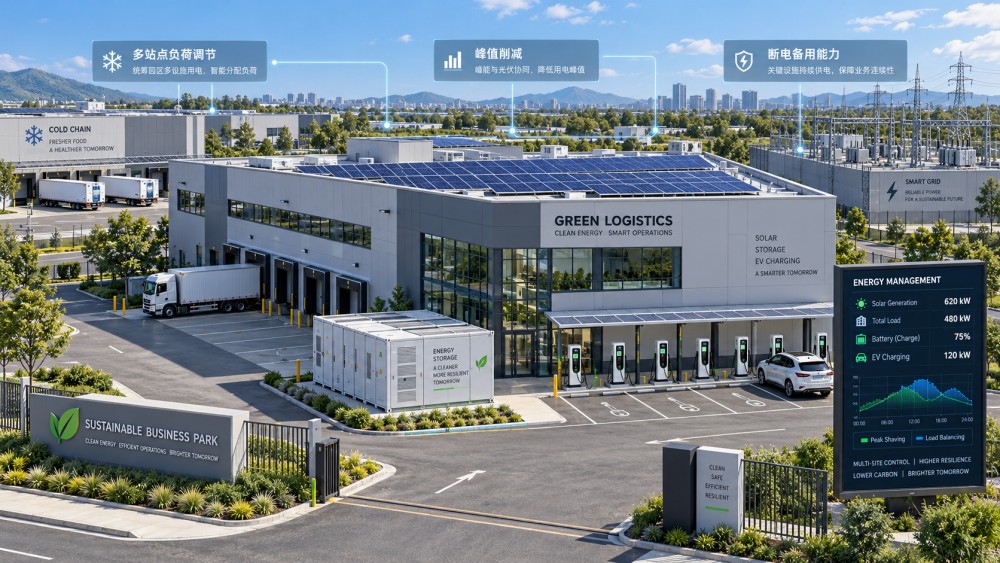
Tariffs change the value of the same technology
A solar array, battery system, or managed charging system has no single economic value across all sites. Its value is shaped by the tariff architecture. Energy charges, time-of-use periods, demand charges, capacity reservations, power-factor penalties, export compensation, and seasonal rules can all alter the preferred design.
Consider a rooftop solar system. At a site with high daytime consumption and limited export value, self-consumption may be the main benefit. At another site, solar output may coincide with low-priced hours while the costly peak arrives after sunset. Adding storage could improve the second profile, but only if the battery has enough power to reduce the relevant demand interval and enough usable energy to sustain the discharge window. A battery that has ample energy capacity but insufficient inverter power will not control a sharp peak. One with high power but limited energy may only defer the peak to the next interval.
Tariff reviews should work from bill components back to physical behavior. This avoids a common error: treating every expensive bill as an energy-consumption problem. A facility can reduce total consumption and still see little bill relief if the remaining load continues to set demand charges. Conversely, a modest change in charging schedule or HVAC staging can materially change the billed maximum demand even when annual consumption barely moves.
Tariff assumptions need version control. Utility terms change, sites move between billing arrangements, and new equipment changes the load that the original model assumed. A financial model should record its tariff source, relevant billing period, meter interval, assumed escalation method, and export treatment. Without that record, later performance reviews become arguments over inputs rather than useful assessments of operating results.
Separate resilience from bill optimization
Storage and onsite generation are often discussed as though cost reduction and backup power are the same service. They are related, but their design requirements differ. Peak shaving generally seeks to discharge during expensive demand periods. Resilience requires energy and power to be available during an outage, sometimes after several days of ordinary market-driven dispatch. A system that uses most of its stored energy every evening may have little reserve when the grid fails overnight.
Resilience planning begins by defining critical loads precisely. “Keep the site running” is not an electrical design brief. The critical-load schedule should identify equipment that must remain energized, equipment that can be restored in stages, motor starting requirements, communications dependencies, fuel or material handling needs, and the duration of acceptable interruption. A warehouse may need life-safety systems, security, network equipment, dock controls, and a limited refrigeration circuit; it may not need every conveyor or administrative circuit during an outage.
Electrical architecture determines whether the intended backup service is feasible. Critical circuits may need a separate panel, transfer equipment, protection coordination review, and controls that prevent unintended islanding. Existing generators also need to be considered as part of the operating sequence. Storage can bridge the interruption before a generator starts, reduce generator loading at low demand, or preserve battery reserve for sensitive loads. However, integration cannot be assumed simply because each asset is capable of backup operation independently.
Solar generation during an outage deserves equal care. Many grid-tied inverters disconnect when the utility supply is lost unless they are installed within a system designed to form and control an islanded electrical network. Even then, available solar output varies with weather and time of day, and load must remain within the islanded system's control limits. Backup capacity should not be presented as firm solely because a rooftop array is installed.
EV charging often exposes a site’s hidden capacity constraint
Fleet depots, employee charging, customer parking, and delivery operations can turn an otherwise manageable site load into a connection-capacity problem. The charger nameplate rating is only the starting point. The relevant profile includes the number of simultaneous sessions, vehicle arrival time, departure deadline, state of charge, route requirements, and whether charging overlaps with existing peaks.
A location where vehicles sit for many hours can often use lower-power charging with managed scheduling. A depot with narrow turnaround windows may need higher power and stronger distribution infrastructure. Treating both as the same “charger installation” leads to poor equipment selection and avoidable upgrades.
Load management should be designed around service requirements rather than a fixed equal share of power. Vehicles with earlier departure times or higher route energy needs can receive priority. The charging controller needs trustworthy data from chargers, meters, and sometimes vehicle or fleet systems; otherwise, it may respond too slowly to prevent a site peak. Manual overrides are also necessary for exceptional operations, but they should be logged because repeated overrides reveal that the normal control policy does not match field conditions.
Portfolio standards should allow local exceptions
Centralization is valuable when it creates consistent data, procurement requirements, cybersecurity expectations, and performance reporting. It becomes counterproductive when every site is forced into the same equipment size or operating logic. A small retail unit with limited electrical capacity, a manufacturing site with process-critical loads, and a leased office with uncertain tenure should not receive identical project assumptions.
A practical portfolio framework uses common decision fields for every facility:
- Electrical baseline: service voltage, transformer capacity, panel utilization, interval demand, power quality observations, and known expansion constraints.
- Commercial position: tariff components, contract term, landlord or utility responsibilities, export treatment, and the cost consequences of exceeding capacity limits.
- Operational flexibility: loads that can be shifted, curtailed, sequenced, or temporarily supplied by backup equipment without disrupting essential activity.
- Resilience requirement: critical circuits, acceptable interruption duration, restart sequence, existing generator role, and communications required during an outage.
- Physical feasibility: roof condition and structural capacity, battery siting, access for installation and replacement, fire separation, drainage, cable routes, and space for switchgear.
These fields enable comparison without pretending that sites are interchangeable. They also show when a project should be delayed. For example, installing solar before a roof replacement can create removal and reinstallation work. Deploying storage before a planned transformer upgrade may lock in an unsuitable interconnection arrangement. A charging project may require trenching, switchboard modifications, or utility coordination that is more significant than the charger hardware itself.
Controls are part of the energy asset
Distributed assets produce value only when their operating logic reflects real conditions. A battery controller needs tariff periods, meter data, reserve settings, state-of-charge limits, and constraints from the interconnection agreement. A solar monitoring system needs clear separation between equipment availability, weather-driven variation, curtailment, and communication failure. An energy management system must identify whether a reduced load came from a successful control action or from a closed facility, failed process line, or meter issue.
Data quality is often the limiting factor. Utility bills can arrive late, submeters may be absent, site clocks can be misaligned, and different vendors may label measurements differently. Establishing a common data model early reduces later rework. At minimum, readings should be traceable to a location, meter, timestamp, unit, and known status. Missing data should remain visible rather than being silently filled with estimates in operational reports.
Commissioning should test normal operation and abnormal conditions. Relevant scenarios include tariff-driven battery dispatch, loss of communications, an unexpected demand spike, transfer to backup operation, solar curtailment, charger priority changes, and restoration after an outage. A system that works during a single sunny-day demonstration may still fail to meet its purpose when several controls interact under stressed conditions.
Use phased decisions when uncertainty is real
Not every site needs a complete energy project immediately. Metering and tariff analysis may be the right first action where the load is poorly understood. A controls upgrade may address a recurring peak before storage is considered. Where site tenure, utility capacity, or production changes are uncertain, modular designs and staged procurement can preserve options.
The strongest multi-site commercial energy plans treat energy as an operating system with physical assets attached to it. They connect billing data to load behavior, distinguish outage support from routine optimization, and leave room for site-specific constraints. That approach produces a portfolio that is easier to operate, audit, and adapt as facilities, tariffs, and electrical demands change.