
It is late afternoon at a busy public charging location near a shopping area, transit hub, or highway service stop. Several drivers arrive within minutes of each other, plug into DC fast chargers, and expect a quick turnaround. At the same time, nearby buildings are still drawing heavily from the grid, air-conditioning or heating loads are high, and the local distribution connection is approaching its practical limit.
From the driver’s perspective, the problem may appear as a slower-than-expected charge, a charger temporarily unavailable for new sessions, or a confusing change in charging power. From the operator’s perspective, the issue is more serious: demand charges may rise, grid connection limits may be exceeded, equipment may operate under unnecessary stress, and adding more chargers can become difficult even when there is enough physical parking space.
This is where smart grid demand response for public charging stations becomes useful. It is not simply a tool for cutting charger power during grid emergencies. When designed carefully, demand response gives charging operators a way to manage available power, respond to grid conditions, protect site economics, and preserve a service experience that drivers can understand.
The hidden conflict behind a busy charging site
Public charging demand is rarely smooth. A station may be lightly used for several hours and then experience a sharp surge after work, during holiday travel, after an event, or when weather changes affect driving range. A conventional approach is to allow every connected charger to request its maximum rated power whenever a vehicle can accept it. That appears simple, but it assumes the upstream grid connection can always supply the combined peak load.
In practice, that assumption often creates a mismatch. A charging site may have several high-power chargers, but its transformer, switchgear, service cable, contracted demand level, or local feeder may not support all units operating at full output at once. Even when the connection can technically handle occasional peaks, the cost of repeated coincident demand may weaken the business case for the site.
Operators sometimes respond by setting a fixed power cap for every charger. This protects the connection, but it can frustrate drivers when capacity is actually available. Another common reaction is to pursue a larger grid connection immediately. That may be appropriate in some locations, but it can involve long lead times, civil works, utility coordination, and capital expense. It should not be the automatic first answer.
The more useful question is: when power is constrained, which charging load can be adjusted, by how much, for how long, and under what rules?
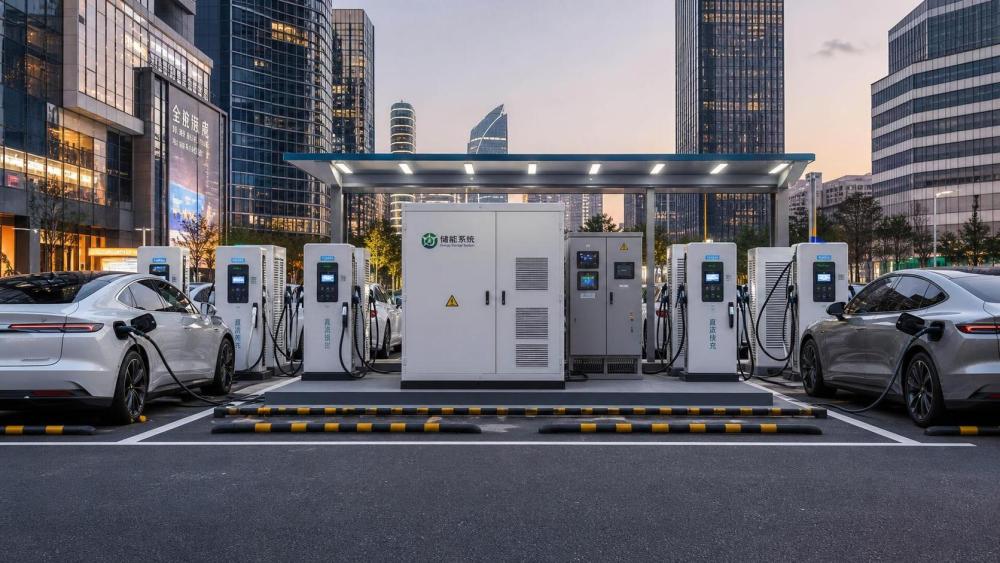
Demand response is a control process, not a single setting
For public charging, demand response refers to the controlled adjustment of charging load in response to a signal, operating limit, price condition, or site objective. The signal may come from a utility program, a grid operator, an energy management system, a building load meter, an on-site battery controller, or a pre-defined schedule. The resulting action may be modest, such as reducing a group of chargers for fifteen minutes, rather than stopping all charging sessions.
This distinction matters. Drivers will reasonably object if a charging station seems unpredictable. They are usually more accepting of managed charging when the rules are sensible: the session continues, the expected completion time is visible, and the charging system prioritizes vehicles that genuinely need energy sooner.
A well-configured control strategy normally works across several layers:
- Site limit: The total import from the grid remains below a defined threshold.
- Charger allocation: Available power is distributed among active charging sessions.
- Grid response: The site can lower demand when a valid external request is received.
- Commercial logic: The system considers electricity tariffs, demand peaks, and operational priorities.
- Driver communication: Charging status and revised power expectations are presented clearly.
These layers should not be treated as separate projects. A site that reacts to a grid event but ignores its own transformer limit is poorly coordinated. A site that limits load correctly but provides no explanation to drivers may create avoidable support calls and negative perceptions.
Start with the operating constraint, not the charger nameplate
Before choosing a demand response method, it helps to establish the real bottleneck. The rated output of the chargers is only one part of the picture. At different sites, the limiting factor may be the utility service capacity, a transformer thermal limit, a switchboard rating, an existing building load, a feeder constraint, or an electricity contract with high demand-related charges.
For a charging hub attached to a retail property, the building load can be the deciding factor. A location may have ample spare capacity in the morning but very little during the store’s busiest hours. At a highway charging site, the issue may be that multiple vehicles arrive at nearly the same time, creating short but intense peaks. At a municipal parking facility, the operator may need to follow a distribution-network request during periods of local congestion.
It is therefore useful to review interval load data alongside charging session data. The goal is not merely to find the largest historical peak. Look for patterns:
- When do vehicle arrivals cluster?
- Do charger peaks coincide with building or site loads?
- How often does the site approach its import limit?
- Are short power spikes causing disproportionate cost exposure?
- Which sessions are time-sensitive, and which are likely to remain connected longer?
This review often reveals that the problem is manageable with dynamic controls. It can also reveal the opposite: the site is consistently constrained for long periods, so network reinforcement, storage, additional generation, or a revised service arrangement may be necessary. Demand response should support a realistic infrastructure plan, not disguise an undersized connection indefinitely.
Decide which charging sessions should move first
A public site cannot treat every vehicle identically if available power is limited. Yet it should not use arbitrary rules either. The charging management logic needs priorities that fit the location’s purpose and can be explained to users.
For example, a highway location may prioritize rapid turnover. A vehicle that has just connected and requires a meaningful amount of energy to continue a trip may be given higher power than a vehicle that is already near its target state of charge. In a city-center car park, the logic may be different. Vehicles expected to remain for several hours can accept lower power temporarily, while short-stay users may receive priority.
Useful decision inputs can include the vehicle’s requested energy, its current charging rate, the estimated departure time if it is provided voluntarily, the time already spent connected, connector type, reservation status, and the site’s operational rules. Not all chargers or vehicles can provide every data point, so the control method must be practical with the information available.
Build the control logic around clear limits
Demand response works best when the operating thresholds are explicit. A charging site may need an absolute ceiling that must never be exceeded, a softer warning threshold that triggers early power sharing, and a temporary emergency limit used only when a grid signal is received. These limits should account for measurement uncertainty and the response time of chargers, meters, and control communications.
Consider a site where the incoming connection must remain below a specified import limit. If the energy management system waits until the meter reads exactly at that limit, it may react too late. Charger output does not always fall instantly, and site loads can change between readings. A prudent control design leaves a buffer and begins reducing charging demand before the hard limit is reached.
The sequence of actions should also be intentional. A common escalation order is to reduce power shared among flexible sessions, defer new high-power sessions if necessary, use available on-site storage where that is part of the site design, and only then apply stronger restrictions. The exact order depends on equipment capabilities and commercial rules, but writing it down prevents inconsistent behavior during busy periods.
For smart grid demand response for public charging stations, interoperability is particularly important. Chargers, meters, payment systems, energy management software, storage controllers, and utility communication channels may come from different suppliers. If they cannot exchange reliable status and control information, the strategy may work in a demonstration but fail during daily operations. Confirm which control commands each charger can accept, how quickly it reports actual power, and what happens if communication is lost.
Do not overlook the driver-facing side of the system
A technically correct power reduction can still feel like a service failure if the driver is left guessing. Public charging differs from many other flexible electrical loads because a person is waiting, planning a journey, or coordinating a work schedule. The user interface, app, receipt, or on-screen message should avoid vague language such as “charging delayed” when a more useful explanation is possible.
Messages do not need to expose complex grid details. A clear notice might state that charging power is being adjusted due to high site demand, that the session remains active, and that the estimated charging time has been updated. If the station uses optional priority charging or reservation rules, those terms should be visible before the driver plugs in rather than appearing as a surprise after payment begins.
Staff and support teams also need a simple view of what the system is doing. When a driver reports slower charging, the support team should be able to distinguish among a vehicle limitation, connector issue, network fault, demand response event, site power cap, or shared-power condition. Without this visibility, normal control actions can be misclassified as equipment failures.
A practical commissioning sequence
Demand response should be tested before the site reaches its busiest operating period. Start by verifying metering. The control platform needs timely, accurate readings for grid import, relevant building load, charger output, battery power where applicable, and critical electrical alarms. Incorrect meter orientation, delayed data, or missing phases can produce decisions that look logical on a dashboard but are wrong at the point of connection.
Next, simulate increasing charger demand in a controlled environment. Confirm that the system recognizes the approaching site limit, sends the intended command, receives confirmation from chargers, and settles at the expected aggregate power. Repeat the test with several chargers starting and stopping at different times. A simple single-charger test may not expose the timing conflicts that occur during real public use.
Then test abnormal conditions. If the control connection fails, does each charger follow a safe fallback limit? If a meter becomes unavailable, does the system use a conservative operating mode? If an external grid event signal is received and then withdrawn, does charging return gradually without causing a rebound peak? These behaviors should be agreed before operation, not improvised after a problem occurs.
Finally, review the first period of live operation closely. Compare commanded power with actual delivered power, examine sessions affected by power sharing, and identify whether the chosen thresholds are too aggressive or too loose. The purpose is not to chase a perfectly flat load curve. It is to maintain safe, predictable operation while making sensible use of the available connection.
When demand response is not enough on its own
Load flexibility has limits. If a charging location routinely has more demand than its grid connection can serve at an acceptable level, controls alone may only distribute dissatisfaction. In that situation, the operator should assess options such as a higher-capacity connection, transformer or feeder upgrades, a revised site layout, battery energy storage, on-site solar generation, or phased expansion of chargers.
Battery storage can help absorb short peaks and reduce reliance on the grid during constrained periods, but it introduces its own design questions: usable energy, charging schedule, power conversion capacity, thermal management, safety systems, and lifecycle operation. Solar generation may reduce daytime import under favorable conditions, but it should not be assumed to match the timing of charging demand. Each option should be evaluated against the actual load profile rather than added as a generic feature.
The central lesson is that public charging capacity is not defined only by the number of connectors installed. It is defined by the relationship between vehicle demand, available electrical capacity, control quality, grid conditions, and the experience delivered at the curb or parking bay. A demand response strategy gives operators a disciplined way to manage that relationship before unnecessary peaks become routine problems.
When the rules are transparent, the data is reliable, and charger power is allocated with a clear purpose, managed charging can protect the grid connection without turning every busy period into a driver complaint.