
A charging site can appear profitable on paper and still produce an unpleasant surprise on the monthly utility bill. The chargers may have delivered a healthy number of sessions, yet a few simultaneous high-power events during the wrong tariff window can push demand charges sharply upward. For fleet depots, highway hubs, workplaces, and retail destinations, this is often the real economics problem—not simply the price paid per kilowatt-hour.
So, do smart grid features actually reduce charging station electricity bills? Usually, yes—but not automatically. Smart controls do not make electricity free, and they cannot solve a weak grid connection or an unsuitable tariff by themselves. Their value comes from changing when, how fast, and sometimes from which source electricity is supplied to vehicles. When those decisions are aligned with tariff rules, site capacity, user needs, and on-site energy resources, the savings can be meaningful.
The most successful charging operators treat smart grid capability as an operating strategy rather than a box to tick in a charger specification. They use data, charging priorities, load limits, and market signals to keep a site useful for drivers while avoiding unnecessarily expensive power consumption.
The bill is not driven by energy consumption alone
Many new charging projects begin with a simple calculation: expected charging volume multiplied by the electricity rate. That approach misses the complexity of commercial electricity billing. Depending on the market and utility agreement, a charging station’s costs may include time-of-use energy prices, maximum demand charges, power-factor penalties, capacity fees, network charges, and taxes.
Demand charges are especially important for DC fast charging sites. A station may use a moderate amount of energy over a month but create a very high 15-minute or 30-minute peak when several vehicles plug in together. Utilities may bill for that peak capacity because the grid must be ready to serve it, even if the event is brief.
Consider a site with multiple 150 kW chargers. If vehicles arrive at once, the aggregate load can quickly exceed what the operator expected from average usage. Without active management, the site may draw its highest power at the most expensive moment of the day. A smart charging system cannot remove the utility tariff, but it can prevent avoidable peaks and shift flexible consumption toward lower-cost periods.
Where smart grid features create savings
The phrase “smart grid” covers a broad set of capabilities. At charging stations, the practical question is not whether a platform has a smart label; it is whether its functions affect the cost drivers on the operator’s bill.
Dynamic load balancing protects the site’s capacity limit
Dynamic load balancing continuously measures the electrical load at a facility or grid connection point. It then allocates available power among chargers in real time. If a building’s HVAC system, refrigeration load, production equipment, or other demand rises, the charging system can temporarily reduce charging power to stay below a predetermined threshold.
This is often the first feature commercial site owners should evaluate. A hotel, warehouse, shopping center, or office campus may already have a constrained connection. Instead of paying for an immediate transformer or service upgrade, the operator can use the available capacity more carefully. The charging experience may be slightly slower at busy moments, but that can be preferable to an expensive upgrade or recurring demand-charge exposure.
Load balancing is most effective when the system sees the whole site, not only the chargers. Charger-to-charger sharing is useful, but it does not prevent a building’s unrelated load from triggering the monthly peak.
Managed charging shifts flexible demand away from expensive hours
Smart charging schedules sessions according to time-of-use tariffs, fleet departure times, driver preferences, or local grid signals. The clearest use case is a fleet depot. Buses, delivery vans, municipal vehicles, and company cars often return in the evening and do not need to leave again until morning. If every vehicle starts charging at maximum power on arrival, the depot may create an expensive evening peak. If the system sequences charging based on each vehicle’s required state of charge and departure deadline, the same fleet can be ready by morning with a flatter load profile.
For public charging, scheduling must be handled with more care. A driver at a motorway charging hub expects rapid service and is unlikely to accept a long delay merely because tariffs are high. Yet even here, smart controls can assign power intelligently, reserve full output for priority sessions, and reduce discretionary load such as on-site batteries charging at the wrong time.
Demand response can turn flexibility into a commercial tool
In some regions, utilities, aggregators, or grid operators offer demand response programs. Participating sites may be asked to reduce consumption during grid stress events or respond to price signals. A controllable charging network is far better positioned to participate than a network where every charger operates independently.
The revenue opportunity should be assessed carefully. Operators need clear rules on event duration, response time, measurement, availability obligations, and penalties for non-performance. Still, demand response can offset operating costs when charging demand is sufficiently flexible. Fleet sites with predictable dwell time are generally stronger candidates than high-turnover public fast-charging locations.
Battery storage reduces grid peaks when it is properly dispatched
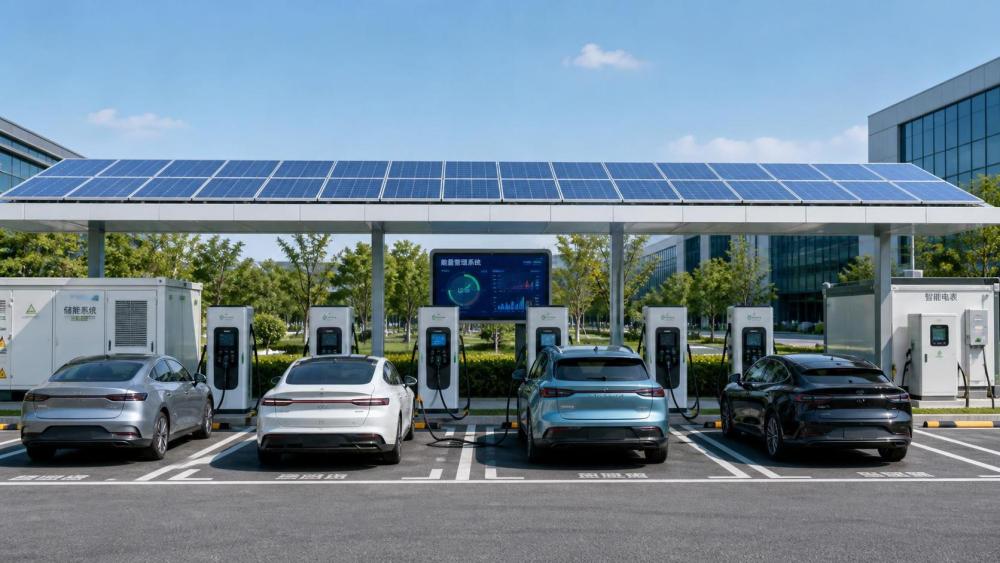
Battery energy storage can support a charging hub by discharging during high-demand periods and recharging when electricity is cheaper or when solar generation is available. This can reduce the power drawn from the grid at critical moments. For sites facing lengthy grid upgrade timelines, storage may also enable earlier deployment of high-power charging capacity.
However, a battery does not guarantee lower bills. Its dispatch logic matters. If it charges during the site’s existing peak, or if it is repeatedly cycled without sufficient tariff arbitrage or peak-shaving value, the economics can deteriorate. Battery sizing, usable capacity, power rating, degradation assumptions, safety systems, and control integration all need to be evaluated as one project—not as separate equipment purchases.
On-site solar helps most when controls match generation and load
Solar PV can reduce purchased electricity during daylight hours, particularly at workplaces, retail sites, parking facilities, and logistics centers with daytime charging demand. The direct benefit depends on the overlap between solar output and vehicle charging. A solar array that produces strongly at midday may offer limited direct value to an overnight fleet unless storage or flexible scheduling is included.
Energy management software can increase solar self-consumption by encouraging eligible vehicles to charge when generation is high, storing surplus energy, or coordinating charging with building demand. It also provides visibility: operators can see whether solar energy is truly serving chargers or simply being exported under less favorable terms.
Not every charging location has the same savings potential
Smart grid functions tend to produce the strongest bill reductions where load is variable, tariffs are complex, and charging can be shifted without damaging the customer experience. A depot with 60 electric vans has different options from a public site where drivers are waiting beside their vehicles.
That distinction matters during procurement. A fleet operator should not select a platform built mainly around consumer convenience features if the site’s largest risk is failing to charge vehicles before dispatch. Likewise, a highway charging developer should not rely on aggressive throttling strategies that make queues longer and damage customer trust.
A practical way to determine whether the investment will pay back
Before choosing smart charging hardware, software, or an energy management system, start with the utility bill. Collect at least 12 months of interval data if possible. Identify the tariff structure, the site’s historical maximum demand, seasonal patterns, and any planned changes in electricity contract terms. The relevant number is not merely the average electricity price; it is the marginal cost of charging during the site’s most constrained periods.
Next, model realistic charging behavior. For fleets, include vehicle arrival times, battery sizes, required departure state of charge, route uncertainty, and charger availability. For public networks, use expected dwell time, session duration, charging power demand, and likely periods of simultaneous use. Overly optimistic utilization assumptions are a common source of poor project economics.
Then define operating priorities. Ask which loads must never be interrupted, which charging sessions can be slowed, and which customers or vehicles receive priority. A hospital-related fleet, for example, may require a different control policy from an employee parking facility. Smart systems are valuable because they can apply these rules automatically—but only after the rules are decided.
Finally, compare several scenarios: unmanaged charging, load-managed charging, tariff-optimized charging, and charging combined with solar or storage. Include software subscriptions, communications, metering, installation, maintenance, and integration work. A low-cost charger with limited control capability may create higher long-term electricity costs; an advanced system may be unnecessary at a small site on a simple flat tariff.
Common assumptions that lead to disappointing results
“Smart charging always means slower charging.” Not necessarily. The goal is to allocate power where it has the greatest operational value. At a multi-port site, intelligent power sharing may allow more vehicles to begin charging immediately, even if not every connector delivers maximum output at once.
“A battery will solve every grid-connection problem.” Storage can help, but it is not a substitute for careful load studies. If demand grows beyond the battery’s duration or power capability, the grid constraint remains. Future expansion plans should be part of the design from day one.
“The charger app is the energy management system.” A user-facing app may show session status and payment information without offering whole-site optimization. Operators should verify whether the system can receive meter data, enforce import limits, read tariff signals, control battery assets, and communicate through suitable open protocols.
“More data automatically means better savings.” Data only becomes useful when someone can act on it. Clear dashboards, alarms, reporting, and accountable operating procedures matter as much as the volume of information collected.
Integration and interoperability deserve as much attention as charger power
A smart charging strategy relies on communications among chargers, meters, site controllers, building management systems, solar inverters, batteries, and sometimes utility or aggregator platforms. If these components cannot exchange reliable data, the intended optimization may remain theoretical.
During technical due diligence, operators should ask practical questions: Can charging limits be adjusted remotely? Does the controller work during a communications outage? How are priorities assigned? Can the platform integrate with existing energy meters and distributed energy resources? Who owns the operational data? Are cybersecurity updates and software support clearly defined?
For developers and EPC contractors, these questions should be addressed early in electrical design and tender documents. Retrofitting meters, gateways, controls, and communications after commissioning is often more disruptive than incorporating them during construction.
The real answer: savings come from disciplined control, not a feature list
Smart grid features can reduce charging station electricity bills by avoiding unnecessary peaks, shifting flexible charging to lower-cost periods, coordinating on-site solar and storage, and creating access to demand response opportunities. The greatest gains tend to occur where charging demand is substantial, tariffs penalize peak power, and vehicles have enough dwell time for managed charging.
But the technology should follow the operating model. A charging network that promises every user instant maximum power will need a different grid and storage strategy from a depot that can plan vehicle charging overnight. The right question is not simply whether smart controls are available. It is whether they are connected to the site’s tariff, physical capacity, customer promise, and daily operating reality.
For charging operators navigating that decision, structured energy intelligence is valuable: understanding grid rules, equipment interfaces, storage options, tariff exposure, and project design trade-offs can turn a charging station from an uncontrolled electrical load into a more resilient energy asset.