
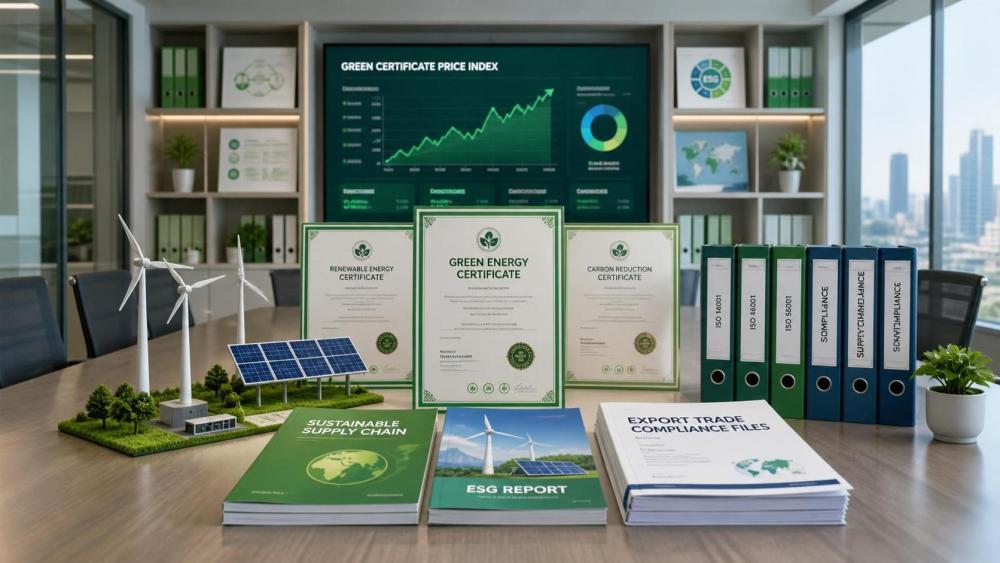
On July 24, 2026, China’s National Energy Administration released the China Green Certificate Price Index, creating a national pricing benchmark for green certificates by energy type and by month. For exporters, manufacturers, overseas buyers, and supply chain compliance teams, the development is worth close attention because it gives a more formal basis for tracing green electricity use, preparing carbon footprint documentation, and supporting compliance work tied to CBAM and broader ESG requirements in cross-border procurement.
A new reference point for green power claims
According to the information provided, the newly issued index is the first benchmark system in China to cover green certificate pricing on a nationwide basis, broken down by category such as wind, solar, and biomass, and also by time period on a monthly basis.
The index is being implemented together with the Trial Guidelines for Accounting Non-Fossil Energy Electricity Consumption. The stated purpose is to provide authoritative pricing and recognition support for international buyers purchasing equipment or services from China when they need to trace green electricity use, prepare carbon footprint reports, and respond to EU CBAM and supply chain ESG requirements.
Where the effect may be felt across the supply chain
Export manufacturers will face closer questions on electricity sourcing
From an industry perspective, manufacturers supplying overseas markets may be affected first because customer due diligence increasingly extends beyond product specifications into energy consumption records and supporting documents. The practical impact is likely to fall on customer inquiries, contract support materials, and carbon-related reporting linked to production and delivery.
What deserves closer attention is whether companies can align their internal electricity-use records and certificate-related materials with the new benchmark framework when responding to buyer audits or documentation requests.
Overseas procurement teams gain a more standardized reference
For international buyers sourcing Chinese equipment or services, the index may matter because it introduces a more structured basis for validating green electricity consumption claims. The likely impact is on supplier screening, compliance review, and the preparation of procurement-related carbon documentation.
Analysis shows that buyers will not only look at whether green electricity was claimed, but also at whether the claim can be referenced against an official pricing and recognition framework tied to the accounting guidelines named in the announcement.
Supply chain service providers may need to adjust document workflows
Service providers involved in certification support, trade documentation, reporting, or supply chain coordination may also feel the effect. Their role often sits between suppliers and buyers, so any change in the official basis for tracing or recognizing green electricity use can affect how supporting files are prepared, reviewed, and communicated.
The immediate point to watch is whether documentation packages for exports need to be updated to reflect the new index and its relationship with non-fossil electricity consumption accounting.
What companies should watch next in practice
How official wording is applied in business documentation
Companies should watch how the index is referenced in actual procurement, reporting, and compliance materials. The release establishes an authoritative basis, but in practice businesses still need to determine how that basis is reflected in quotations, supplier disclosures, audit responses, and carbon footprint files.
The link between pricing benchmarks and recognition standards
Another practical point is the connection between the price index and the Trial Guidelines for Accounting Non-Fossil Energy Electricity Consumption. Firms should pay attention to how these two elements are used together when customers ask for proof of green electricity use rather than treating pricing information and recognition rules as separate issues.
Which products and export markets raise the most questions
Analysis shows that businesses exposed to overseas compliance reviews should focus on product lines and customer relationships where carbon footprint reporting, CBAM-related disclosure, or ESG screening already plays a role. The issue is not only whether a company has green power-related materials, but whether those materials can be organized in a way that supports buyer review.
Supplier records, timing, and client communication
What deserves closer attention is the readiness of upstream records and supporting files. Companies may need to review supplier qualifications, certificate-related documents, reporting timelines, and customer communication processes so that requests tied to green electricity tracing can be answered consistently during procurement and delivery cycles.
Why this looks more like a policy signal than a finished market outcome
Observably, this development is more appropriately understood as a significant policy and compliance signal rather than a fully settled market result. The confirmed fact is that an official index and a supporting accounting framework are now in place. The part that still requires observation is how quickly different buyers, suppliers, and service providers incorporate that framework into routine commercial practice.
From an industry perspective, the importance of the update lies in standardization. It points to a more formal approach to pricing and recognition for green electricity claims in cross-border supply chains. At the same time, it would be premature to treat the release alone as proof of immediate uniform adoption across all transactions or sectors.
How this news is best understood now
At this stage, the release matters because it gives the market a clearer official reference for green certificate pricing and green electricity compliance support in China. For exporters and overseas buyers, the near-term significance is practical: better structure for tracing, reporting, and explaining electricity-related claims in trade settings.
It is more appropriate to understand this as a foundational compliance development with both immediate documentation relevance and longer-term signaling value. The operational effect is likely to depend on how procurement teams, manufacturers, and service providers translate the new framework into day-to-day records and customer-facing materials.
Basis of this report and points for continued verification
This article is based on the user-provided news title, event date, and event summary. For this kind of development, relevant source types typically include official government notices, company disclosures, industry association updates, authoritative media reporting, and standard-setting documents.
No specific official source link was provided in the input, so the exact official release document still requires continued verification. Follow-up attention should focus on subsequent official wording, implementation details in business use, and how the index is cited in compliance, carbon reporting, and procurement workflows.