How to Evaluate Renewable Equipment Tenders for Risk, Compliance, and Total Cost
Evaluating renewable equipment tenders often becomes difficult at the point where several bids look acceptable on paper but carry very different levels of technical risk, compliance exposure, and long-term operating cost. This is a common problem in solar, storage, grid, and EV charging projects, where the cheapest offer can later create delays, redesign work, warranty disputes, or performance gaps that were not obvious during the tender stage.
If you are comparing renewable equipment tenders for procurement or cost control, the real task is not simply choosing a lower number. It is deciding whether the bid can actually support the project design, satisfy grid and safety requirements, stay maintainable over time, and avoid hidden cost transfers into installation, commissioning, operations, or replacement. A structured review process helps reduce those mistakes before the contract is signed.
Why tender evaluation gets complicated so quickly
Many procurement teams start with a familiar spreadsheet logic: list suppliers, compare unit prices, check delivery time, and rank the offers. That works for simple commodity purchases, but renewable energy equipment usually sits inside a larger technical system. A battery container interacts with the power conversion system, thermal management, fire protection, controls, communication protocols, and site operating strategy. A solar inverter affects energy yield, protection settings, grid code behavior, monitoring, and future service access. A charger is tied to utility connection limits, user load profiles, software, payment logic, and maintenance response.
Because of that, tender evaluation tends to go wrong in a few predictable ways. One bid may be cheap because it excludes accessories the project still needs. Another may comply in one market but not in the specific country or utility territory where the project will be built. Some offers look technically complete until engineering teams review drawings and discover mounting changes, cable routing changes, foundation impacts, or communication mismatches. The cost difference then appears later as change orders, downtime risk, or extra integration work.
This is why renewable equipment tenders should be treated as risk review exercises as much as price comparisons. The goal is not to eliminate all uncertainty. The goal is to identify where cost, compliance, and execution risk are hiding before they become contract or site problems.
Common mistakes when reviewing renewable equipment tenders
A frequent mistake is comparing offers that are not technically aligned. One supplier may quote based on the issued specification, while another quietly substitutes a different product family, derates performance assumptions, narrows the environmental range, or excludes commissioning support. If the comparison table only shows top-level price and lead time, those differences get missed.
Another common issue is treating compliance as a yes-or-no statement instead of checking the exact basis. In renewable projects, compliance can involve electrical safety, grid interconnection behavior, communication standards, fire protection expectations, site environmental conditions, and documentation required by local stakeholders. A supplier saying that a product is “compliant” is not the same as showing that the exact offered configuration fits the project’s jurisdiction, design basis, and operating mode.
There is also a tendency to separate procurement from lifecycle thinking. A lower purchase price can still lead to a higher total cost if spare parts are difficult to source, software access is restricted, warranty terms are narrow, local service support is weak, or replacement intervals are shorter than expected. In renewable infrastructure, the tender stage often determines years of maintenance burden.
Start by checking whether the bids are truly comparable
Before scoring suppliers, make sure each tender response is being measured against the same scope and assumptions. This sounds basic, but it is the point where many evaluations become distorted. If one supplier includes detailed commissioning, training, monitoring licenses, spare parts, and interface support while another excludes them, the headline numbers are not comparable.
It helps to build a comparison sheet around functional scope rather than product labels alone. For example, instead of just comparing “inverter” to “inverter,” break the bid into output rating conditions, overload behavior, harmonic limits, communication interfaces, protection functions, enclosure rating, ambient operating range, grid support functions, monitoring access, and service obligations. For storage, include cell chemistry, usable energy assumptions, degradation basis, round-trip efficiency basis, thermal design, fire protection boundaries, black start or backup capability if relevant, and integration responsibilities between supplier packages.
At this stage, clarifications matter more than rankings. If a bid is vague, ask for the exact offered configuration, exclusions, assumptions, and interfaces. A weak tender review process often skips clarification because teams want to move fast. In practice, that shortcut usually creates slower decisions later.
How to evaluate risk in renewable equipment tenders
Risk assessment becomes clearer when you divide it into a few practical categories instead of treating it as a general concern.
Technical fit risk
Check whether the equipment matches the project’s actual operating conditions. This includes temperature range, altitude, humidity, dust, corrosion exposure, duty cycle, cycling profile, grid conditions, and space constraints. A technically credible bid should show how the equipment performs under those conditions, not just under standard test assumptions.
Integration risk
Some of the most expensive problems appear where systems meet each other. Review communication protocols, SCADA compatibility, EMS interfaces, protection coordination, cable and connector standards, auxiliary power needs, and mechanical layout implications. In solar-plus-storage and EV charging projects especially, integration gaps can be more damaging than product defects.
Delivery and execution risk
Lead time claims should be checked against manufacturing location, logistics complexity, customization requirements, factory testing needs, and the level of supplier dependency on third-party components. A tender that looks fast may still carry schedule risk if critical subcomponents or site services are not firmly covered.
Supplier support risk
Review service structure, local technical presence, escalation procedures, spare parts availability, software support, and warranty claim handling. In long-life energy assets, post-delivery support often matters as much as the original supply terms.
What compliance review should actually include
Compliance review is often handled too late or too loosely. In renewable equipment tenders, it helps to separate documentation review from true project suitability review.
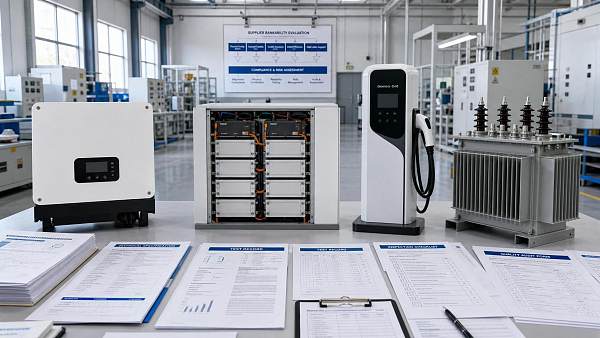
First, verify whether the bid includes the documents required for the project approval and handover process. These may include type test reports, datasheets, drawings, quality documents, interface descriptions, safety information, and installation or operation manuals. Missing documentation can delay approval even when the hardware itself is acceptable.
Second, confirm whether the offered configuration aligns with local code and utility expectations. That means checking the exact functional behavior relevant to the project, such as ride-through performance, protection settings, anti-islanding logic, shutdown behavior, fire separation assumptions, communication requirements, metering compatibility, and cybersecurity or access-control requirements where applicable. Generic claims are not enough if the system has to be accepted by utilities, insurers, site owners, or project lenders.
Third, review responsibility boundaries. Compliance failures often come from confusion over who provides what: the equipment supplier, EPC contractor, integrator, commissioning agent, or project owner. If a tender leaves these boundaries unclear, the project can inherit unresolved obligations after award.
How to compare total cost instead of purchase price alone
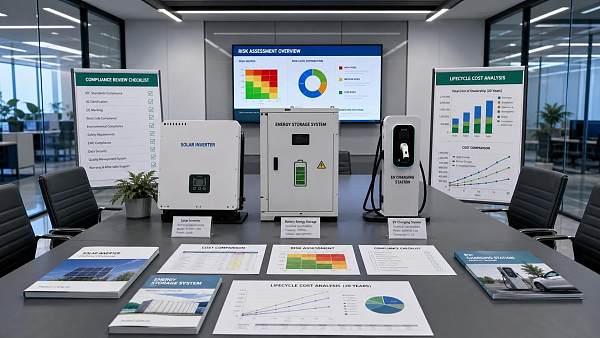
Total cost in renewable equipment tenders should be reviewed across the life of the asset, not only at procurement entry. A practical way to do this is to break the cost view into five layers.
- Acquisition cost: equipment price, transport, insurance, taxes or duties if relevant, and optional accessories that may actually be necessary.
- Installation cost: civil impact, wiring complexity, mounting requirements, crane or handling needs, commissioning effort, and interface engineering.
- Operating cost: energy losses, parasitic loads, consumables, inspection needs, software subscriptions, and service visits.
- Reliability cost: downtime exposure, failure response time, spare parts logistics, replacement frequency, and performance degradation assumptions.
- End-of-life or transition cost: upgrade path, compatibility with future expansion, decommissioning complexity, and possible repowering impacts.
For example, two storage tenders may look similar in nominal capacity, but one may require more HVAC power, tighter operating limits, more frequent maintenance intervention, or earlier augmentation. Two charger tenders may share the same power rating but differ in cable cooling complexity, software dependence, field service coverage, or site power management flexibility. In those cases, purchase price tells only a small part of the cost story.
A practical review process for procurement teams
If you need a workable method rather than a theory list, the following process is usually easier to apply across renewable equipment tenders.
- Define the non-negotiables before opening bids. Separate mandatory technical and compliance requirements from preferred features. This prevents teams from being persuaded by attractive extras while core requirements remain unclear.
- Normalize bid scope. Create a clarification round to align assumptions, inclusions, exclusions, delivery boundaries, and service obligations. Do this before scoring price.
- Score technical fit independently from cost. Ask engineering, operations, and commissioning stakeholders to review the bids separately. Combining everything too early tends to hide red flags behind price advantages.
- Run a compliance checklist against the actual project context. Do not rely only on standard product claims. Match the tender to site conditions, utility expectations, and handover requirements.
- Model lifecycle cost items visibly. Even if exact numbers are not available, list the cost drivers that could shift the decision later. This keeps hidden burdens from disappearing inside procurement averages.
- Review supplier support and contract language. Check warranty triggers, exclusions, response obligations, software access terms, spare parts support, and responsibilities during commissioning and fault resolution.
- Document why the selected bidder is the lowest-risk acceptable option. This is useful for internal approval, audit trails, and future lessons learned.
Where industry intelligence can help during tender review
Procurement teams do not always struggle because they lack a tender spreadsheet. More often, they lack enough structured market and technical context to ask the right questions. This is where an industry information platform can support the process in a practical way.
For teams working across solar, storage, grid modernization, or EV charging infrastructure, it is useful to compare not just product brochures but also the broader technology context around grid behavior, integration needs, operational constraints, and project delivery patterns. A platform such as Global EcoPower & Energy Matrix Intelligence Network (EPEM) can be relevant here because it organizes renewable power, storage, charging, grid automation, and distributed energy topics in a way that helps procurement, engineering, and project teams work from the same technical and commercial frame. That kind of reference is most useful early in the decision process, when bid assumptions are still being tested and not yet locked into contract form.
How to avoid repeating the same tender mistakes
Most recurring tender problems come from process habits rather than isolated supplier issues. One habit is issuing specifications that are too broad for accurate comparison. Another is allowing commercial review to move ahead while engineering clarifications remain unresolved. A third is failing to capture lessons from previous projects, so teams keep rediscovering the same integration and warranty problems.
A stronger approach is to maintain standard evaluation templates by equipment category, with sections for technical fit, compliance evidence, service model, interface risk, and lifecycle cost drivers. Those templates should evolve after each major tender. If a previous project faced delays due to communication protocol mismatches, commissioning scope gaps, or thermal management assumptions, those checks should become part of the next tender package by default.
It also helps to involve operations and maintenance teams earlier. They often spot supportability issues that are easy to miss in a procurement-only review, such as restricted software access, long spare part lead times, or impractical service procedures. Those details rarely look dramatic during bid evaluation, but they shape asset performance later.
Frequently Asked Questions
Is the lowest bid usually the wrong choice?
Not necessarily. A low bid can still be the right choice if the scope is complete, the compliance basis is clear, the technical fit is strong, and the supplier support model is credible. The problem is choosing a low bid before checking those conditions.
How detailed should a tender clarification round be?
Detailed enough that each bidder’s scope, exclusions, assumptions, interfaces, and service obligations can be compared on the same basis. If major items remain ambiguous, price ranking will be unreliable.
What matters most in renewable equipment tenders: compliance or cost?
They should not be separated. A bid that is cheaper but weak on compliance can create redesign, approval delays, or operational restrictions that increase actual cost later. Compliance review is part of cost control, not an extra step after it.
Should procurement teams evaluate technical risk without engineering input?
No. Procurement can organize the framework, but engineering, commissioning, and operations input are usually necessary to assess technical fit, interface risk, and maintainability accurately.
How can buyers compare tenders across different renewable technologies?
Use the same decision logic even when the equipment changes: normalize scope, verify compliance, review integration boundaries, assess supplier support, and model lifecycle cost. The checklist details will differ for solar, storage, grid, and EV charging systems, but the evaluation structure can stay consistent.
Conclusion
The hard part of evaluating renewable equipment tenders is rarely the spreadsheet itself. It is recognizing where risk, compliance gaps, and long-term cost are hidden inside offers that look similar at first glance. A disciplined review process helps teams compare bids on a real like-for-like basis, test supplier claims against project conditions, and avoid pushing unresolved problems into later project stages.
For procurement decisions in renewable energy, a good tender is not simply the cheapest one or the most detailed one. It is the one that remains technically workable, compliant, supportable, and economically sensible after the project moves from paper into installation and operation.