
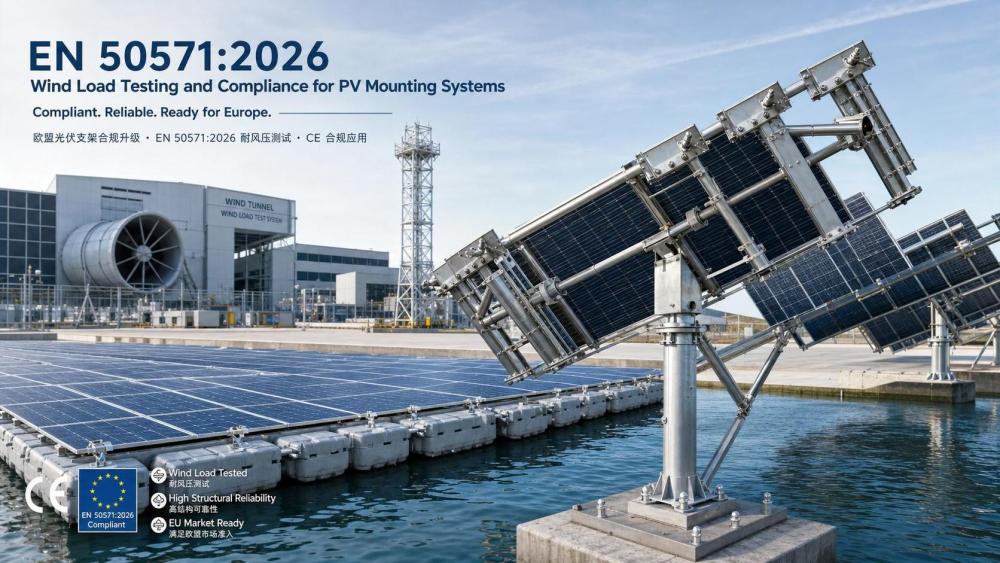
As of June 28, 2026, the revised EN 50571:2026 has entered mandatory enforcement in the EU, bringing a stricter compliance threshold for photovoltaic mounting systems sold or installed within the European Economic Area. The update is especially relevant for manufacturers, exporters, project bidders, and procurement teams because it adds dynamic wind-pressure durability testing for tracker structures and floating PV support systems, while uncertified mechanical components can no longer complete CE conformity declarations.
What the new standard now requires
According to the provided information, CEN began mandatory implementation of the revised EN 50571:2026 at 00:00 on June 28, 2026. The new version adds real-time cyclic wind-load durability testing requirements for tracker mounting systems and floating PV support structures.
The rule applies to photovoltaic mechanical components that are sold or installed in the European Economic Area. Products that do not obtain the required certification cannot complete a CE conformity declaration. The update directly affects type approval and project bidding eligibility for Chinese exporters of PV mounting systems.
Where the commercial impact is likely to appear first
Export-facing manufacturers may see compliance become a sales gate
From an industry perspective, manufacturers and direct exporters are likely to feel the effect first because certification is tied to market access. The main pressure point is no longer only product supply, but whether the relevant mounting components can support CE-related compliance documentation under the revised standard.
Bid and tender teams may face tighter qualification checks
Analysis shows that project bidding functions are also likely to be affected. Since the provided information states that uncertified products can directly affect type approval and bidding eligibility, companies involved in EU-facing tenders need to pay closer attention to how product certification status is presented in qualification materials and technical submissions.
Procurement and delivery coordination may become more sensitive
Observably, procurement teams, channel partners, and supply-chain service providers may need to focus more closely on certification timing, supporting documents, and shipment readiness. Where products are intended for sale or installation in the EEA, the compliance status of mechanical components could become a practical issue in order confirmation, delivery scheduling, and downstream acceptance.
What companies should monitor now
Check which product categories are exposed
What deserves closer attention is whether a company’s product mix includes tracker mounting systems, floating PV support structures, or other photovoltaic mechanical components intended for the EEA market. That distinction matters because the new testing requirement is explicitly tied to specific structural categories while the broader rule applies to PV mechanical components sold or installed in the region.
Review certification documents against CE declaration needs
Companies should pay attention to whether existing certification files and technical documentation are sufficient for CE conformity declaration under EN 50571:2026. The immediate business issue, based on the provided facts, is not abstract policy interpretation but whether documents can support continued market entry and project participation.
Prepare for customer and bidder communication
Analysis shows that commercial teams may need a clearer communication path with EU customers, project owners, and tender counterparties. Where certification status is uncertain or in transition, the practical concern is how that affects qualification review, order progress, and contract discussions.
Separate confirmed rules from follow-up interpretation
It is important to distinguish the confirmed requirement from later market interpretation. The confirmed fact is that the revised standard is mandatory and linked to certification and CE conformity. What still requires continued observation is how different market participants, buyers, and project processes apply that requirement in day-to-day business decisions.
Why this reads as more than a procedural update
Observably, this development is better understood as a concrete compliance change rather than a symbolic standards revision. The effective date is already in force, and the consequence for uncertified products is directly connected to CE conformity declaration and market participation. At the same time, Analysis shows it should not be overstated as a complete industry reset based on the current input alone. What it clearly signals is a tighter relationship between structural performance verification and commercial access in the EU PV mounting segment.
How to read the signal at this stage
At this stage, it is more appropriate to understand the enforcement of EN 50571:2026 as an immediate compliance requirement with broader strategic implications. In the short term, the focus is on certification, documentation, and bidding eligibility. In the longer view, the signal points to rising scrutiny of PV mounting system performance in the EU market. The current information supports a cautious, practical reading rather than a broad market conclusion.
Basis of this article
This article is based on the user-provided news title, event date, and event summary. For developments of this type, commonly relevant source categories may include official notices, standardization body documents, company disclosures, industry association updates, and reporting by authoritative trade media. A specific official source link was not provided in the input, so further verification is still needed. Follow-up attention should remain on any official wording, implementation clarification, or market-side interpretation related to certification, CE conformity declaration, and project qualification.