
India’s Ministry of New and Renewable Energy (MNRE) issued a circular on July 4, 2026 that changes the compliance threshold for battery energy storage system projects seeking national subsidies. From October 1, 2026, those projects must hold both UL 1973 for safety and IEC 62933-3-2 for performance and life. The change matters because it reaches beyond paperwork: it can affect equipment selection, certification planning, tender preparation, and partner qualification reviews across the BESS supply chain, especially for companies preparing bids in the second half of 2026.
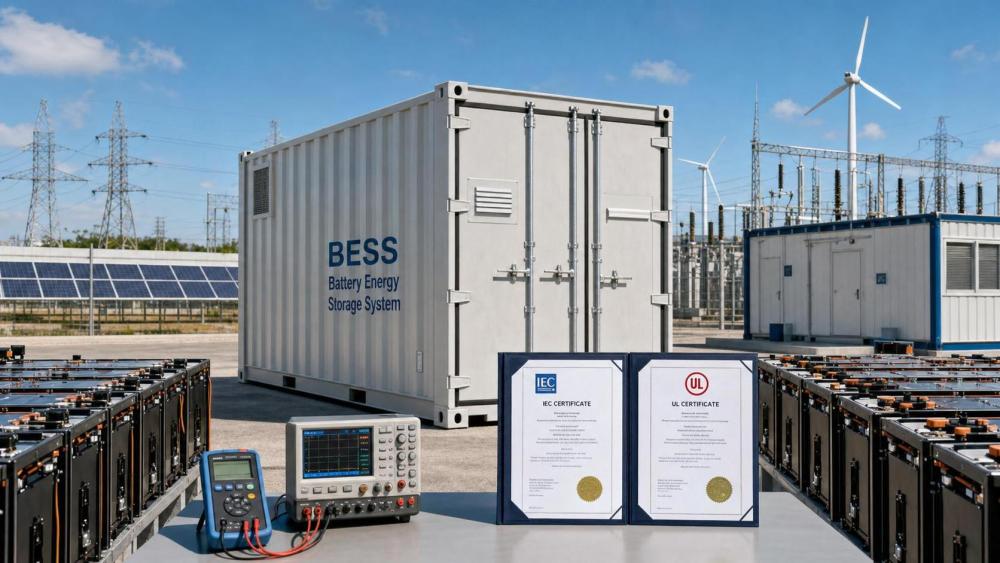
What the New MNRE Circular Confirms
The confirmed facts are limited but clear. MNRE published the circular on July 4, 2026. The requirement takes effect on October 1, 2026. It applies to all battery energy storage system projects applying for national subsidies. To qualify, projects must have both UL 1973 certification, identified in the input as covering safety, and IEC 62933-3-2 certification, identified as covering performance and life. The new rule does not apply retroactively. At the same time, it is stated to affect equipment selection for tendered projects in the second half of 2026, and Chinese BESS integrators need to reassess the qualifications of their local certification partners.
Where the Compliance Shift May Be Felt First
Project bidders facing earlier specification decisions
From an industry perspective, bidders for subsidy-linked projects may be among the first to feel the change because certification status can become a practical condition for product eligibility. The likely pressure point is the technical bid stage, where equipment choices may need to align with the new dual-certification requirement before the October 1 effective date. What deserves closer attention is whether procurement teams and bid managers have matching certification documentation ready for review in tender packages.
BESS integrators reviewing certification pathways
Analysis shows that system integrators may need to revisit how they sequence product selection, testing, and compliance verification. The issue is not only whether a system is technically suitable, but whether the certification pathway can support subsidy-linked market access under the revised rule. For Chinese BESS integrators specifically mentioned in the input, the immediate concern is partner qualification: local certification partners may need to be re-evaluated for capability, timing, and document readiness.
Testing and certification service providers under closer scrutiny
Observably, certification-related firms and testing service providers may face stronger due-diligence demands from clients. If dual certification becomes a hard requirement for subsidy applications, companies relying on external testing, document preparation, or local coordination will need clearer visibility on who can support compliance work in time for project schedules. The business impact is likely to center on certificate validity, report completeness, and alignment between technical files and bid requirements.
Procurement and delivery teams managing timing risk
For procurement teams, the rule change may affect supplier screening and delivery planning. A supplier that can deliver equipment but cannot support the required certification package may create compliance risk for subsidy-linked projects. Analysis shows that the practical effect may appear in purchase orders, supplier qualification checks, and milestone planning rather than in product pricing alone. Companies involved in cross-border delivery may also need to watch whether certification timing starts to influence shipment sequencing or acceptance conditions.
What Companies Should Review Now
Check whether certification claims are bid-ready
It is more appropriate to understand the current task as a document and eligibility review rather than a general market reaction. Companies preparing for India subsidy-linked opportunities should verify whether product-level or project-level certification materials can be presented in a form suitable for tender and compliance review. The key point is to avoid assuming that existing safety or performance materials are interchangeable with the dual requirement described in the circular.
Reassess local certification partners and interfaces
The input specifically notes that Chinese BESS integrators need to reassess local certification partner qualifications. Analysis shows this should include a review of partner scope, process reliability, and coordination ability across technical documents, testing arrangements, and submission support. Where local partners sit between manufacturers, integrators, and project developers, any weakness in execution could affect timelines for bid alignment or subsidy eligibility preparation.
Track tender language and supporting documentation closely
Because the new rule is stated to affect equipment selection for second-half 2026 tenders, companies should pay close attention to how tender documents describe certification conditions, acceptable evidence, and timing expectations. What deserves closer attention is whether buyers begin to reference the dual-certification requirement directly in technical specifications, qualification forms, or supplier compliance checklists.
Prepare for execution details that are still not provided
The input does not provide detailed implementation procedures, so companies should avoid treating every compliance question as settled. Observably, businesses will need to keep watching for further official wording, practical review standards, and any clarification on how the certification requirement is checked during subsidy application or project approval processes.
Why This Looks Like an Execution Signal
Analysis shows that this update is more than a general policy statement because it sets a defined effective date and ties compliance directly to access to national subsidies. At the same time, it should not be overstated as a fully closed rule environment, since the input does not include detailed enforcement mechanics or documentary procedures. It is more appropriate to understand this as a concrete execution signal with immediate implications for project preparation, while leaving room for continued observation on implementation practice.
How to Read the Change at This Stage
At this stage, the development can be read as a targeted compliance threshold change for subsidy-linked BESS projects in India. Its importance lies in how quickly it may move into equipment selection and partner qualification decisions for late-2026 tenders. A neutral reading is that the rule has already crossed from policy language into actionable project planning, but the full operational impact will depend on how certification expectations are reflected in tender documents, compliance reviews, and market response.
Basis of This Article and What Still Needs Verification
This article is based on the user-provided news title, event date, and event summary. For events of this type, relevant source categories commonly include official government notices, regulator releases, trade or customs authority information, industry association updates, standards organization documents, and reporting by established industry media. No specific official source link was provided in the input, so that link still needs to be verified on an ongoing basis. Continued monitoring should focus on any detailed policy text, certification enforcement interpretation, changes in tender wording, industry feedback, and how affected companies implement the requirement in practice.