
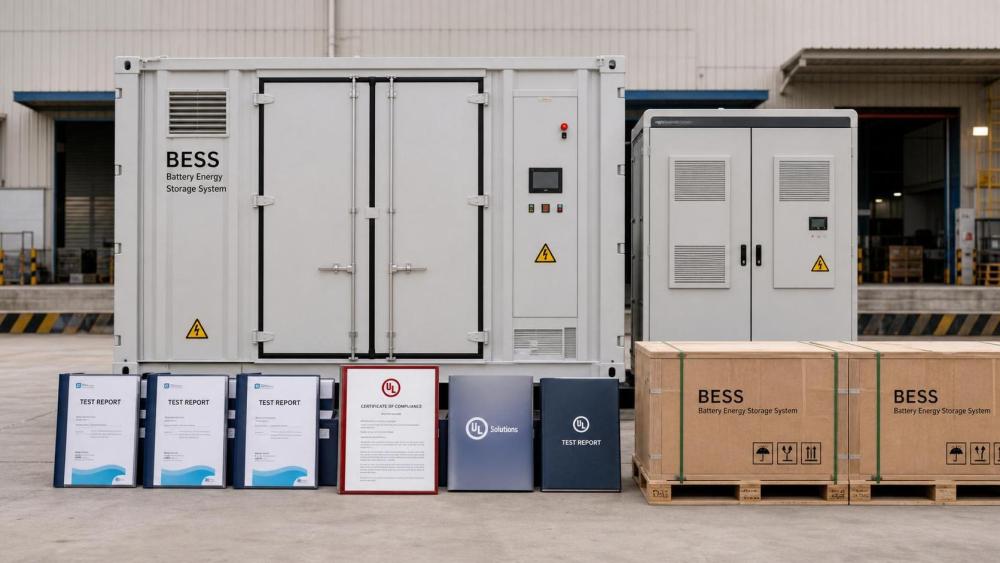
Effective October 1, 2026, a new U.S. Department of Energy compliance notice changes the import path for battery energy storage systems entering the U.S. market. The rule requires importers of BESS units to submit both UL 1973 and UL 9540A full test reports issued by NRTL-authorized laboratories, which puts immediate attention on certification preparation, trade documentation, shipment scheduling, and supplier qualification for manufacturers and exporters serving U.S.-bound projects.
What the new U.S. import notice confirms
According to the provided event summary, the U.S. Department of Energy released the Energy Storage Import Compliance Notice on July 12, 2026. The notice requires that, from October 1, 2026, all battery energy storage systems imported into the U.S. market must be submitted with complete UL 1973 and UL 9540A test reports.
The reports must be issued by laboratories authorized under the NRTL framework. The requirement applies to imported finished BESS products, including containerized systems, outdoor cabinet systems, and grid-connected BESS units. The summary also states that single-document exemptions and self-declarations will not be accepted.
The confirmed scope of impact identified in the provided information is the market access route and delivery timeline for Chinese BESS manufacturers exporting to the United States.
Where the rule change is likely to be felt first
Export access shifts from product readiness to document readiness
From an industry perspective, exporters of finished BESS products are likely to feel the change first because market entry is tied not only to the physical product but also to the simultaneous availability of two complete test reports. What deserves closer attention is that the rule, as described, does not allow self-declaration or a single-document workaround, which makes documentation completeness a practical condition for shipment planning.
Manufacturing and project delivery may face tighter sequencing
For BESS manufacturers supplying the U.S. market, the effect is likely to appear in production release, pre-shipment review, and delivery scheduling. Analysis shows that where certification files are incomplete or not aligned with the imported finished system, shipment timing could become more exposed to compliance checks. This is especially relevant for businesses handling containerized, outdoor cabinet, and grid-connected system configurations covered by the notice.
Procurement and buyer-side qualification may become more document-driven
Procurement teams, importers, and project buyers may need to pay closer attention to supplier qualification and document review before orders move into execution. Observably, the rule raises the importance of verifying whether UL 1973 and UL 9540A reports are complete and whether they are issued by NRTL-authorized laboratories, rather than treating testing status as a later-stage formality.
Testing and certification support functions may become more time-sensitive
Certification-related service providers and testing support teams may also be affected because report availability becomes part of the import compliance chain. It is more appropriate to understand this as a timing and documentation issue rather than a broad market conclusion: businesses involved in report preparation, technical file review, and import paperwork may need to align more closely with shipment windows and customer delivery commitments.
Operational points companies should watch now
Check whether the covered product is the imported finished system
Analysis shows that companies should first confirm whether their U.S.-bound product falls within the imported BESS categories identified in the notice: containerized systems, outdoor cabinet systems, and grid-connected finished systems. This matters because the summary describes the rule as applying to complete imported systems rather than to a simplified or partial filing approach.
Review the completeness of test files before shipment commitments
What deserves closer attention is whether both UL 1973 and UL 9540A full reports are available before delivery promises are made. Since the notice does not accept single-document exemptions or self-declarations, businesses should treat report completeness as a front-end compliance checkpoint in export planning, contract execution, and handover preparation.
Verify report issuance paths and laboratory status
Observably, the issuing laboratory also becomes a practical compliance variable because the provided information specifies NRTL-authorized laboratories. Companies involved in exporting, sourcing, or purchasing should therefore pay attention to whether the supporting reports match that requirement and whether internal document review processes are strict enough to catch gaps early.
Watch for changes in tender, purchase, and delivery documents
It is more appropriate to understand this rule as something that can influence commercial paperwork as well as certification files. Analysis shows that companies should watch for updates in bid documents, supplier qualification terms, import submission packages, and delivery schedules, while avoiding the assumption that execution practice is already fully settled beyond the text provided in the notice summary.
How to read the policy signal at this stage
Observably, this development is more than a routine testing reminder because it ties U.S. import acceptance for BESS to dual-report submission under a defined laboratory pathway. At the same time, it should not be overstated as a final picture of market outcomes. Based on the provided information, it is more appropriate to understand this as a landed compliance signal with direct implications for export access and delivery preparation, while the detailed enforcement rhythm and market response still require continued observation.
From an industry perspective, the most important near-term question is not abstract policy direction but how consistently the requirement will be reflected in import review, procurement documents, supplier screening, and project execution. That is where companies are likely to see the practical effect first.
Why this matters beyond the headline
In practical terms, the notice raises the compliance threshold for BESS imports into the United States by linking access to the simultaneous submission of UL 1973 and UL 9540A full reports from NRTL-authorized laboratories. For exporters, manufacturers, buyers, and certification support teams, the issue is less about headline policy language and more about whether documentation, testing, and delivery planning are aligned in time.
Current observation suggests that this should be read as an implemented rule change with immediate operational relevance from October 1, 2026, while detailed execution practice, buyer response, and downstream document changes remain areas that still need to be watched carefully.
Basis of this article and what still needs verification
This article is based on the user-provided news title, event date, and event summary. For events of this kind, relevant source types usually include official notices, regulator publications, customs or trade authority information, industry association updates, standards organization materials, and reporting by authoritative trade media.
No specific official source link was provided in the input, so the original publication path and any later clarifications still need to be verified on an ongoing basis. Observably, the areas that warrant further follow-up include detailed enforcement language, certification interpretation in practice, possible changes in tender or procurement documents, industry feedback, and how affected companies implement the requirement in actual export and delivery processes.