
The Global EcoPower EV charging infrastructure intelligence platform is designed to make a fragmented energy market easier to interpret for organizations planning, supplying, financing, building, or operating low-carbon power assets. Its role is not limited to tracking charging equipment. It connects electric vehicle charging with the systems that determine whether a charging project can operate reliably and generate acceptable long-term returns: grid capacity, renewable generation, battery storage, site design, interoperability, regulation, equipment quality, and operating strategy.
This matters because EV charging is often treated as a standalone infrastructure category. In practice, a charging station is part of a wider power system. A high-power charging hub may require costly distribution upgrades; a fleet depot may create new demand peaks that alter electricity costs; and a solar-plus-storage project may improve charging economics only when its control logic, tariff structure, and load profile are properly aligned. The Global EcoPower EV charging infrastructure intelligence platform, operated within the broader EcoPower & Energy Matrix Intelligence Network (EPEM), is intended to bring these interdependencies into one practical decision framework.
It turns charging infrastructure from an equipment question into a project question
Many early-stage charging discussions begin with a simple request: AC chargers or DC chargers, how many units, and what power rating? Those are necessary questions, but they are rarely enough to determine whether a project is viable.
The useful starting point is the actual use case. A workplace car park, apartment complex, logistics depot, retail destination, public highway site, bus terminal, and commercial vehicle yard have fundamentally different load patterns and service requirements. A destination site may benefit from lower-power AC charging because vehicles remain parked for several hours. A highway corridor must manage rapid turnover, high availability expectations, and significant peak demand. A depot may require dozens or hundreds of vehicles to be ready by a fixed departure time, making charging management more valuable than simply installing the highest possible charger output.
EPEM’s intelligence coverage helps users examine charging projects across this wider chain of decisions. It covers AC charging, DC fast charging, ultra-fast charging, liquid-cooled charging, fleet and depot charging, charging station layout, payment systems, charging-network software, and vehicle-to-grid applications. More importantly, it positions these subjects alongside distribution-grid planning, battery storage, renewable power, energy management, and digital controls.
That perspective helps prevent a common commercial error: selecting hardware before understanding the site’s power constraints and revenue model. A charger with a high nameplate rating does not necessarily deliver high utilization or strong economics. If the local network connection is constrained, if demand charges are material, or if vehicle dwell time is long, a lower-capacity or managed-charging configuration can be the more rational solution.
Grid connection is often the real bottleneck
In many markets, the main delay in charging deployment is not charger procurement. It is securing sufficient grid capacity, completing the connection process, and funding upstream reinforcement. This is particularly relevant for DC charging hubs, electric bus facilities, port-adjacent logistics sites, and large commercial fleets.
For project planning, the platform’s value lies in bringing attention to the questions that affect delivery risk:
- What is the site’s existing contracted capacity, and how much spare capacity is available?
- Will the local distribution network require a new transformer, switchgear, feeder, or substation upgrade?
- How will simultaneous charging be controlled during peak periods?
- Are time-of-use tariffs, capacity charges, or demand charges likely to change operating economics?
- Can battery storage reduce grid-import peaks or defer part of the connection upgrade?
- What metering, protection, communication, and utility-approval requirements apply locally?
These questions are especially important because charging demand is not static. A facility may begin with a modest number of chargers and later add electric delivery vans, employee vehicles, or larger customer traffic volumes. Designing only for present load can create expensive rework. Conversely, overbuilding electrical infrastructure before demand is proven can tie up capital in underused assets.
A well-informed approach separates the site’s ultimate electrical master plan from its initial charger deployment. Civil works, cable routes, transformer space, switchboard capacity, and communications architecture can be designed for expansion, while chargers are installed in phases according to utilization. This is where charging intelligence becomes project intelligence rather than a product catalogue.
Why renewable power and storage must be assessed with charging together
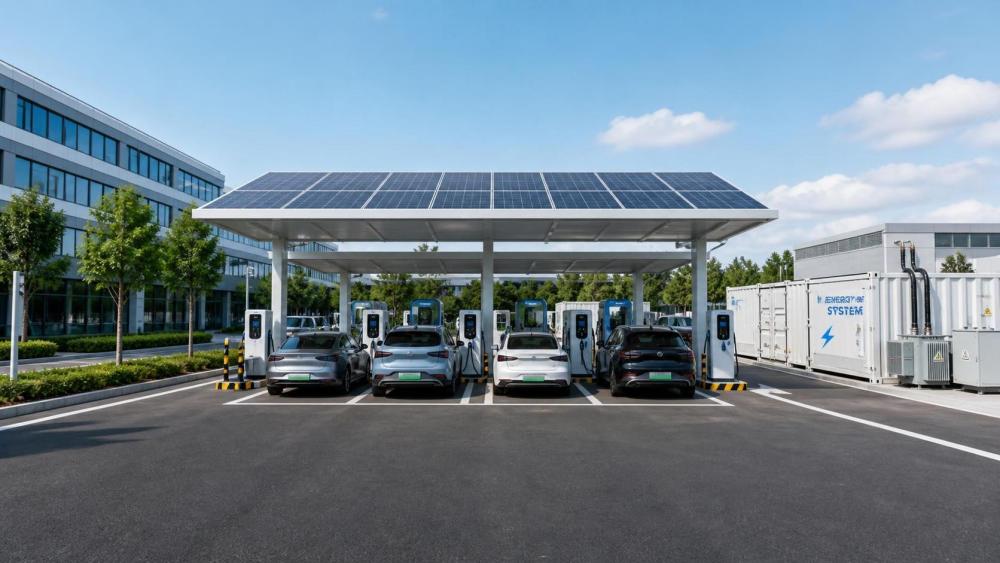
Electric mobility is increasingly planned alongside rooftop solar, carport PV, utility-scale renewable procurement, and on-site battery systems. The combination is attractive, but it should not be assumed that solar generation automatically makes a charging project economical.
Solar output and charging demand do not always coincide. Office charging may align reasonably well with daytime PV output, while overnight depot charging does not. Retail charging may follow customer behavior rather than solar production. Fast-charging sites may experience highly irregular load spikes that cannot be covered reliably by on-site solar alone. Storage can help shift energy, limit peak imports, and provide operational flexibility, but its value depends on tariff design, battery cycling, dispatch strategy, degradation assumptions, and grid-service opportunities where available.
EPEM covers solar PV, inverters, mounting systems, balance-of-system components, battery energy storage systems, power conversion systems, battery management systems, thermal management, fire safety, and energy management platforms. This lets users assess integrated configurations rather than treating solar, storage, and charging as unrelated investments.
For example, a commercial site considering a solar canopy and DC chargers should evaluate more than annual solar generation. Relevant issues include the maximum instantaneous charger load, expected charging hours, transformer loading, export restrictions, battery sizing, resilience requirements, and the control system’s ability to prioritize charging, storage, or building loads. A system that looks compelling in an annual energy-balance model may perform poorly if it cannot manage short-duration peaks or if its operational controls are poorly configured.
Technology assessment needs to go beyond connector types and rated power
Charging equipment specifications are important, but a procurement decision should not rest on power ratings alone. The practical performance of a charging network depends on electrical architecture, software integration, component durability, maintainability, and the supplier’s ability to support the equipment throughout its operating life.
For AC charging, decision-makers often need to assess load balancing capability, user authentication, billing integration, enclosure rating, cable management, remote monitoring, and compatibility with local electrical rules. For DC charging, the assessment becomes more demanding: power-module architecture, dynamic power sharing, cooling approach, connector configuration, fault handling, payment terminal integration, communication protocols, spare-part availability, and field-service response all influence uptime.
Liquid-cooled ultra-fast chargers may be appropriate for high-throughput corridors or heavy-duty applications, but they introduce additional maintenance and environmental considerations. A large advertised power output has limited value if the site’s grid connection cannot support it, if the vehicle fleet cannot accept it, or if utilization remains low. The right question is not “What is the fastest charger available?” but “What charging system delivers the required vehicle availability at the lowest defensible lifecycle cost?”
Interoperability is another area where projects can encounter avoidable difficulty. Charging hardware, backend platforms, payment providers, fleet-management systems, and utility or energy-management platforms need a clear integration strategy. Open Charge Point Protocol (OCPP) is widely used for charger-to-management-system communication, but implementation quality and version support should be confirmed in each procurement process. Vehicle communication standards, connector formats, payment rules, cybersecurity obligations, and local market requirements also vary by region. Compatibility should be tested through documentation, reference deployments, and contractual acceptance criteria rather than assumed from a supplier’s general claim.
What the platform helps users compare before committing capital
The Global EcoPower EV charging infrastructure intelligence platform is most useful when it supports a structured comparison between alternatives. A charging project can be evaluated through four connected lenses: technical feasibility, commercial viability, delivery readiness, and operating resilience.
Technical feasibility includes site capacity, grid studies, charger architecture, vehicle compatibility, civil constraints, safety systems, communications, and future expansion. Commercial viability includes utilization assumptions, electricity procurement, tariff exposure, pricing model, incentives where applicable, maintenance cost, payment fees, financing conditions, and the risk of stranded capacity. Delivery readiness includes permitting, utility timelines, equipment lead times, local installation capability, commissioning procedures, and compliance documentation. Operating resilience includes remote diagnostics, spare-parts planning, service-level agreements, cybersecurity, warranty terms, and the ability to manage outages without losing customer or fleet confidence.
This framework is relevant not only to charging-network operators. Equipment manufacturers can use it to understand how their products fit into project requirements. EPC contractors can identify design interfaces before construction begins. Export-oriented suppliers can see why a technically acceptable product may still fail to meet a buyer’s requirements for local certification, software access, documentation, or after-sales support. Investors can test whether revenue forecasts account for connection delays, utilization ramp-up, power-price volatility, and replacement costs.
It provides context for market changes, not just technology updates
Charging infrastructure demand is shaped by more than EV sales. Public policy, building codes, grid investment, vehicle-fleet electrification targets, electricity tariffs, land availability, urban-planning rules, and domestic manufacturing policies can all change the timing and type of demand.
For example, passenger-car charging and commercial-fleet charging do not develop at the same pace. Public charging may depend on consumer adoption, parking access, and site-host agreements. Fleet electrification is more closely tied to route predictability, vehicle availability, depot power capacity, and total cost of ownership. Heavy-duty charging introduces another layer of complexity because power levels, vehicle dwell times, corridor planning, and transmission or distribution infrastructure requirements can be substantially larger.
A platform focused on both energy and infrastructure can help users interpret such differences. Rather than viewing a market as simply “high growth,” users can ask which segment is expanding, what enabling infrastructure is missing, whether grid upgrades are keeping pace, and which technologies are becoming commercially necessary. This distinction matters when setting export priorities, allocating development capital, or selecting local partners.
Risk review is as important as opportunity mapping
The charging sector has attracted strong interest, but not every installed charger becomes a productive asset. Low utilization, delayed utility connections, poorly structured site-host contracts, unstable software integration, unclear maintenance responsibilities, and aggressive revenue assumptions have undermined many projects.
Equipment risk also extends beyond initial compliance. Buyers should review certification requirements in the destination market, though the applicable standards and approval pathways must be verified for each jurisdiction. Electrical safety, electromagnetic compatibility, metering accuracy, accessibility rules, fire protection, cybersecurity, data privacy, and payment compliance may all affect project acceptance. A supplier that can provide traceable test reports, clear technical files, firmware-management procedures, installation guidance, and responsive service documentation is often lower risk than one competing only on unit price.
Battery-backed charging projects require particular care. Battery cell quality, thermal control, fire detection and suppression design, enclosure protection, emergency response planning, and system-level integration cannot be evaluated as separate checklist items. They interact. A storage unit may have credible individual components but still create project risk if controls, protection coordination, ventilation, commissioning, or maintenance procedures are weak.
A practical information base for integrated energy decisions
The broader purpose of EPEM is to help connect technical teams, commercial teams, and project stakeholders around the same operating reality. Charging networks increasingly sit at the intersection of transport, real estate, electricity distribution, digital services, and renewable-energy development. Decisions made in one area can materially affect the others.
For a company assessing a charging opportunity, the relevant question is therefore not merely whether electric mobility is growing. It is whether a specific site, fleet, product, or market can support a reliable charging service under real grid, cost, regulatory, and operational conditions. The Global EcoPower EV charging infrastructure intelligence platform helps organize the information needed to answer that question with greater discipline.
Its practical contribution is to show that charging infrastructure should be planned as a long-life energy asset. When grid connection, charging demand, equipment selection, storage integration, digital control, compliance, and maintenance are considered together, project decisions become more realistic—and the likelihood of costly redesigns after installation is reduced.
- solar PV
- battery energy storage systems
- EV charging infrastructure
- battery management systems
- power conversion systems
- grid connection
- rooftop solar
- energy storage
- AC charging
- fleet charging
- depot charging
- fleet electrification
- switchgear
- energy management platforms
- EPC contractors
- charging hubs
- Global EcoPower EV charging infrastructure intelligence platform