
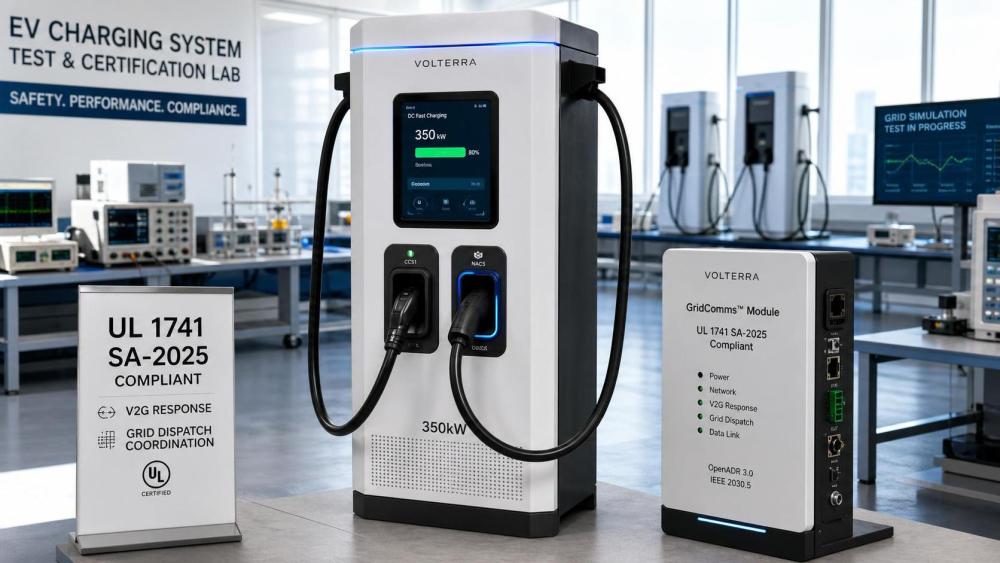
On September 1, 2026, a new US compliance threshold took effect for imported DC fast charging equipment. The immediate focus is not only on charger hardware, but also on whether imported systems already include a plug-and-play communication module compatible with UL 1741 SA-2025 and capable of responding to V2G instructions and grid dispatch signals. For EV charging equipment manufacturers exporting to the US, especially those in China, this is worth close attention because market access now depends on communication capability, firmware certification, and the coordination of FCC and UL testing rather than on charging performance alone.
What the DOE Mandate Requires
The US Department of Energy released the Interoperability Mandate for Grid-Interactive EVSE on August 2, 2026. Under that requirement, from September 1, 2026, all DC fast charging equipment imported into the United States, including liquid-cooled and high-power supercharging systems, must be shipped with a built-in communication module compatible with UL 1741 SA-2025.
The confirmed functional requirement is that the module must support V2G command response and the parsing of grid scheduling signals. The rule directly affects US import access for Chinese EV charging equipment manufacturers. The summary provided also makes clear that the compliance path involves BMS coordination, communication firmware certification, and a dual FCC plus UL testing process.
Where the Pressure Will Be Felt First
Export-facing charger manufacturers move to the front line
From an industry perspective, manufacturers shipping DC fast chargers to the US are the most directly affected group because the requirement is tied to import eligibility. The impact is likely to appear first in product configuration, model readiness, technical documentation, and delivery planning. What deserves closer attention is whether existing export models were designed around hardware power specifications only, or whether they are already prepared for embedded communication compliance.
Firmware and control integration become part of the sales gate
Analysis shows that the rule reaches beyond physical charging equipment and into control logic. Because the requirement explicitly includes V2G response and grid signal parsing, communication firmware and system-level interoperability become part of the commercial threshold for entering the US market. The affected business links are likely to include firmware validation, version control, and coordination between charging system control layers and BMS-related functions.
Testing and certification workflows gain more weight
Observably, testing service providers, compliance teams, and cross-border delivery managers will need to pay closer attention to timing and sequencing. The summary identifies FCC and UL as a dual testing path, which means certification work is not a single-step box-checking exercise. For companies already managing shipment windows and customer acceptance milestones, the main concern is whether compliance preparation changes lead times, document readiness, or handoff procedures with US-side buyers and partners.
What Companies Should Be Checking Now
Watch for any clarifications around the rule language
Analysis shows that companies should closely monitor any further official wording, interpretation, or implementation detail tied to the DOE mandate. The rule summary establishes the baseline requirement, but business decisions will depend on how that language is applied in actual import, certification, and customer acceptance workflows.
Review product scope model by model
What deserves closer attention is the exact product range affected in a company's export portfolio. The provided information clearly names imported DC fast charging equipment, including liquid-cooled and supercharging systems. Companies should therefore review which models, variants, and configured systems fall within that scope and whether embedded communication modules are already standard or still optional.
Check coordination between BMS, firmware, and compliance evidence
From an industry perspective, one practical risk is treating the new requirement as a standalone communications issue. The summary explicitly mentions BMS coordination and communication firmware certification, so engineering, compliance, and export teams need aligned internal records on technical interfaces, firmware status, and test documentation. Customer communication may also need to reflect whether compliance is built into current shipments or pending in revised configurations.
Reassess delivery commitments and customer-facing documentation
Observably, suppliers and exporters should pay attention to order execution, pre-shipment review, and document completeness. Where deliveries are tied to the US market, the practical focus is likely to include specification sheets, certification materials, declaration packages, and lead-time discussions with buyers. The policy signal and actual shipment readiness are not necessarily the same thing, so companies need to distinguish between nominal compliance intent and deliverable, test-backed product status.
Why This Looks Like More Than a Short-Term Compliance Detail
Analysis shows that this development is better understood as a policy signal about how the US wants imported EV charging equipment to interact with the grid, rather than as a narrow hardware adjustment. The requirement explicitly connects charger imports with interoperability, V2G responsiveness, and grid signal handling. That suggests the compliance focus is moving deeper into software, communications, and system behavior.
At the same time, it would be premature to treat this alone as a complete market outcome. The confirmed facts establish a mandatory requirement and a clear compliance direction, but the broader commercial impact will still depend on how manufacturers, testing workflows, and buyers respond in practice. It is more appropriate to understand this as an active regulatory shift with immediate entry implications and continued implementation questions.
How the Industry Should Read This Moment
For the EV charging supply chain, this update matters because it changes what counts as import-ready equipment in the US market from September 1, 2026. The core issue is no longer limited to charger power architecture or product form factor; communication capability compatible with UL 1741 SA-2025 is now part of the access threshold described in the provided summary. A neutral reading is that this is both an immediate compliance change and a longer-term signal that grid-interactive functions are becoming central to market entry expectations.
Basis of This Article and What Still Needs Verification
This article is based on the user-provided news title, event date, and event summary concerning the DOE requirement for imported EV charging equipment. For developments of this kind, relevant source types typically include official government announcements, company statements, industry association updates, standards organization documents, and reporting from authoritative trade media.
A specific official source link was not provided in the input, so the underlying wording and any later clarification should continue to be verified. Continued attention should be given to any subsequent official interpretation, implementation detail, and certification-related guidance connected to the mandate.