
UL announced on July 9, 2026 that UL 2202-2026 has become mandatory with immediate effect, introducing a new thermal runaway containment propagation test (TCPT) for DC fast charging infrastructure rated at 150 kW or above. The change directly matters to manufacturers, exporters, certification-facing teams, and buyers involved in North America-bound EV charging equipment, because it links product access more tightly to structural compliance and certification timing rather than to commercial readiness alone.
What the new requirement formally changes
According to the provided event summary, the updated UL 2202-2026 standard was announced by UL on July 9, 2026 and is effective immediately.
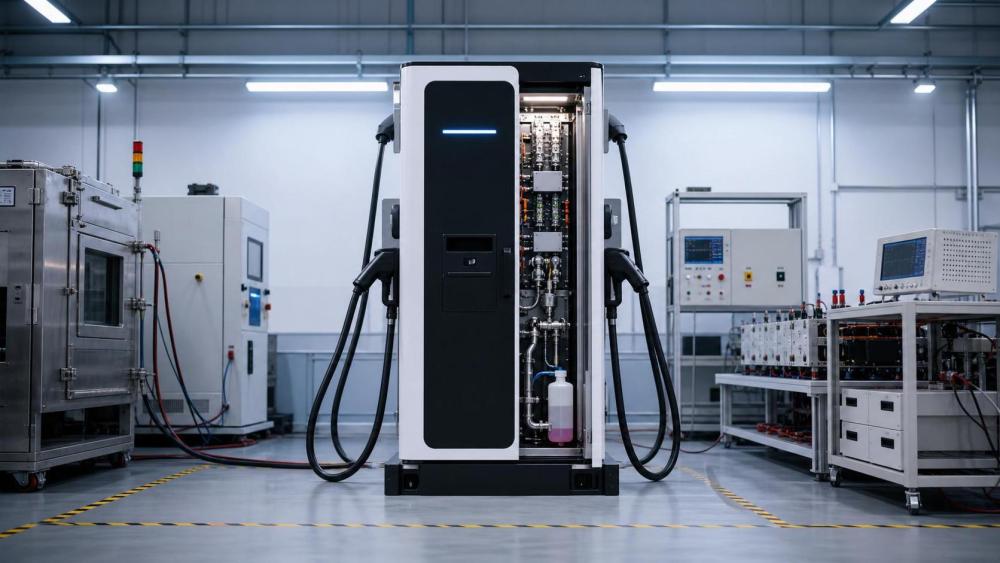
The revision adds a thermal runaway containment propagation test (TCPT) aimed at liquid-cooled modules and stacked power semiconductor structures.
The scope given in the input covers DC fast charging infrastructure equipment with a rated power of 150 kW or higher.
The provided information also states that this change directly affects the certification timeline for Chinese charging pile manufacturers exporting to North America, as well as the compliance requirements tied to structural design.
Where the pressure is likely to appear first in the value chain
Export programs tied to North America
From an industry perspective, exporters are likely to feel the impact first because market entry for affected products depends on passing the updated certification pathway. What deserves closer attention is the possibility that shipment planning, customer commitments, and model launch sequencing may need to align more closely with test readiness and design review status.
For these companies, the main business exposure is in certification scheduling, technical file preparation, and delivery coordination. The practical compliance focus is whether products at or above the 150 kW threshold can demonstrate conformity under the newly effective test requirement.
Product design and manufacturing decisions
Analysis shows that manufacturers of high-power DC fast charging equipment may need to review whether existing structural layouts involving liquid-cooled modules or stacked power semiconductor arrangements remain suitable under the new test condition. The impact is not only on final testing but also on design validation, component integration, and documentation that supports a compliance submission.
In operational terms, engineering and manufacturing teams should pay attention to whether current designs, internal verification records, and product change control documents are sufficient for a certification process shaped by TCPT requirements.
Procurement and project buyers
Buyers, project developers, and procurement teams may also be affected where product acceptance is tied to certification status or technical specifications. Observably, the issue is less about price movement in the abstract and more about whether procurement timelines, technical bid alignment, and delivery expectations reflect the updated compliance threshold for 150 kW and above equipment.
What deserves closer attention is the wording used in purchase specifications, qualification reviews, and acceptance documents, especially where imported fast-charging systems are involved.
Testing and certification-facing service providers
Certification support teams and testing-related service providers may see changes in workload and review sequencing because the standard now includes an additional test item for specific structures. Analysis shows that the key issue is process coordination: technical documentation, sample readiness, and communication around test applicability may become more important in ongoing export programs.
For these participants, the relevant business link is the handoff between product design evidence and formal certification execution rather than any confirmed change in market demand.
What companies should review now
Check product scope against the 150 kW threshold
Companies should first identify which models clearly fall within the stated scope of DC fast charging infrastructure rated at 150 kW or above. This is the baseline step for deciding which export models, bids, or customer programs may be exposed to the updated requirement.
Re-examine compliance files for thermal runaway protection claims
Analysis shows that the immediate practical task is to review technical files, design descriptions, and test-related materials linked to liquid-cooled modules and stacked power semiconductor structures. The input does not provide detailed execution criteria, so this should be treated as a compliance review trigger rather than proof that any specific design already passes or fails.
Reassess certification and delivery timing
What deserves closer attention is the link between certification timing and commercial delivery. Where projects depend on North America-bound approvals, companies may need to revisit internal schedules, customer commitments, and submission sequencing in light of the standard taking effect immediately.
Watch for downstream changes in specifications and acceptance language
Observably, companies should continue monitoring how this standard update may appear in bid documents, buyer qualification requirements, after-sales obligations, and quality traceability expectations. Since the input does not include detailed implementation language beyond the standard change itself, these downstream effects should still be tracked rather than assumed.
Why this should be read as an execution signal
Analysis shows that this update is more appropriately understood as a rule already entering execution rather than a distant consultation-stage development, because the provided information states that UL 2202-2026 is effective immediately. At the same time, it would be premature to treat every commercial consequence as settled, since the input does not provide detailed certification interpretations, transition handling, or buyer-side enforcement practices.
From an industry perspective, the most important signal is that compliance for high-power DC fast chargers is becoming more closely tied to thermal runaway containment performance in specified structural configurations. The part that still requires observation is how consistently this requirement will shape certification pacing, project documentation, and procurement behavior across actual transactions.
How to read the immediate significance
The current development is best understood as a concrete compliance change with direct relevance to North America-bound EV fast charging equipment at or above 150 kW. It does not by itself confirm broader market outcomes, but it does indicate that certification planning and structural design review now deserve earlier attention in export and delivery decisions.
In that sense, this is neither just a routine standards update nor a basis for sweeping conclusions. It is more appropriate to understand it as an implemented rule change that companies should factor into certification, product configuration, and project execution workflows while continuing to watch for clearer downstream enforcement signals.
Basis of this article and what still needs verification
This article is generated from the user-provided news title, event date, and event summary. The factual basis used here is limited to the stated announcement date, the immediate effectiveness of UL 2202-2026, the addition of the TCPT requirement, the stated applicability to DC fast charging infrastructure rated at 150 kW or above, and the stated relevance to Chinese manufacturers exporting to North America.
For this type of development, relevant source categories would typically include official announcements, regulator or market-surveillance releases, trade or customs authority information, industry association updates, standards organization documents, and reporting by authoritative trade media. A specific official source link was not provided in the input, so the underlying publication and any supporting technical text still need to be verified on an ongoing basis.
What still warrants continued observation includes any further official wording, certification execution interpretations, changes in tender specifications, buyer acceptance language, industry feedback, and the way affected companies adjust compliance and delivery arrangements in practice.