
On July 8, 2026, the U.S. Department of Energy updated its procurement guidance for federally funded EV charging infrastructure, tying public fast-charging projects supported by the Bipartisan Infrastructure Law to DC fast chargers certified under the latest UL 2202-2026 standard. For charger manufacturers, exporters, project buyers, testing and certification providers, and downstream delivery teams, this is worth close attention because the change links procurement eligibility to a newer compliance baseline and adds technical requirements around liquid-cooled module thermal runaway protection, V2G communication compatibility, and localized data storage.
What the revised guidance now requires
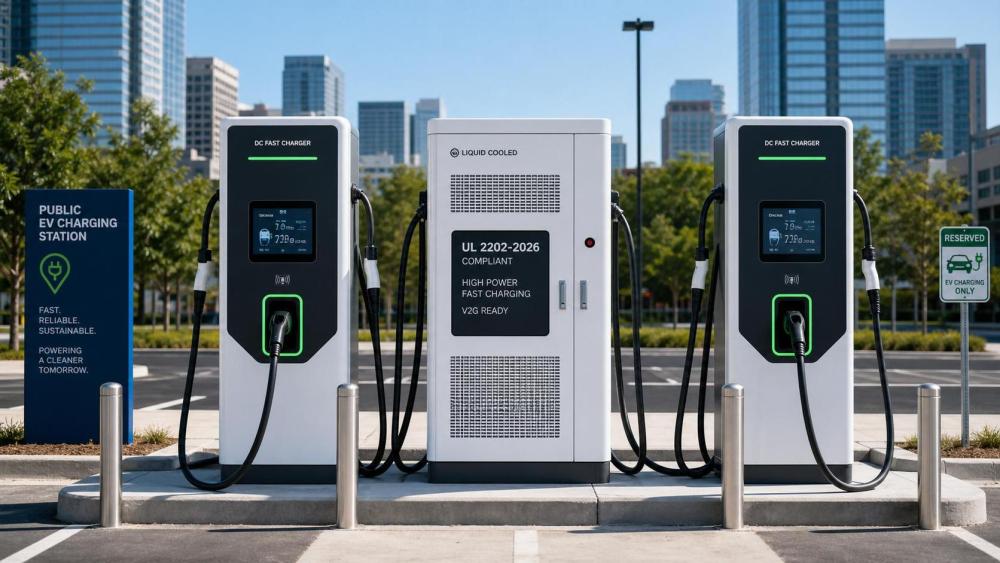
The confirmed change is that DOE released Rev.3.1 of its Technical Guidance for Procurement of EV Charging Infrastructure Supported by Federal Funds on July 8, 2026. Under that guidance, all public fast-charging stations built with Bipartisan Infrastructure Law funding must procure DC fast-charging equipment that has been certified to the latest UL 2202-2026 version.
The confirmed technical additions named in the input are threefold: requirements related to thermal runaway protection for liquid-cooled modules, V2G communication compatibility, and localized data storage. The input also states that this change directly affects the market-entry path for Chinese charging equipment manufacturers exporting to the United States.
Where the pressure points are likely to appear
Export qualification is moving closer to certification timing
From an industry perspective, exporters of DC fast chargers may be affected first because access to federally funded public fast-charging procurement is now tied to the latest UL 2202-2026 certification. The immediate business impact is likely to center on product qualification, technical file readiness, and whether export models are aligned with the updated certification path rather than older approval assumptions.
What deserves closer attention is the connection between certification status and sales access. Where projects are funded under the BIL framework described in the input, certification is no longer only a technical matter for market confidence; it becomes part of procurement eligibility.
Procurement teams will need tighter specification screening
Buyers, project developers, and procurement teams involved in public fast-charging deployment may be affected because equipment selection now has to match the revised DOE guidance. The practical pressure point is likely to be bid specification alignment, supplier qualification review, and document checks tied to the applicable UL 2202-2026 certification status.
Analysis shows that procurement workflows may need closer attention to certification evidence, product configuration consistency, and whether the equipment offered for delivery matches the version covered by testing and approval documents. This matters especially where funded projects cannot absorb compliance mismatches late in the purchasing cycle.
Testing, certification, and delivery support become more operationally relevant
Testing bodies, certification-related service providers, and supply-chain support teams may also feel the effect because the updated baseline introduces named technical items that can influence review scope and delivery preparation. The likely impact is not limited to laboratory assessment; it can extend to technical documentation, compliance interpretation, and handoff materials used in procurement and project delivery.
Observably, after-sales and traceability functions may also need attention where localized data storage and communication compatibility form part of the compliance expectation. Even without further execution details in the input, these points can affect how suppliers prepare records and support downstream project acceptance.
What companies should check now
Review whether current product approvals match the new procurement gate
Analysis shows that manufacturers and exporters should first verify whether products intended for U.S. public fast-charging projects funded under the BIL framework are already certified to UL 2202-2026, rather than assuming earlier certification versions will remain sufficient for those procurements.
Recheck technical documents against the newly named requirements
What deserves closer attention is whether technical documentation, test reports, and product descriptions clearly address liquid-cooled module thermal runaway protection, V2G communication compatibility, and localized data storage. The input does not provide execution detail beyond these items, so companies should treat this as a compliance review priority rather than assume a settled enforcement interpretation.
Watch bid documents and purchaser language closely
For suppliers pursuing funded projects, bid terms, purchaser checklists, and technical schedules deserve close monitoring. It is more appropriate to understand this as a change that can move from guidance text into practical supplier screening, especially where procurement teams begin translating the revised requirement into document-level acceptance conditions.
Plan for possible effects on delivery and support commitments
Observably, where certification timing, documentation readiness, or product configuration updates are still in progress, delivery planning and customer commitments may need rechecking. The input does not confirm specific transition arrangements, so companies should continue tracking official wording and market practice before treating any internal timeline assumption as settled.
How this development is best understood at this stage
Analysis shows that this is more than a general policy signal because the procurement condition is tied to a named guidance revision, a defined funding context, and a specific certification baseline. At the same time, it is not yet something the industry should overread into a fully mapped execution framework, because the input does not provide detailed implementation steps, transition treatment, or procurement-language examples.
It is more appropriate to understand this as a concrete compliance and procurement signal with immediate relevance for equipment positioning, while still leaving room for continued observation on how certification interpretation, bid wording, and project-level enforcement develop in practice.
A practical reading for the market
The main industry significance of this update is that procurement access for certain U.S. public fast-charging projects is being connected more directly to the latest UL 2202-2026 certification expectations. For manufacturers, exporters, buyers, and compliance service providers, the key issue is not only the existence of a new rule reference, but how quickly technical documentation, certification status, and procurement submissions are brought into line with it.
Current observation suggests this should be read as an implemented rule change within the funded procurement context described in the input, while the detailed market response and execution standards still warrant continued tracking.
Basis of this article and points still requiring verification
This article is generated from the user-provided news title, event date, and event summary. For developments of this kind, relevant source categories commonly include official notices, regulator publications, trade or customs authority information, industry association updates, standards organization documents, and reporting by established industry media.
No specific official source link was provided in the input, so the exact official publication link still needs to be verified on an ongoing basis. Further observation is also needed on detailed policy language, certification implementation interpretation, changes in tender documents, market feedback, and how companies are executing against the revised requirement.