
On August 4, 2026, the U.S. International Trade Commission issued a preliminary ruling in case 337-TA-1428 involving EV charging equipment exported from China to the United States. The decision points to alleged patent infringement tied to core communication protocol and safety control technologies associated with UL, ChargePoint, and Siemens. For charger makers, overseas distributors, OEM partners, and procurement teams across North America, Latin America, and the Caribbean, this matters because it raises immediate questions around importability, customs clearance, sales compliance, and supply continuity.
What the Preliminary ITC Decision Confirms
The confirmed facts are limited but commercially significant. The ITC released a preliminary determination on August 4, 2026, in investigation 337-TA-1428. According to the information provided, the ruling found that AC and DC charging piles exported to the U.S. by multiple Chinese EV charging equipment manufacturers were suspected of infringing three core patents related to communication protocols and safety control.
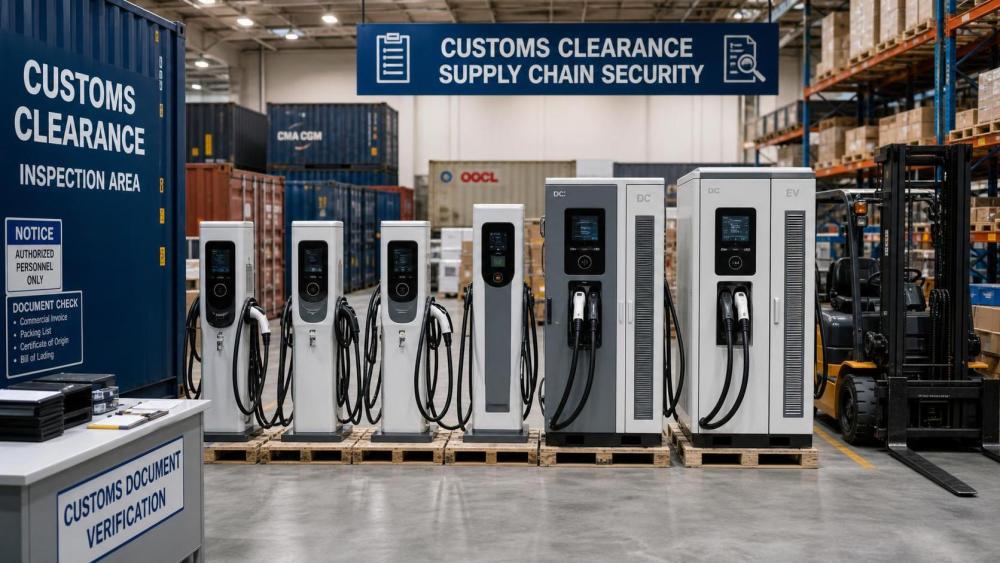
The patents referenced in the case are associated with UL, ChargePoint, and Siemens. The reported consequence of this preliminary determination is that some models could face outcomes linked to the Section 337 process, including possible import restrictions and customs detention. The summary also indicates that the ruling may directly affect customs clearance for overseas distributors, compliance in end-market sales, and OEM private-label cooperation.
Where the Commercial Impact May Surface First
Pressure on distributors and import channels
From an industry perspective, overseas distributors are among the first parties likely to feel the effect. If certain charger models face import restrictions or customs holds, the impact would not stay at the legal level alone; it could move quickly into shipment scheduling, inbound inventory planning, and customer delivery commitments. What deserves closer attention is whether channel partners have product exposure tied to the affected export lines and whether substitute models are available within current procurement plans.
Compliance risk for end-market sales
For companies selling EV charging equipment into the U.S. market, the issue is not only whether products can enter the country, but also whether downstream sales remain compliant once the case develops. Analysis shows that sales teams, installers, and project operators may need to review whether products already in the pipeline, under quotation, or awaiting installation involve models exposed to the investigation. The practical concern is that legal uncertainty at the import stage can become a commercial compliance issue further down the chain.
OEM and private-label arrangements under scrutiny
The summary specifically mentions OEM private-label cooperation, which makes this an operational issue for brand owners as well as manufacturers. Observably, where a product is sold under another company’s label, questions can extend beyond production responsibility to documentation, technical specifications, and market-facing representations. Businesses operating under OEM structures should therefore pay close attention to how product origin, model mapping, and technical ownership are documented across contracts and shipment files.
Procurement dependence in nearby regional markets
The reported risk is not limited to the U.S. alone. The information provided highlights urgent sourcing exposure for channel partners in North America, Latin America, and the Caribbean that rely on Chinese supply chains. Analysis shows that even where final demand sits outside the United States, procurement and routing decisions may still be affected if U.S.-bound inventory, shared model platforms, or regional stocking strategies are linked to the same supplier base.
What Companies Should Be Watching Now
Follow the official process, not only the headline
What deserves closer attention is the distinction between a preliminary ruling and a final commercial outcome. Companies should track subsequent official language, procedural developments, and any clarification regarding affected product scope. In practice, this means legal, sales, and supply chain teams should work from updated case information rather than assumptions based on the initial headline alone.
Identify exposed models and shipment documents
Businesses with U.S.-linked charger sales should review which AC/DC models may be connected to the allegations described in the ruling summary. The immediate operational focus is less about broad market positioning and more about product-level traceability: model numbers, bills of materials, customs documentation, technical specifications, and shipment status. This is especially relevant for distributors and OEM partners that manage multiple labels across the same manufacturing base.
Recheck delivery commitments and customer communication
Where projects depend on imports from China, procurement and commercial teams may need to reassess delivery schedules and contract assumptions. Analysis shows that the practical exposure can appear in customs timing, order fulfillment, and customer expectations before any broader market conclusion is reached. Clear communication with buyers, channel partners, and installation counterparts becomes important when delivery risks are linked to an ongoing trade and IP process.
Review supplier readiness and supporting records
Companies relying on affected supply chains should also examine whether suppliers can provide complete supporting materials related to product identity, compliance records, and fulfillment timing. Observably, this type of case can make documentation quality and response speed more important for day-to-day execution, particularly where customs clearance and partner due diligence become more sensitive.
Why This Matters Beyond a Single Case
Analysis shows that this development should not yet be treated as a fully settled market outcome, but it is more than a routine legal headline. It signals that intellectual property and compliance risks in EV charging equipment can quickly become trade risks with direct operational consequences. That is particularly relevant in categories such as AC/DC chargers, where product acceptance depends not only on price and availability, but also on protocol compatibility, safety control, and market access.
It is more appropriate to understand this as both a short-term procurement warning and a longer-term signal that cross-border charger sales face closer scrutiny when core technical rights are disputed. At the same time, because the information provided refers to a preliminary ruling, the case still warrants continued observation rather than definitive conclusions about all affected products or final remedies.
How the Industry May Need to Frame This Development
At this stage, the most balanced reading is that the ITC action introduces immediate commercial uncertainty for parts of the EV charging supply chain connected to Chinese exports to the U.S. The direct concern is practical: customs exposure, sales compliance, and OEM cooperation may all come under pressure if product models fall within the scope of the dispute. The broader takeaway is not that the market outcome is already fixed, but that legal and technical disputes in charger systems can translate quickly into sourcing and channel decisions.
For industry participants, the current situation is better understood as an active development requiring verification, product mapping, and contingency planning, rather than as a closed case with fully determined consequences.
Basis of This Article and Ongoing Verification
This article is based on the user-provided news title, event date, and event summary. The information available for this piece states that the relevant development occurred on August 4, 2026, and concerns a preliminary ITC ruling in case 337-TA-1428 involving alleged patent infringement by certain Chinese EV charging equipment exported to the United States.
For this type of industry update, commonly relevant source categories may include official ITC notices, company statements, industry association releases, authoritative media coverage, and documents from standards-related organizations. A specific official source link was not provided in the input, so the details should continue to be verified against subsequent official disclosures and related reporting. The main areas for continued observation are the procedural progress of the case, any clarification on affected product scope, and whether trade enforcement measures materially change channel operations.