
On June 26, 2026, Germany’s Federal Network Agency approved the grid connection of a commercial V2G DC fast-charging site in the Berlin-Brandenburg region, signaling that grid-connected EV charging projects are being assessed not only as charging equipment deployments but also as assets that must meet power system interaction requirements. For exporters of charging equipment, certification bodies, procurement teams, and software integration providers, the development is worth close attention because it ties market access more directly to bidirectional charging compliance, dynamic grid response testing, and real-time dispatch interface readiness.
What the approval confirms
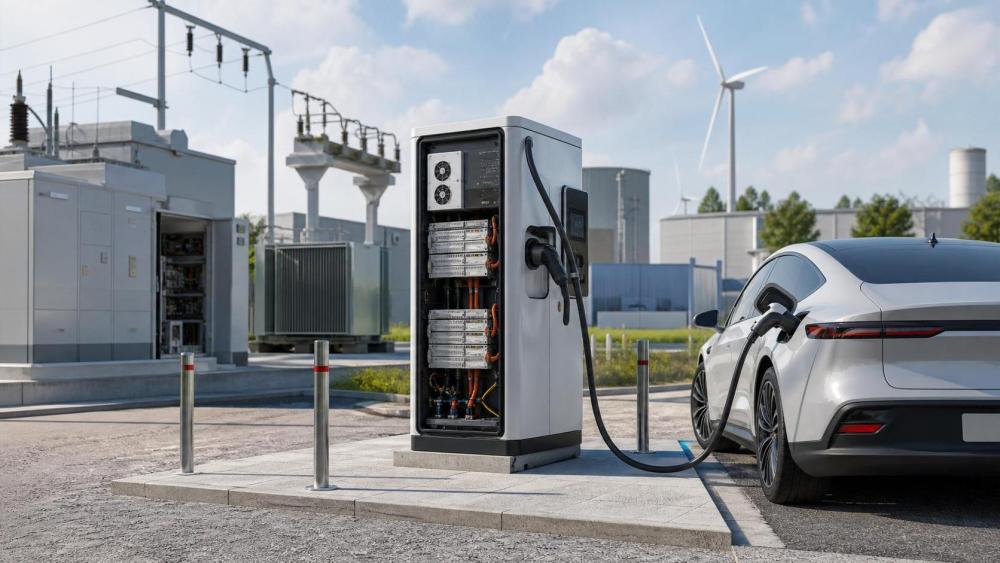
The approved project is described as the first commercial grid-connected V2G DC fast-charging station in the Berlin-Brandenburg area. According to the provided event summary, the installation complies with DIN SPEC 70121-2 and VDE-AR-E 2623-2. The site uses liquid-cooled bidirectional charging and discharging modules supplied by a leading Chinese manufacturer. The equipment is also required to pass EN 50549-1 dynamic response testing and real-time dispatch interface certification.
The confirmed information further indicates that this approval reflects a shift in European EV charging infrastructure procurement from one-way charging toward closer coordination with smart grid operations. In practical terms, the summary identifies new certification needs and software protocol adaptation requirements for export-oriented charging pile suppliers.
Where the practical pressure may appear first
Export-facing charger suppliers may face a broader compliance scope
From an industry perspective, suppliers serving overseas EV charging projects may be affected because the required product scope is no longer limited to conventional charging performance. What deserves closer attention is whether product documentation, test planning, and certification preparation now need to cover bidirectional charging functions, grid response capability, and dispatch interface compatibility alongside core hardware specifications.
Procurement teams may tighten technical bid conditions
Buyers and project procurement teams may be affected at the specification and qualification stage. Analysis shows that once a grid-connected V2G project has been approved under named standards and testing requirements, procurement documents may place greater weight on compliance evidence tied to DIN SPEC 70121-2, VDE-AR-E 2623-2, EN 50549-1, and interface certification. This could influence supplier shortlisting, technical bid alignment, and delivery readiness reviews.
Testing and certification service providers may see more interface-driven work
Certification-related firms and testing organizations may be drawn earlier into project execution because the summary explicitly points to dynamic response testing and real-time dispatch interface certification. Observably, this means that hardware validation alone may be insufficient in some future tenders, and the testing path may need to address how equipment interacts with grid-side control requirements.
After-sales and integration teams may carry more delivery responsibility
Software integration providers and after-sales service teams may also be affected because protocol adaptation is specifically identified in the event summary. The main operational impact may appear in commissioning, interoperability checks, and post-delivery support, especially where exported equipment must demonstrate stable interaction with external scheduling or control systems.
What companies should review now
Recheck whether existing certification plans still match project demand
Analysis shows that exporters should review whether current certification roadmaps were built for one-way charging products only. If product planning still assumes a unidirectional compliance path, the gap may now appear in bidirectional charging functions, EN 50549-1-related testing preparation, and interface certification readiness.
Prepare technical files for both hardware and software review
What deserves closer attention is the documentary side of delivery. For companies participating in overseas tenders or supply negotiations, technical files may need to support not just module performance claims but also protocol adaptation, dispatch interface descriptions, and relevant test evidence. Where the execution details are not yet fully disclosed, it is more appropriate to treat this as a documentation readiness issue rather than assume a finalized market-wide filing standard.
Watch tender language and qualification wording closely
Observably, one of the earliest market signals may appear in technical specifications and supplier qualification clauses rather than in broad public rule changes. Companies should therefore monitor whether future bid documents increasingly refer to bidirectional charging capability, smart-grid coordination, dynamic response tests, or interface certification as preconditions for participation or award evaluation.
Build delivery planning around compliance lead time
From an industry perspective, even when demand exists, the path from quotation to commissioning may become more dependent on testing schedules, certification sequencing, and integration validation. Exporters, supply chain coordinators, and service teams should therefore account for possible changes in compliance lead time, acceptance workflows, and post-installation support obligations.
Why this looks like an execution signal, not just a technical milestone
Analysis shows that the significance of this development lies less in the novelty of V2G as a concept and more in the fact that a commercial site was approved for grid connection under named standards and certification conditions. That makes the event more appropriately understood as an execution signal: the purchasing side of EV charging infrastructure may begin translating smart-grid compatibility into practical supplier requirements.
At the same time, this should not yet be treated as proof of a uniform market rule across all projects or jurisdictions. Observably, the more cautious reading is that the approval highlights a direction of travel in compliance and procurement, while the pace of broader adoption still depends on later project documents, certification practice, and market response.
How this development is best understood now
At this stage, the event is best read as a concrete sign that bidirectional charging capability is moving closer to real project qualification in parts of the European market. For charging equipment exporters, the immediate issue is not only whether V2G demand exists, but whether certification scope, software protocol compatibility, and delivery documentation are sufficient for smart-grid-linked procurement conditions. The change is therefore more appropriately understood as an applied compliance signal with wider implications still requiring observation.
Basis of this article and what still needs verification
This article is based on the user-provided news title, event date, and event summary. For developments of this kind, commonly relevant source types may include official regulatory announcements, publications from supervisory authorities, information released by trade or customs authorities, industry association materials, standard-setting organization documents, and reporting by established professional media.
No specific official source link was provided in the input, so the precise documentary basis still requires ongoing verification. What should continue to be monitored includes later official wording, certification enforcement interpretations, changes in tender documents, market feedback from procurement and testing parties, and how suppliers implement the stated requirements in actual export and delivery projects.