
Solar canopies above EV chargers are often presented as a straightforward combination: generate electricity overhead, sell charging below, and reduce the site’s grid purchases. In practice, the inverter sits at the point where those two systems meet—and it can create maintenance costs that are easy to underestimate during development.
So, what are the real maintenance costs of solar inverters on charging canopies? They are not limited to an annual technician visit or the occasional replacement fan. The actual cost includes remote monitoring, planned inspections, preventive cleaning, firmware and communications work, replacement parts, call-out labor, warranty administration, electrical testing, and the lost charging revenue when a fault takes solar generation or chargers offline.
For a small workplace canopy with AC chargers, inverter maintenance may remain relatively simple. For a public fast-charging hub, depot, retail car park, or highway location with high utilization, the same inverter fault can have wider consequences. It may affect energy-management logic, demand-control settings, customer charging availability, and the site operator’s reputation. That is why the maintenance budget should be built around operating conditions and failure consequences, not simply inverter purchase price.
The visible maintenance budget is only the starting point
Most owners can identify the direct line items: periodic inspections, visual checks, torque verification, filter or fan service where applicable, and a basic monitoring subscription. These are necessary, but they rarely tell the full story. A canopy inverter is often installed in a more exposed and operationally demanding environment than a conventional rooftop inverter.
It may be mounted above vehicle lanes, near charging equipment, in a coastal car park, on a logistics site with dust and diesel residue, or beside a busy retail entrance. It may experience reflected heat from paving, restricted airflow within an enclosure, vibration from structural movement, and recurring electrical disturbances from charging loads. None of these conditions automatically causes failure, but together they influence inspection frequency, component wear, fault rates, and the time needed to restore service.
A realistic operating budget should separate routine maintenance from corrective maintenance. Routine work is predictable. Corrective work is where many project models become too optimistic, particularly if access is difficult, the inverter is proprietary, or the local service network is thin.
Monitoring is inexpensive until the alarms are not actionable
Remote monitoring is usually the lowest-cost maintenance activity, but it is not automatically low effort. A monitoring platform that only reports “inverter fault” may be enough for a simple PV asset. It is often inadequate for a solar charging site, where the operations team needs to know whether the problem is on the DC PV side, the inverter, the AC distribution board, the meter, the site controller, the charger network, or the grid connection.
A common operational problem is not a failed inverter but a communications mismatch after a charger-management update, router replacement, meter configuration change, or firmware revision. The inverter may still be converting power correctly, yet export control, self-consumption optimization, or load-management logic may no longer behave as designed. Resolving that issue can involve several parties: the inverter supplier, charger operator, energy-management provider, electrical contractor, and network communications team.
That coordination time belongs in the lifecycle cost discussion. It is especially relevant where solar output is being actively allocated between EV charging, onsite loads, battery storage, and grid export. EPEM’s broader coverage of distributed energy systems and digital grid controls points to a practical reality: as assets become more integrated, maintenance is increasingly about controls and interfaces, not just hardware.
Owners should ask a direct question before signing an operations contract: who receives the alarm, who decides whether it is critical, and who has authority to make a remote configuration change? If the answer is unclear, the cost may emerge later as repeated site visits and prolonged troubleshooting.
Heat, contamination, and access drive the practical service burden
Solar canopies are exposed by design. This makes environmental assessment more important than a generic “outdoor-rated” specification. Airborne dust can block cooling paths. Pollen and leaves can accumulate around vents. In coastal areas, salt-laden air can accelerate corrosion risk. In vehicle-heavy locations, exhaust residues and brake dust may add to contamination. High ambient temperatures, combined with heat reflected from asphalt or concrete, can place sustained thermal stress on power electronics.
The maintenance implication is not that every inverter needs frequent intrusive servicing. Many modern units are designed to minimize it. The key is to match the service plan to the site. A sheltered corporate car park in a mild climate and an uncovered fleet depot in a hot, dusty region should not have identical inspection assumptions.
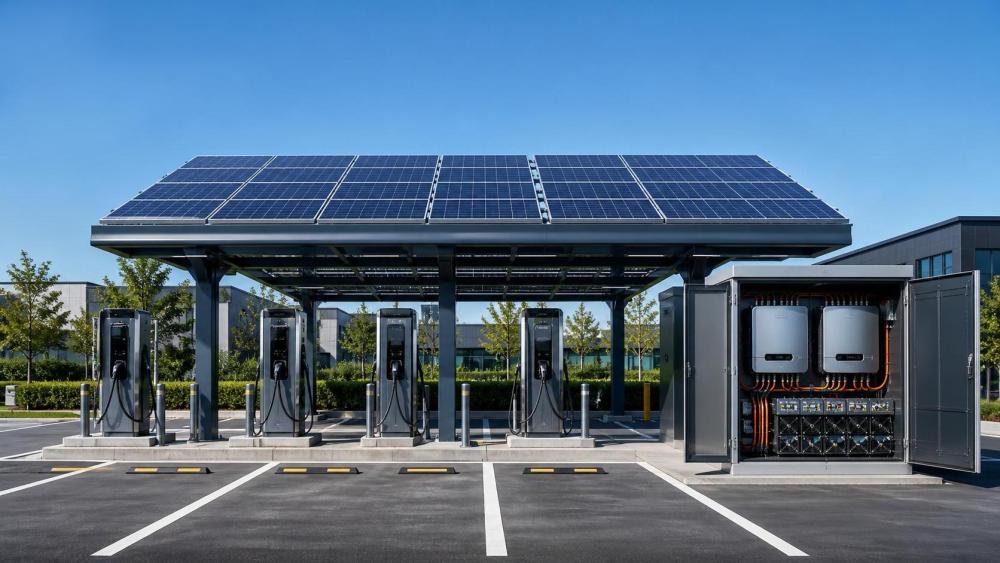
Physical access matters just as much. An inverter placed high within the canopy structure may look tidy in the design drawings, but every inspection could require a lift, lane closure, safety exclusion zone, or work outside peak charging hours. An inverter mounted in a ground-level protected technical cabinet may be easier and cheaper to service, although the cabinet itself must manage heat, water ingress, vandalism, and cable routing properly. There is no universal best arrangement; maintainability should be assessed alongside electrical efficiency and visual design.
Spare parts and replacement strategy matter more than many owners expect
Inverter warranties can reduce exposure, but a warranty is not the same as zero maintenance cost. It may cover a defective component while excluding travel, labor, shipping, commissioning, access equipment, diagnostic work, or business interruption. The response process may also require fault logs, photographs, serial-number verification, and a prescribed troubleshooting sequence before replacement approval.
For larger charging portfolios, it is worth deciding in advance whether to hold critical spares. This does not necessarily mean storing complete inverters at every site. It may mean keeping a small number of compatible replacement units centrally, identifying approved local service partners, and ensuring configuration files and commissioning records are recoverable. A replacement inverter that arrives without the correct settings, communications credentials, export-limit configuration, or protection parameters will not restore the asset quickly.
Compatibility deserves attention in multi-vendor projects. If the PV inverter, battery power conversion system, DC chargers, meters, and energy-management system are supplied under separate packages, future replacements can become more complicated. New equipment may need software integration, revised control logic, or confirmation against grid-connection requirements. The initial procurement saving from a fragmented package can be outweighed by later support complexity.
The largest cost may be lost operating value, not the repair invoice
When people ask, “What are the actual maintenance costs of solar canopy inverters?” they often expect a service-price figure. But the commercially significant number is frequently the cost of unavailable capacity. That cost changes from site to site.
If an inverter failure only stops solar production, EV chargers may still operate using grid electricity. The immediate effect is lost onsite solar value and potentially higher imported-energy cost. If the fault also disrupts the site controller or trips a shared AC section, charging availability may be affected. At a low-utilization office car park, that may be inconvenient. At a public DC charging station, fleet depot, or logistics terminal, downtime can carry contractual, operational, and customer-service consequences that exceed the repair itself.
This is why maintenance planning should distinguish between inverter failure modes. Does a fault isolate only one PV block? Can chargers continue safely from the grid? Is there a bypass arrangement? Does the control system fail safely, and does it revert to a practical operating mode? These are engineering questions, but they shape the O&M budget and revenue-risk profile.
A better way to budget the lifecycle cost
Rather than applying a single percentage to inverter capital cost, build a site-specific maintenance model. Start with the physical system: inverter quantity, type, mounting location, cooling arrangement, electrical architecture, access method, and environmental exposure. Then map the digital system: monitoring portal, communications network, meter interfaces, charger backend, energy-management platform, and any battery or export-control functions.
Next, identify the response path. Who performs remote diagnosis? Who attends site? What is the expected availability of qualified electricians? Are replacement units locally stocked? Which work requires a charger shutdown, a grid isolation, traffic management, or a lift? A maintenance plan that ignores these practical constraints may look economical on paper but will be expensive when the first fault occurs.
Finally, assign value to downtime using the project’s actual commercial model. Consider avoided electricity purchases, expected export value where relevant, charging-margin exposure, demand-management effects, and operational disruption. This does not require pretending that every fault has a precise monetary outcome. It requires identifying which failures are merely inconvenient and which are genuinely costly.
Design decisions that reduce future maintenance friction
The most useful maintenance savings are often made before construction. Provide safe access to inverter locations. Keep DC and AC isolation points clearly labeled and reachable. Protect cables from vehicle impact and water pathways. Avoid placing heat-sensitive electronics where canopy geometry restricts ventilation. Specify monitoring that can show both electrical status and communications health. Retain as-built drawings, protection settings, network diagrams, passwords, and commissioning records in a controlled but accessible format.
It is also sensible to avoid treating inverter maintenance as an isolated PV workstream. At a solar-plus-charging site, the inverter is part of a wider power system involving distribution equipment, charging loads, grid constraints, and often energy-management controls. The strongest O&M arrangements define interfaces between these systems before a fault forces the issue.
For developers, EPC contractors, and owners evaluating solar charging infrastructure, the practical lesson is simple: budget for the inverter’s environment, access, software dependencies, and failure consequences—not only for periodic servicing. A well-chosen inverter can be reliable, but reliability does not remove the need for a clear repair pathway. The projects that remain easier to operate are usually the ones where maintenance was treated as a design input, not an afterthought.