
India’s photovoltaic inverter import rules tightened on July 14, 2026, when the Bureau of Indian Standards (BIS) issued a revised notice requiring imported PV inverters to meet both IS/IEC 62109-2 and UL 1741 SB from August 1, 2026. For manufacturers, exporters, importers, distributors, and procurement teams tied to the India market, the issue is not only a standards update but a direct compliance gate affecting customs clearance, market access, delivery scheduling, and certification cost control.
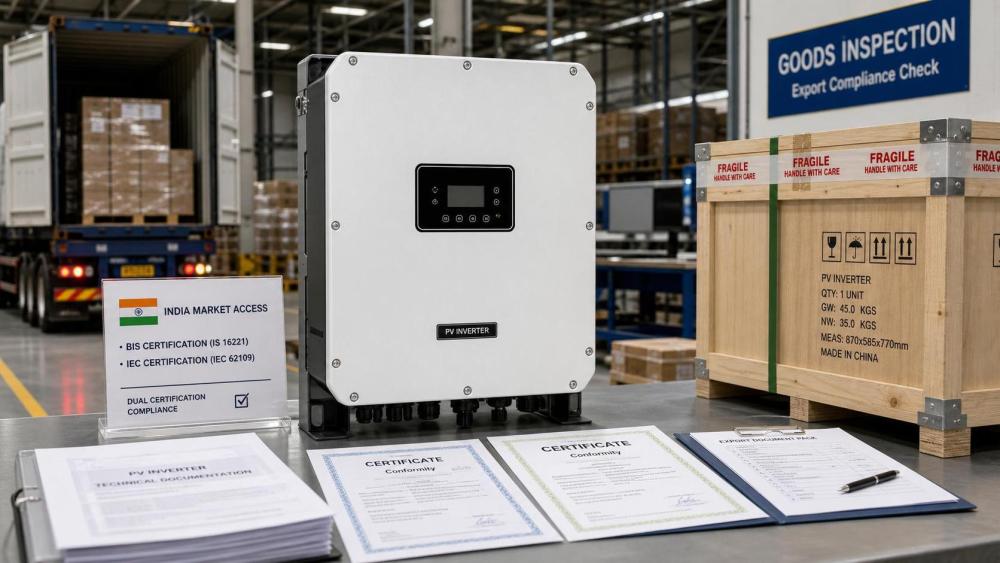
What the revised BIS notice confirms
According to the provided event information, BIS released the revision on July 14, 2026. The notice states that all imported photovoltaic inverters must simultaneously comply with IS/IEC 62109-2, which addresses electric shock protection, and UL 1741 SB, which covers grid interaction and anti-islanding, starting on August 1, 2026.
The confirmed effect described in the input is that products without both mandatory certifications will not be able to clear customs or be listed for sale. The input also states that the change directly affects the delivery pace and compliance cost of Chinese inverter exporters serving India.
Where the rule change is likely to hit first
Export shipments facing a new access threshold
From an industry perspective, exporters shipping PV inverters to India are likely to feel the impact first because the new requirement turns dual certification into a precondition for market entry. The most immediate pressure points are shipment readiness, pre-export compliance review, and whether goods can move through customs and into sale channels without interruption.
Procurement and channel decisions may tighten
Buyers, import-side procurement teams, and distribution channels are also likely to adjust their screening logic. Observably, the rule change raises the importance of checking whether a product already holds both certifications before order confirmation, tender participation, stocking decisions, or listing arrangements. In practice, this shifts attention toward documentation completeness, product qualification status, and delivery commitments tied to compliant models.
Testing and certification-related services may become more central
Certification-related firms and testing service providers may see higher demand for document review, test coordination, and timeline management. Analysis shows that when a rule links market access directly to two mandatory certifications, the administrative side of compliance becomes more important alongside product performance itself. What deserves closer attention is whether technical files, reports, and certification evidence can support cross-border delivery schedules without creating bottlenecks.
After-sales and traceability functions cannot stay separate from compliance
For service providers handling installation support, replacement logistics, or quality traceability, the rule matters because products that cannot lawfully clear customs or enter sale channels may also disrupt downstream service planning. The practical implication is that compliance status may increasingly need to align with model management, spare unit planning, and product recordkeeping.
What companies should examine now
Check whether current models satisfy both certification conditions
Analysis shows that the first practical question is straightforward: whether products intended for India already meet both IS/IEC 62109-2 and UL 1741 SB. Where the answer is unclear, companies should treat this as a live compliance review issue rather than a paperwork formality, especially for products close to shipment or listing.
Review documents used in trade, customs, and sales channels
What deserves closer attention is whether certification-related documentation is consistent across export files, product technical materials, sales submissions, and channel-facing records. The input confirms the consequence of failing dual certification, but it does not provide detailed implementation procedures. That means companies should watch closely for how certification evidence is expected to appear in practical customs and sales processes.
Reassess delivery timing and procurement commitments
Observably, the short gap between the July 14, 2026 notice and the August 1, 2026 effective date makes delivery planning a key operational concern. Companies with ongoing orders, pending shipments, or near-term procurement cycles should pay close attention to how compliance readiness aligns with promised lead times, booking plans, and inventory release decisions.
Track further wording, execution practice, and market-facing documents
The input confirms the new mandatory requirement, but it does not set out detailed enforcement language beyond customs clearance and sale access. It is more appropriate to understand this as a rule change that has already formed a clear access condition while still requiring continued observation of execution wording, certification interpretation, tender language, and market feedback.
Why this reads as an execution signal, not just a policy headline
Analysis shows that this development is more than a general standards update because the input ties certification status directly to customs clearance and sales eligibility. That makes the change operational in nature: it affects whether goods can move, not only how they are described. At the same time, the available information remains narrow, so the market still needs to observe how the requirement is reflected in document review, channel acceptance, and procurement practice.
How the market may need to frame this change
From an industry perspective, the most reasonable reading at this stage is that India has introduced a concrete compliance threshold for imported PV inverters, with immediate implications for market access and delivery execution. The event should not be overstated into a broader market conclusion, but it should be treated as a real rule shift that can affect certification planning, order screening, and shipment arrangements in the near term.
Basis of this article and points still to verify
This article is based on the user-provided news title, event date, and event summary. For developments of this kind, commonly relevant source categories include official notices, releases from regulatory authorities, customs or trade administration information, industry association updates, standards organization documents, and reporting from authoritative trade media.
A specific official source link was not provided in the input, so the precise official document path still needs to be verified on an ongoing basis. Further observation should focus on detailed implementation language, certification enforcement practice, tender document updates, channel response, and how affected companies execute compliance in actual shipments and sales activity.