
In hot climates, agrivoltaic projects do not automatically cause significant crop-yield losses. For some crops, carefully managed solar shade can maintain yields, improve marketable quality, and reduce irrigation demand during extreme heat. For others—particularly crops that require high, uninterrupted light levels or mechanized cultivation—solar structures can reduce output enough to undermine the agricultural case.
The practical question is not whether panels shade crops. They do. The question is whether the reduction in solar radiation is offset by lower canopy temperature, reduced evapotranspiration, improved soil-moisture retention, and protection from heat stress. The answer differs sharply by crop, site, array geometry, irrigation reliability, and farm-management capability.
That distinction matters because agrivoltaics is often discussed as a simple dual-use land strategy. In reality, it is a combined energy-and-agriculture system with two operating objectives that can conflict. A layout optimized only for photovoltaic generation may create uneven shade, restrict machinery access, and make irrigation or harvesting harder. A layout designed around crop performance may require higher mounting structures, wider row spacing, altered tracker operation, or lower module density—each affecting power yield and project cost.
Hot-climate agrivoltaics: lower yield is possible, but not inevitable
In conventional open-field agriculture, high solar irradiance is usually beneficial up to a point. Once air and leaf temperatures exceed a crop’s preferred range, however, additional radiation can become a stress factor rather than a productivity advantage. Crops may close stomata to conserve water, reducing photosynthesis. Flowers can abort, fruit may develop sunscald, and water demand can rise rapidly. These risks are especially relevant in arid and semi-arid regions where intense sunlight coincides with limited water availability.
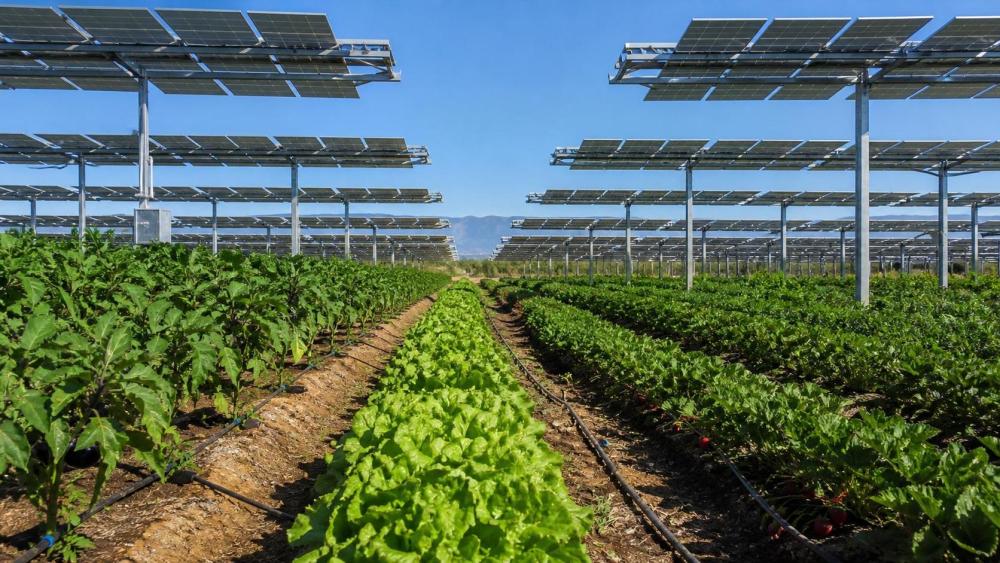
Solar arrays alter this environment. They reduce direct radiation during portions of the day, while the panel structure can moderate soil and leaf temperatures. In hot environments, this can be useful for shade-tolerant or heat-sensitive crops. It is less useful where sunlight is already the main constraint, where crops are grown during cooler seasons, or where the project configuration produces prolonged and poorly distributed shading.
It is therefore misleading to describe agrivoltaics as either a universal crop-protection solution or an unavoidable agricultural loss. The effects should be assessed crop by crop and season by season.
Crop response matters more than the label “agriculture”
The most important early decision is selecting crops based on their response to shade, heat, and local growing conditions—not simply choosing whatever is commonly grown nearby. Leafy vegetables, some herbs, berries, forage crops, and certain root vegetables may perform reasonably under partial shade in hot periods. Their response is influenced by the timing and intensity of shade, cultivar choice, planting density, and local humidity.
For heat-sensitive horticultural crops, reduced direct exposure may protect leaves and fruit from extreme conditions. In these cases, the relevant measure is not only total harvested weight. It is also marketable yield: the portion of production that meets commercial grade. Lower sunscald, less wilting, and more uniform quality can have economic value even when total biomass changes little.
By contrast, grain crops and other broad-acre field crops often present a more difficult case. They are generally managed with large machinery, require extensive open growing areas, and may depend on high light availability during critical development stages. A project can theoretically accommodate such crops, but high structures and wide panel spacing may be required. That design can increase structural steel, foundation work, cable lengths, and installation complexity. The agricultural system then becomes more expensive, while the PV layout may deliver less energy per hectare than a conventional utility-scale solar plant.
Perennial crops deserve separate treatment. Orchards, vineyards, and some other established systems already use trellises, irrigation lines, and specialized equipment. Integrating solar canopies into these operations requires a detailed understanding of plant growth, pruning, spraying, airflow, access, and long-term maintenance. A solar structure that works above low annual crops may be unsuitable for taller crops or orchard systems.
Shade quality is more important than average shade percentage
Many proposals rely on a single shading ratio, such as 20% or 30% coverage. That number is useful but insufficient. Plants respond to the distribution of light over the day and through the crop canopy. Two projects with the same module coverage can produce very different crop conditions.
Fixed-tilt systems often create predictable but persistent bands of shade. Depending on orientation and row spacing, parts of the field may receive much less morning or afternoon sunlight than others. This can lead to variable crop development, inconsistent maturity, and difficult harvesting schedules. The problem is often more visible in fields with slopes, irregular geometry, or rows that were positioned for electrical density rather than planting patterns.
Single-axis trackers can create moving shade, which may distribute reduced irradiance more evenly. They also introduce operational choices. In some designs, tracker backtracking reduces inter-row shading for the PV system; in agrivoltaics, tracker angles may potentially be adjusted to manage crop exposure during severe heat. But crop-oriented tracker control is not a free benefit. It must be evaluated against generation losses, wind-stow requirements, warranty conditions, control-system capabilities, and power-purchase obligations.
Module height is equally consequential. Higher clearance improves airflow, allows larger equipment to pass beneath the arrays, and can reduce the sense of a closed canopy. It also raises structural cost. In high-wind regions, taller systems can require more robust foundations and stronger steel. The added cost may be justified for intensive, high-value agriculture, but is less likely to work for low-margin crops unless land constraints or policy incentives are unusually favorable.
Water savings can be real, but they do not eliminate irrigation risk
One of the strongest agrivoltaic arguments in hot climates is lower water demand. By reducing direct solar exposure and lowering soil temperature, panel shade can reduce evaporation from the soil surface. Crops may also experience lower transpiration demand during the hottest periods. This can be valuable where water is costly, pumping energy is high, or heat waves are becoming more frequent.
Still, a shaded field is not necessarily a low-water field. Water use depends on crop type, rooting depth, soil texture, wind, humidity, planting density, and irrigation uniformity. In dry regions, rainfall may be too limited to support commercial cropping regardless of the shade provided. A project should not use theoretical water savings as a substitute for a verified water source, irrigation design, and seasonal water budget.
Panel runoff is another often-overlooked design issue. Rainwater can concentrate along module edges, creating strips of wetter soil beneath certain locations while leaving adjacent rows dry. Without drainage and irrigation adjustments, this uneven distribution can lead to erosion, localized waterlogging, nutrient movement, or non-uniform growth. The issue is particularly relevant during short, intense rainfall events common in some hot-climate regions.
Drip irrigation is frequently more compatible with agrivoltaics than overhead systems because it can be zoned around structural posts and crop rows. Yet it must be designed with maintenance access in mind. Leaks, clogged emitters, and damaged lines are harder to identify where vegetation, racking, and electrical infrastructure share the same space.
Comparing conventional solar, conventional farming, and true agrivoltaics
A meaningful land-use comparison requires more than asking whether crops can survive beneath modules.
Conventional utility-scale solar generally maximizes electrical output per hectare and simplifies construction, fencing, vegetation management, and operations. It may include grazing or low-intensity ground cover, but agricultural production is not central to the project design. This model is often the lowest-cost approach for power generation, particularly where land is relatively available.
Conventional open-field farming gives crops full access to sunlight and supports familiar machinery and agronomic practices. In extremely hot settings, however, it exposes crops directly to heat waves, water stress, wind, and sun damage. Its agricultural productivity may be constrained by climate volatility even without solar development.
Purpose-designed agrivoltaics accepts compromises in both systems. PV capacity density may be lower than in a conventional solar farm. Farming operations may be slower or require modified equipment. In return, the land can produce electricity while supporting selected crops, potentially improving resilience against intense heat and creating a second revenue stream. The system works best when the agricultural operation is commercially credible in its own right, rather than treated as a permitting device or a minor landscaping obligation.
For landowners and project financiers, the relevant metric is therefore not only crop yield per hectare. It is combined land productivity, adjusted for the cost of elevated structures, reduced PV density, agricultural labor, irrigation, insurance, grid connection, and long-term operating responsibility. A project with a modest reduction in crop volume may still be viable if crop quality improves and solar revenue is strong. Conversely, a project with acceptable crop yields may fail economically if custom structures and complicated operations erode returns.
The most common planning errors
The first error is treating shade tolerance as proof of commercial suitability. A crop may survive under partial shade but still produce too slowly, mature unevenly, or fail to meet buyer specifications. Agronomic trials should examine saleable output, labor requirements, pest and disease conditions, and harvest timing—not simply plant health.
The second is designing the PV system before involving agricultural operators. Row width, post locations, turning radius, crop access, irrigation layout, storage areas, and harvest logistics should be set with the farming plan, not added after civil and electrical design are complete. Retrofitting agricultural access into a dense solar layout is expensive and often ineffective.
The third is assuming that solar shade always improves hot-climate production. Excessive shade can increase humidity near the crop canopy, delay drying after irrigation or rainfall, and change pest and disease pressure. In humid-hot regions, the benefit of lower temperature may be offset by poorer airflow and a more favorable environment for fungal problems. Climate type matters: dry heat, humid heat, high wind, monsoon rainfall, and cool-night desert conditions require different designs.
The fourth is using annual averages to make a seasonal decision. Crops are sensitive to conditions during germination, flowering, fruit set, and ripening. A shading pattern that is beneficial during the hottest months can be harmful in cooler production periods. Crop calendars and PV simulations need to be assessed together.
How to judge whether a hot-climate site is suitable
A robust assessment begins with a baseline. Developers need at least one or more representative growing seasons of local yield, water use, pest pressure, heat damage, and farm-gate pricing. Without this baseline, claims of crop preservation or water savings cannot be measured.
The next step is to model the solar layout at crop level. This should include monthly and hourly shade movement, ground irradiance distribution, panel height, row spacing, terrain, and likely tracker behavior. Energy simulation alone is not enough. The output must be translated into agronomic implications for the intended crop and planting calendar.
Small pilot plots are often more valuable than broad claims from projects in another climate zone. A trial can compare open-field controls with multiple array configurations, monitoring soil moisture, air and leaf temperature, crop development, irrigation volume, crop quality, and labor time. The trial should run long enough to capture meaningful heat events, not merely a mild growing season.
Contract structure also matters. If an agricultural partner is expected to manage crops, agreements should define access rights, crop restrictions, irrigation responsibility, herbicide and pesticide protocols, damage liability, electrical safety procedures, and restoration obligations. The relationship is operational, not symbolic. A solar asset owner and a farm operator will have different priorities during construction, maintenance outages, harvesting periods, and extreme-weather events.
What the evidence supports—and what it does not
Available experience supports a cautious conclusion: agrivoltaic projects can avoid significant yield reductions for selected crops in hot climates, and in some cases can improve crop quality or resilience under severe heat. That outcome is most plausible where shade is moderate and evenly managed, irrigation is dependable, crop choice is appropriate, and the solar system is designed around agricultural operations from the outset.
It does not support the broader claim that any solar farm can become productive farmland simply by leaving vegetation under the modules. Nor does it mean agrivoltaics is the best use of every agricultural site. Projects with deep shade, low clearances, weak water access, unsuitable crops, or no experienced farm operator are likely to struggle.
For decision-makers evaluating whether agrivoltaic projects reduce crop yield significantly in hot climates, the most useful comparison is not “solar versus farming.” It is between a conventional PV layout, an open-field crop system exposed to growing heat risk, and a purpose-built dual-use design with measurable agricultural objectives. The strongest projects recognize that electricity generation and crop production are separate businesses sharing one site. Their success depends on designing for both, rather than assuming one will adapt to the other.