
A commercial rooftop solar project should be financed according to the value the organization wants to retain, the cash flow it can support, and the operating obligations it is prepared to carry. A loan, lease, and power purchase agreement (PPA) can all place the same modules and inverters on the same roof, yet they produce very different outcomes for balance-sheet treatment, tax benefit access, contract flexibility, and value at the end of the term.
The first distinction is ownership. With a loan, the site owner generally acquires the solar asset. With a lease or PPA, a third party commonly owns it and grants the host site either use of the equipment or the right to buy its electricity. That single difference affects nearly every later question: who claims available incentives, who approves equipment replacement, who receives renewable energy attributes where applicable, and what happens when the building is sold or the roof requires major work.
Start with the economic profile of the site
Financing should be evaluated only after the expected operating profile is credible. A proposal based on annual solar production alone can make several structures appear similar when they are not. The relevant comparison starts with interval electricity use, demand charges where they apply, export rules, tariff escalation exposure, roof service life, and the expected duration of occupancy.
A facility that consumes most of its electricity during daylight hours generally gives onsite solar a stronger value base than a facility with low daytime load and frequent export. A PPA price may look attractive against the blended utility bill, but the comparison becomes weaker if much of the solar output is exported at a lower value. Likewise, a system designed around a demand-charge reduction assumption needs to show whether solar production actually overlaps with the site’s demand peaks. Solar alone often reduces energy purchases without consistently reducing the highest measured demand.
Roof condition belongs in the financing review, not merely the engineering file. A roof replacement expected during the finance term can require module removal, storage, reinstallation, electrical recommissioning, and possible mounting-system replacement. Under ownership, the site controls the timing but bears the cost. Under a lease or PPA, the agreement must assign the scope, cost, outage coordination, insurance treatment, and any production guarantee consequences. A low opening payment has little value if an unpriced roof event later becomes a dispute.
Loan financing: ownership with capital commitment
A solar loan is usually the clearest route when retaining the asset, its energy savings, and its residual value matters. The borrower pays the installed project cost through debt and repays principal and interest over an agreed term. Electricity produced by the system offsets utility purchases, and the host retains the financial effects associated with ownership, subject to local tax and accounting treatment.
The main attraction is that debt service can be aligned with expected utility savings while ownership remains with the site. After the loan is repaid, the system can continue producing electricity with ongoing operating and maintenance costs rather than a continuing energy-service payment. This structure also gives more direct control over repowering, adding battery storage, changing monitoring providers, or replacing inverters if the operational strategy changes.
That control comes with execution exposure. The borrower must fund or finance the initial cost, maintain the asset, manage warranties, and absorb performance deviations not covered by EPC, module, inverter, or operations contracts. A loan proposal should therefore be reviewed with the full project contract set rather than as an isolated interest-rate comparison.
A common error is to compare loan payments with the first-year utility savings and stop there. The more useful view separates energy savings, demand-charge effects, incentive timing, debt service, insurance, maintenance, property-related costs, and the expected cost of roof interventions. It should also show output under a conservative production case rather than treating the engineering yield estimate as a fixed cash receipt.
Leases: access to solar equipment without direct asset ownership
Under a solar lease, the host pays a scheduled charge for use of the system. Payment may be fixed, escalating, or structured with other agreed terms. The lessor commonly owns the equipment and may take responsibility for specified maintenance, monitoring, insurance, and performance obligations. The host receives the benefit of electricity produced onsite but must read the agreement closely to establish what is included.
A lease can reduce the initial capital requirement and provide a more predictable payment schedule than direct ownership. It is often considered where preserving capital for core operations has greater value than owning rooftop equipment. Its predictability, however, should not be confused with a guaranteed economic outcome. Utility tariffs can change differently from lease escalators, site load can fall, shading can increase after nearby construction, and exported generation may have less value than expected.
Lease structures require particular attention to end-of-term mechanics. The agreement may offer renewal, purchase, return, or removal. Each option has practical implications. Removal from an aging roof can be expensive. Purchasing the system late in its life requires clarity on price determination, remaining warranties, inverter condition, monitoring access, and transfer of documentation. Renewal should not be assumed to be costless or automatic.
Accounting treatment also deserves early review. Modern accounting rules may require many lease obligations to be recognized in ways that differ from older assumptions about off-balance-sheet financing. The classification depends on the specific contract and applicable accounting framework, so commercial summaries should not make broad accounting claims before the executed terms have been assessed.
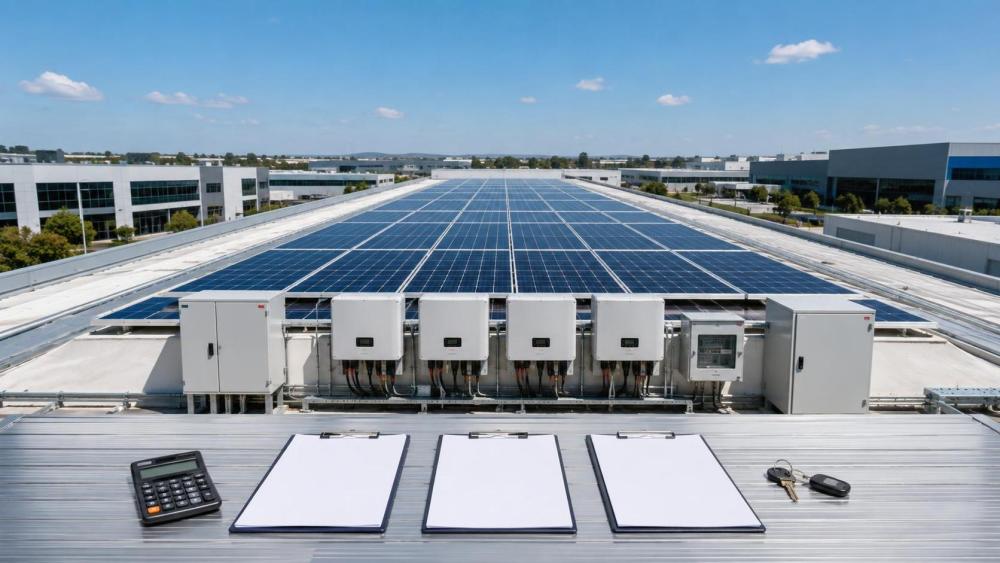
PPAs: buying solar electricity rather than financing equipment
A rooftop solar PPA is an energy purchase contract. A third-party provider develops, owns, and operates the system, while the host purchases generated electricity at an agreed price. The price may be fixed, may rise according to a stated escalation schedule, or may use another formula. The host avoids an upfront equipment purchase and often shifts significant asset-performance responsibility to the provider.
The proper PPA comparison is not “solar price versus current utility rate.” It is a comparison of the contracted solar energy price against the avoided cost of utility electricity for the specific intervals when the system generates, plus the commercial value of any exported power and the cost of contract commitments. A flat utility rate is easy to use in a presentation, but interval tariffs, demand components, minimum bills, and seasonal pricing can materially alter the avoided-cost calculation.
Production risk allocation is a defining feature. Some PPAs charge only for metered solar energy, placing lower-production risk primarily on the provider. Others include availability or performance concepts that need careful definition. The contract should state the meter location, treatment of grid outages, curtailment ordered by the utility, force majeure, planned maintenance, inverter clipping, and production losses caused by site-side restrictions. A system can be technically available while unable to generate useful onsite value because the facility is closed, load is constrained, or the grid connection is unavailable.
Terms that deserve close reading in a PPA
- Escalator design: A modest annual price increase can be reasonable if it reflects the expected value of displaced electricity, but its effect compounds across a long term. It should be tested against several utility-price paths rather than a single assumed escalation rate.
- Minimum purchase or take-or-pay language: This can create exposure when operations contract, occupancy changes, or a production facility changes shifts. A PPA tied to actual metered generation has a different risk profile from one that imposes a minimum payment.
- Change in law and tariff provisions: The contract should distinguish changes that affect the project’s cost from changes that affect the host’s bill savings. Broad pass-through language can shift uncertainty back to the host.
- Property transfer and landlord consent: Roof access rights, easements, lender consent, and assignment rights must work when the building is refinanced, sold, or leased to another occupant. These documents often take longer to negotiate than the commercial price.
- Buyout rights: A purchase option may be useful, but the timing, valuation method, taxes, and transfer of warranties should be stated. A vague future buyout is not equivalent to a usable ownership path.
PPAs can be particularly sensitive to tenant and property changes because the provider has an investment tied to both a roof and an electricity purchaser. If the building is leased, the lease term, renewal options, permitted use, landlord approvals, and credit support should be mapped against the PPA term. A system expected to operate for decades should not rely on a short occupancy arrangement without a workable assignment or early-termination structure.
Comparing risk allocation rather than headline cost
Loans, leases, and PPAs often appear to be alternatives on a single price spectrum. They are better understood as different allocations of capital risk, asset risk, electricity-price risk, and contractual rigidity.
With a loan, the owner takes the asset and financing risk but receives the upside from savings beyond debt service and from continued production after repayment. A lease shifts some equipment responsibility to the lessor while retaining a scheduled payment obligation. A PPA shifts much of the capital and operating burden to the provider, but the host accepts a long-term electricity purchase arrangement and may give up ownership-related benefits.
The value of risk transfer depends on the site. A newly constructed building with a long ownership horizon, strong daytime consumption, and a durable roof may support direct ownership well. A location with uncertain occupancy, near-term capital priorities, or limited capacity to manage equipment may place more value on a lease or PPA. Conversely, a low-load site with frequent export may be unattractive under any structure until system sizing or tariff assumptions are corrected. Financing cannot repair a weak physical or load-matching case.
Build one comparable model before selecting a structure
All options should be tested against the same technical baseline: identical system size, expected degradation approach, production model, interconnection constraints, roof access assumptions, and operations scope. Changing module capacity, inverter loading ratio, or maintenance responsibility between proposals can create the illusion that a financing option is superior when the underlying systems are not equivalent.
Use a cash-flow view that shows timing, not only lifetime totals. Include construction-stage payments, incentives and their timing, debt or contract payments, utility bill reductions, export value, maintenance, insurance, roof-related costs, tax effects where applicable, and termination payments. Run downside cases for lower production, slower utility-price growth, delayed interconnection, reduced onsite load, and a roof intervention. The result is a clearer picture of which structure remains acceptable when the project performs below its central estimate.
Before signature, the financing documents should align with the EPC contract, equipment warranties, operations agreement, utility interconnection terms, building lease, roof warranty, and insurance requirements. Misalignment in access rights, outage responsibility, or ownership of replacement equipment can become costly after installation, when changing a contract is far harder than resolving the issue during approval.
The strongest choice is the one whose payment obligations, asset rights, and risk allocation remain coherent with the building’s likely use over the full contract period. Headline savings matter, but durable commercial rooftop solar financing rests on the terms that still apply when production, occupancy, roof condition, or electricity pricing does not follow the original forecast.