
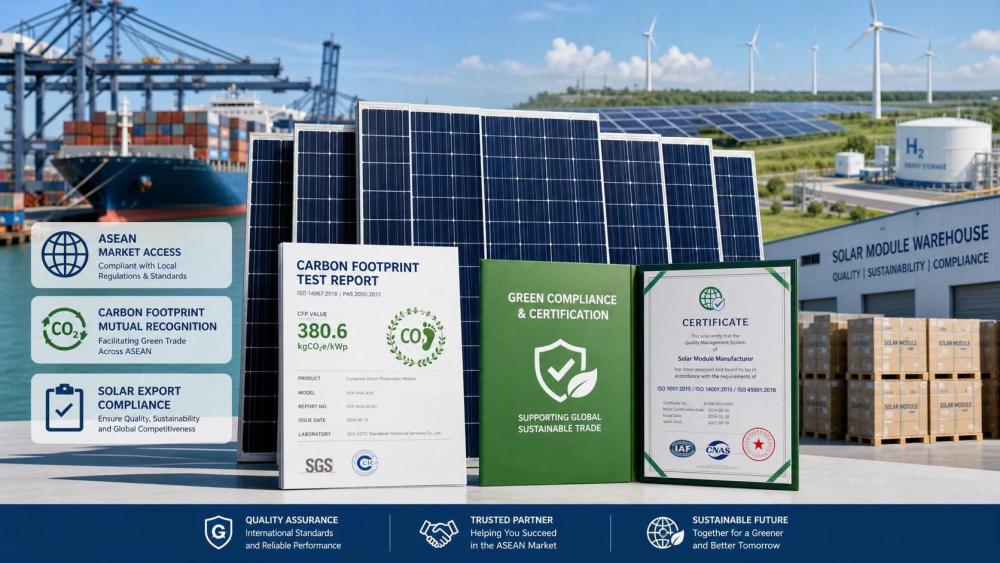
On July 13, 2026, the ASEAN Secretariat together with Indonesia, Vietnam, Thailand, Malaysia, the Philippines, and Singapore introduced the ASEAN photovoltaic module carbon footprint mutual recognition framework, creating a new compliance reference for PV module carbon footprint reporting across government procurement, RE100 verification, and green credit review in the region. For PV exporters, project integrators, procurement teams, and certification-related service providers, the immediate point of attention is that ISO 14067 carbon footprint reports issued by ILAC-MRA recognized laboratories can now serve as a unified basis in these scenarios, which changes how market entry timing, document preparation, and repeated testing costs may be managed.
A new common basis for carbon footprint acceptance
According to the provided event information, the framework was released on July 13, 2026 by the ASEAN Secretariat in coordination with Indonesia, Vietnam, Thailand, Malaysia, the Philippines, and Singapore. From the date of release, ISO 14067 carbon footprint reports issued by laboratories recognized under ILAC-MRA are accepted as a unified basis for government procurement, RE100 certification, and green credit review within the covered regional context.
The confirmed information also indicates that this arrangement reduces repeated testing costs for Chinese PV export companies, shortens market access cycles in ASEAN markets, and is particularly relevant for distributed solar and solar-plus-storage project integrators.
Where the rule change is likely to be felt first
Export documentation is becoming more central to market entry
From an industry perspective, PV export companies are likely to feel the impact first because the change directly affects how carbon footprint evidence is presented during market access and commercial screening. The practical effect is less about product redesign and more about whether the company already holds usable ISO 14067 documentation from an ILAC-MRA recognized laboratory, and whether that documentation can be aligned with procurement and financing requirements in the destination market.
Project procurement and integration workflows may move faster
Distributed solar and solar-plus-storage integrators may be affected because project bidding, qualification review, and financing support often depend on whether supporting compliance documents are accepted without repeated local testing. Analysis shows that a unified acceptance basis can reduce friction in procurement and project preparation, especially where carbon footprint reporting has become part of technical or commercial review. What deserves closer attention is whether procurement files and bid packages begin to reference this recognition mechanism more explicitly.
Certification and testing service providers will need to match the new acceptance path
Certification-related companies and testing service institutions may also see a shift in client demand. The key issue is no longer only producing a carbon footprint report, but producing one that clearly fits the ILAC-MRA recognition condition and can be used in procurement, RE100-related verification, and green credit review. In business terms, document validity, accreditation status, and consistency across submissions may become more important than before.
Procurement and financing reviewers may standardize their screening logic
Buyers, financing reviewers, and related compliance teams may be affected because the framework introduces a common reference point for evaluating carbon footprint evidence. Observably, this can influence supplier qualification review, shortlist decisions, and the pace of document checks. Companies involved in supply and delivery should therefore pay closer attention to whether customer-side document requests, tender wording, and supplier onboarding requirements begin to reflect the new framework.
What companies should check now
Review whether existing reports meet the acceptance condition
Companies serving ASEAN-bound PV business should first verify whether their current carbon footprint reports are based on ISO 14067 and whether the issuing laboratory falls under ILAC-MRA recognition. This is a practical screening step, because the framework points to report acceptability rather than to a broader narrative about sustainability performance.
Track changes in tender files and customer compliance requests
Analysis shows that the next visible stage of implementation may appear in procurement language rather than in broad policy commentary. Exporters, integrators, and channel partners should therefore monitor whether government procurement files, RE100-related review requests, and green credit documentation begin to cite this framework or mirror its document logic.
Prepare for shorter document review cycles, but do not assume uniform execution
The provided information indicates a shorter market access cycle, but it does not supply detailed operating procedures for every use case. Companies should be prepared for faster document review in some projects while continuing to confirm the exact submission format, supporting attachments, and acceptance wording required by counterparties. It is more appropriate to treat the timing benefit as a direction of change rather than a guaranteed outcome in every transaction.
Keep supply chain records aligned with delivery and traceability needs
Where carbon footprint reports become part of procurement or financing review, supporting technical files, shipment documents, and supplier qualification records may face closer comparison. Companies should therefore pay attention to consistency between the carbon footprint report and the product, project, and delivery documentation used in bids, contracts, and after-sales traceability.
Why this looks like an execution signal, not just a policy headline
Observably, this development is more than a general sustainability statement because it defines a recognizable acceptance route for carbon footprint reports in concrete business settings: government procurement, RE100 certification, and green credit review. That gives the announcement practical weight for compliance and trade operations. At the same time, analysis shows it should not yet be treated as a fully uniform operating outcome across all projects and counterparties, because the provided information does not include detailed local procedures, review templates, or enforcement wording.
What deserves closer attention is how quickly the framework appears in actual tender documents, financing reviews, and customer compliance requests. Industry participants should also watch how laboratories, certification support firms, and procurement teams interpret the documentary threshold in day-to-day execution.
How this update is best understood at this stage
At this stage, the framework is best understood as a meaningful rule implementation signal for PV carbon footprint document acceptance in key ASEAN market processes. Its immediate value lies in reducing repeated testing and improving the efficiency of market entry preparation for exporters and project-side participants. The broader commercial effect, however, still depends on how procurement entities, certification workflows, and financing reviewers apply the framework in practice. A rational reading is that the rule direction is clear, while execution detail still warrants continued attention.
Basis of this article and what still needs verification
This article is generated from the user-provided news title, event date, and event summary. For developments of this type, relevant source categories commonly include official announcements, regulator releases, trade or customs authority information, industry association updates, standard-setting documents, and reporting by established media outlets. A specific official source link was not provided in the input, so the exact official publication path still requires follow-up verification.
Further observation is still needed on implementation detail, including any more specific policy wording, certification execution criteria, procurement document changes, market feedback, and how companies apply the framework in actual export, bidding, financing, and delivery processes.