
Public Charging Infrastructure Planning: Site Criteria, Grid Capacity, and Utilization
Effective public charging infrastructure planning requires more than identifying a visible parking area and selecting high-power chargers. For project managers, the hard part is aligning three decisions that are often handled separately: where drivers will genuinely stop, what the local electrical network can deliver, and whether the site can generate sufficient utilization over its operating life. A location may have strong traffic counts but weak dwell time. A retail site may offer ideal amenities but require an expensive transformer upgrade. A highway hub may have demand potential but face a long utility interconnection process that changes the project schedule and capital plan.
Public charging is therefore an infrastructure development exercise, not simply a charger deployment exercise. It combines land and access rights, civil works, electrical design, distribution-grid coordination, digital operations, tariff exposure, user behavior, and future expansion. The most reliable projects treat these elements as one planning model from the earliest feasibility stage.
Start With the Charging Mission, Not the Equipment Rating
The first question is not whether to install AC, DC fast, or ultra-fast charging. It is what role the location will serve in a driver’s journey. Public charging sites generally fall into several overlapping use cases: destination charging at retail, hospitality, healthcare, or leisure facilities; urban top-up charging near workplaces and mixed-use districts; corridor charging for intercity travel; and high-throughput charging for taxis, ride-hailing vehicles, delivery fleets, or public transport. Each produces different arrival patterns, parking durations, energy demand, and tolerance for waiting.
A driver stopping for a meal, appointment, or shopping visit may accept lower charging power if the vehicle can remain parked for a meaningful period. A corridor user usually values predictable charging speed, clear wayfinding, safe access, and nearby services more than the visibility of the charging brand. Fleet-oriented public hubs can need high power, but they also need circulation space, vehicle turning geometry, uptime discipline, and a commercial arrangement that recognizes concentrated demand at certain hours.
This distinction prevents a common mistake: specifying large charger capacity based on anticipated EV growth rather than the actual behavior the site is designed to capture. High power can improve throughput, but it also increases connection requirements, demand-charge exposure where applicable, equipment cost, thermal considerations, and the consequences of underutilization. The appropriate charging mix should be derived from expected dwell time, vehicle mix, charging-window reliability, and the operational objective of the property owner.
Site Selection Is an Access and Experience Problem
Traffic volume alone is a weak proxy for charging demand. A strong site gives drivers a practical reason to enter, park, charge, and leave without friction. This includes road access from both directions where relevant, safe entry and exit, sufficient bay dimensions, intuitive wayfinding, lighting, drainage, and the ability to avoid conflict with loading areas, pedestrian routes, or peak parking demand. A charger that is technically operational but difficult to reach will not perform as planned.
Project teams should look beyond the plot boundary. Nearby competing charging locations, local EV adoption patterns, hotel and retail operating hours, vehicle ownership profiles, taxi or delivery activity, and seasonal travel behavior can materially affect utilization. In an urban location, parking enforcement and access control may matter as much as charger power. At a highway site, drivers will judge the availability of amenities, personal safety, and the confidence that chargers will be available when they arrive.
Lease terms and site control deserve the same attention as civil layout. A charging project often needs a long enough tenure to justify grid works and equipment investment. It may also need rights for trenching, switchgear placement, communications equipment, signage, transformer space, future bays, and maintenance access. If these rights are not defined early, a seemingly scalable site can become constrained after the first construction phase.
The most useful site survey is multidisciplinary. It should combine parking and circulation observations with electrical inspection, land constraints, utility asset proximity, communications availability, flood or drainage conditions, local permitting requirements, and the property’s own expansion plans. A new warehouse, restaurant extension, rooftop solar system, or refrigeration load can alter the power balance that the charging project initially relied upon.
Grid Capacity Must Be Assessed Early and at the Right Level
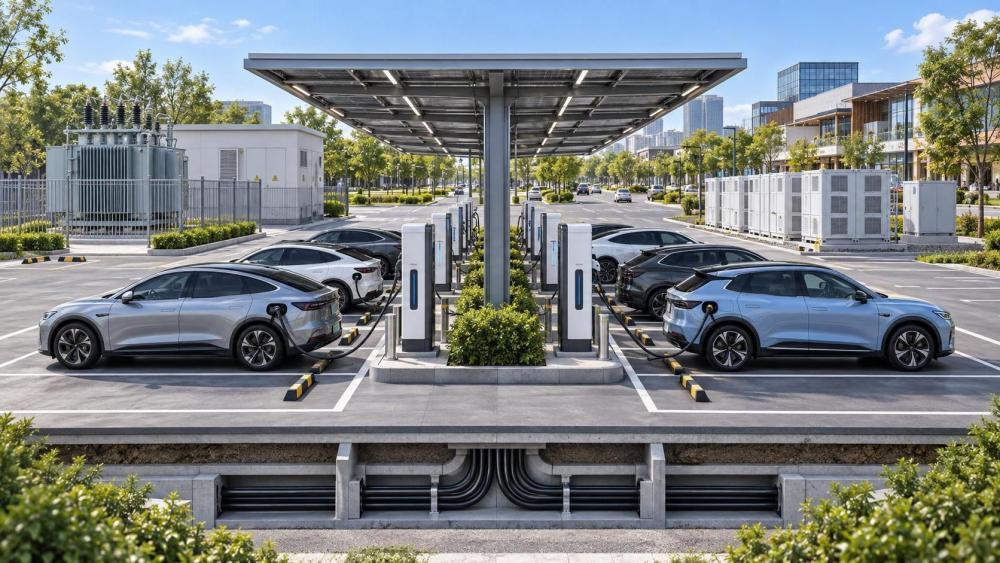
Grid capacity is frequently the critical path for public charging infrastructure. The site may have an existing electrical connection, but that does not mean it can support the proposed charging load. Available capacity depends on the existing service, transformer loading, feeder conditions, local network constraints, fault-level requirements, voltage quality, and the utility’s planned reinforcement work. The answer cannot be inferred from the size of a building’s current meter or from the nominal rating of the nearest distribution transformer.
A practical feasibility review begins with a realistic maximum-demand model. This should distinguish between installed charger nameplate capacity and the coincident load likely to occur under the intended operating strategy. It should also account for existing site demand, future building loads, auxiliary systems, lighting, HVAC requirements for equipment where applicable, and an appropriate allowance for expansion. The model is not an attempt to predict every charging session perfectly. Its purpose is to provide a defensible basis for utility discussion and internal capital decisions.
Smart load management is often central to the business case. Dynamic power allocation can reduce the probability that every outlet draws maximum power at the same time, while protecting the site’s import limit and prioritizing vehicles according to a defined operating rule. However, software does not remove physical grid constraints. If driver expectations are based on advertised high-power charging, the power-sharing strategy must be transparent and designed around actual peak conditions.
Battery energy storage may be relevant where grid reinforcement is slow, constrained, or disproportionately expensive. It can support peak shaving, manage short periods of higher charging demand, and improve flexibility when paired with energy management controls. Yet storage introduces its own design questions: usable energy, power capability, cycling pattern, safety systems, footprint, maintenance, controls integration, and the commercial value of avoiding grid peaks. It should be evaluated as part of the site energy system, not treated as an automatic substitute for a robust connection.
Utilization Is Built Through Reliability and Network Fit
A charger’s utilization is influenced by more than EV market penetration. Drivers need confidence that they can find the site, enter it without difficulty, initiate a session, pay through an accepted method, and obtain a dependable charge. A technically advanced charger with poor payment integration, unclear tariffs, intermittent communications, or recurring maintenance issues can lose demand quickly. In public charging, operational trust is part of location value.
For planning purposes, utilization should be reviewed at several levels: sessions per charger, energy delivered, occupancy duration, peak-hour congestion, failed-session rates, and the effect of power sharing on actual charging speed. These measures tell different stories. High occupancy with modest energy delivery may indicate vehicles staying too long. High energy volume with queues may justify additional capacity. Low utilization may reflect immature local demand, but it can also reveal a poor access route, an uncompetitive tariff, low visibility in charging maps, or a site that does not match the charging mission.
Commercial planning should also avoid assuming that utilization rises evenly over time. Demand may be concentrated on weekends, commuting periods, holiday travel windows, or fleet shift changes. Electricity tariffs and capacity charges, where relevant, can make these same peak periods more costly to serve. A sound operating model therefore connects driver demand forecasting with the electricity procurement approach, charger control settings, and maintenance response plan.
Design for Expansion Without Paying for Everything Up Front
Scalability is often misunderstood as installing the largest possible number of chargers on day one. A more disciplined approach is to build a phased site. Civil works, duct routes, foundations, switchboard space, communications architecture, and parking layout can be prepared for later expansion, while initial charger deployment reflects near-term demand and confirmed grid capacity. This reduces disruption and avoids rebuilding trenches or pavements when the next phase is approved.
Phasing only works if the first-stage design preserves technical options. Equipment rooms need adequate access and clearance. Cable routes must be sized with future conductors in mind. The control platform should support additional chargers and load-management logic. Site drawings should show reserved bays and avoid placing landscaping, bollards, signage, or drainage features where later infrastructure will be needed. These are modest decisions during design but expensive changes after commissioning.
Interoperability also matters. Public sites typically need coordination among chargers, backend software, payment services, utility meters, energy management systems, and sometimes rooftop solar, on-site storage, or building-management controls. Project teams should confirm applicable local technical requirements and interface responsibilities before procurement. A fragmented responsibility matrix is a frequent cause of commissioning delays: the charger may be installed, but metering, communications, payment activation, or utility acceptance remains incomplete.
A Practical Development Sequence
The most effective projects move from a broad opportunity screen to a narrower, evidence-based design. Begin by defining the charging mission and the users the site must serve. Then test access, land control, parking operations, and nearby demand drivers. In parallel, open a utility dialogue early enough to understand connection options, likely studies, dependencies, and indicative timing. Do not wait for final charger selection before raising the grid question.
Once the site concept is viable, develop an electrical single-line concept, maximum-demand assumptions, civil layout, communications plan, and phased deployment strategy together. Review the operating model before construction: pricing logic, payment methods, customer support, monitoring, maintenance obligations, spare parts, fault escalation, and data ownership. These details determine whether the asset remains usable after the EPC handover.
Global EcoPower & Energy Matrix Intelligence Network (EPEM) follows charging infrastructure alongside grid modernization, energy storage, distributed energy, and low-carbon project development because these decisions are increasingly connected. For developers, utilities, EPC teams, and project owners, the useful question is rarely “which charger is best?” It is whether the selected site, grid strategy, operating model, and expansion path work as one investable system.
Before committing capital, confirm the site’s actual connection pathway, demand assumptions, ownership boundaries, and service requirements with the relevant utility, engineering team, and property stakeholders. A charging hub can be expanded later; a poorly chosen access route or an underestimated grid constraint is much harder to correct once the site is built.