
On July 3, 2026, the U.S. Department of Energy issued a notice affecting public EV charging projects funded under the Bipartisan Infrastructure Law, temporarily lowering the review benchmark for a Buy American localization waiver from 55% to 45% through December 31, 2026. For charging equipment manufacturers, exporters, project suppliers, certification-related service providers, and procurement teams, this is worth attention because it changes the near-term compliance threshold tied to market access, sourcing, and delivery planning for eligible projects.
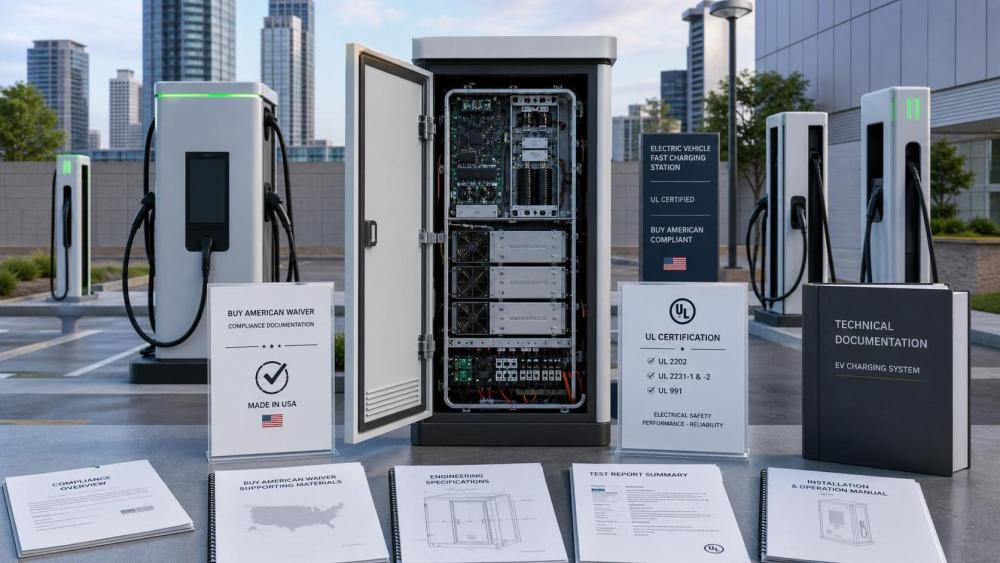
A temporary adjustment in the waiver review benchmark
The confirmed facts are limited and clear. DOE released the notice on July 3, 2026. The notice applies to public EV charging projects supported by the Bipartisan Infrastructure Law. Within that scope, the review benchmark for a Buy American localization waiver was temporarily reduced from 55% domestic content to 45%. The stated validity runs through December 31, 2026. The summary also indicates that the move is intended to ease a current U.S. domestic capacity gap in charging equipment and creates a transitional market-access window for Chinese suppliers of AC/DC charging modules and complete units that comply with UL 2594 and UL 2231.
Where the rule change may be felt first
Suppliers targeting BIL-funded charging projects
From an industry perspective, the most direct impact is on companies supplying equipment into public EV charging projects that fall under the BIL funding framework. The change matters because waiver review is tied to localization requirements, which in turn affect whether a supplier can realistically compete for covered procurement. What deserves closer attention is whether suppliers can demonstrate that their products fit within the revised review threshold while also meeting the relevant technical and certification expectations already referenced in the event summary.
Certification and testing-related participants
For testing bodies, certification support firms, and compliance teams, the practical effect is likely to center on documentation readiness. The event summary specifically points to UL 2594 and UL 2231, so affected businesses should pay attention to whether certification status, test reports, technical files, and product configuration records are aligned with procurement and compliance review needs. The rule change does not remove the need for product conformity; it changes the near-term waiver review benchmark within a defined time window.
Procurement and delivery planning teams
Procurement functions, project integrators, and supply chain service providers may also need to adjust how they assess sourcing and delivery risk. Analysis shows that when a localization benchmark is temporarily lowered, bid preparation, supplier qualification, and delivery sequencing become more sensitive to paperwork, product scope, and timing. In this case, the limited duration through the end of 2026 means procurement decisions may need closer alignment with project schedules and supporting compliance records.
What companies should track during the transition window
Check certification scope against product and project scope
Observably, one immediate task is to confirm whether the relevant AC/DC charging modules or complete chargers are covered by the cited UL standards in a way that matches actual project use. Companies should not assume that a general claim of compliance will be sufficient across all tenders or review scenarios. The practical focus is on keeping test reports, certification statements, technical specifications, and product descriptions consistent.
Watch for official wording and implementation interpretation
It is more appropriate to understand this as a live compliance development rather than a fully settled execution outcome. Businesses should continue monitoring how the notice is referenced in subsequent official language, project documentation, or waiver review practice. The event summary confirms the benchmark change and validity period, but it does not provide full implementation detail, so companies should treat any operational conclusion with caution.
Prepare tender and trade documents more carefully
For exporters, suppliers, and project-facing commercial teams, a practical priority is document discipline. What deserves closer attention is whether product origin descriptions, compliance materials, technical submittals, and bid documents are prepared in a way that reduces mismatch risk during procurement or project review. A temporary window can create opportunity, but it can also increase scrutiny around supporting records.
Keep delivery and after-sales commitments realistic
Analysis shows that a temporary easing in review thresholds may influence order timing and supplier selection, but it does not remove execution risk. Companies should pay attention to delivery scheduling, product traceability, and after-sales support arrangements, especially where project qualification depends on multiple compliance elements being submitted together.
Why this looks more like an execution signal than a settled reset
Observably, this notice can be read as an execution-level signal tied to current supply constraints rather than a final policy destination. The confirmed facts support that reading: the benchmark reduction is temporary, it is linked to a waiver review context, and it expires on December 31, 2026. From an industry perspective, that means the development is relevant now, but it should still be followed alongside later clarification, procurement practice, certification interpretation, and market response.
How this development is best understood now
At this stage, the most balanced reading is that DOE has opened a defined transitional compliance window for certain EV charging equipment used in BIL-funded public projects. The development matters because it can affect sourcing, bidding, certification preparation, and delivery planning, especially for suppliers relying on compliance with UL 2594 and UL 2231. It is more appropriate to understand this as a temporary and actionable rule signal with real commercial implications, while recognizing that the full execution effect still depends on how the market and project documents respond during the remainder of 2026.
Basis of this article and what still needs verification
This article is based on the user-provided news title, event date, and event summary. For developments of this type, commonly relevant source categories may include official agency notices, regulator publications, trade or customs authority information, industry association materials, standards organization documents, and reporting by established professional media. A specific official source link was not provided in the input, so the underlying notice and any related implementation materials still need continued verification. What should continue to be watched includes policy detail, certification interpretation, changes in tender documents, industry feedback, and how companies execute against the temporary review benchmark in practice.