
Floating Solar Projects on Industrial Ponds: How to Assess Site Suitability
An industrial pond can be a candidate for floating solar when its water levels, operating requirements, anchoring conditions, environmental constraints, and electrical connection can support an installation throughout its intended life. A large, open water surface is not enough: a pond that looks available on a site plan may be needed for emergency storage, treatment access, or equipment movements.
For a first suitability decision, establish whether the pond can remain operational with an array in place, then test the likely mooring arrangement and route to a usable electrical connection. Address these constraints before refining capacity or energy-yield estimates; any one of them can substantially change the layout or stop the project.
Start with the pond’s operating envelope
The first question is not how many modules fit on the water, but what the pond is required to do. Industrial ponds may store process water, receive stormwater, support cooling, hold treated effluent, or form part of a containment system. Their operating priorities differ, and those priorities determine which areas must remain clear.
Obtain operating records and speak with the teams responsible for the pond. Identify normal and exceptional water levels, filling and drawdown rates, overflow routes, and any planned changes in water demand. A pond with a stable average level may still experience rapid changes during a storm, a production upset, or a maintenance shutdown. The floating system and mooring lines must accommodate the full credible range, not just the level observed during a site visit.
Map the infrastructure that cannot be obstructed: inlets, outlets, pumps, aerators, sampling points, access ramps, spillways, and emergency-response routes. Ask whether boats, dredging equipment, or temporary barriers need to cross the water. An array that prevents access to a failed pump can create an operating risk greater than the value of the electricity it produces.
Where water quality is integral to a process, establish whether partial surface coverage could affect oxygen transfer, temperature, treatment performance, or inspection practices. The effect depends on the pond and its equipment; it should be assessed against operating requirements rather than assumed to be beneficial or harmless.
Turn the water surface into a usable layout
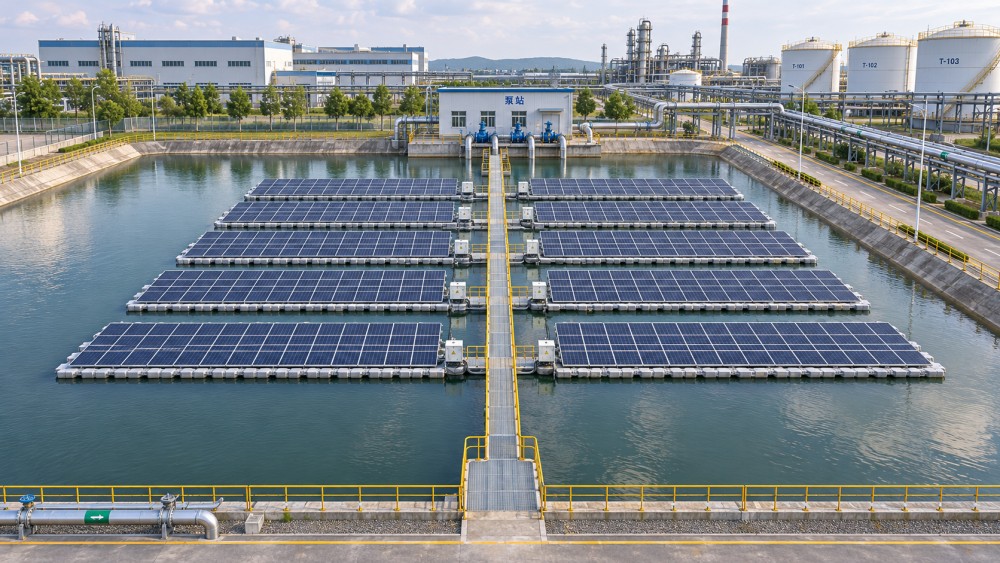
Use an up-to-date survey to distinguish total pond area from the area that can actually host equipment. Mark fluctuating shorelines, steep or inaccessible banks, exclusion zones, shaded areas, and spaces needed for operations. Include the movement envelope of the array and mooring lines as water levels change. A layout drawn at only one water elevation can overstate usable space.
Consider several arrangements rather than filling every available area. A smaller array with clear maintenance corridors may be more practical than a tightly packed layout that complicates cleaning, recovery, or pond work. Separating the array into sections can improve access in some configurations, but it can also add mooring and electrical complexity. Compare the options with the pond operator before fixing a capacity target.
Check nearby structures and equipment for shading at relevant times of day and seasons. Tanks, stacks, buildings, pipe racks, and perimeter vegetation can affect both the position of the array and cable routes. Account for future plant works where reliable plans exist; an installation should not assume that an active industrial site will remain unchanged.
Read the water and pond lining together
Water depth and bottom conditions influence how the system can be anchored and maintained. Collect bathymetric information at a resolution appropriate to the pond, including submerged structures and slopes. A shallow margin may leave floats or cables grounded during drawdown; deeper areas may increase mooring complexity. Sediment accumulation and dredging plans also matter because the pond profile can change over the project life.
Determine whether the pond is lined and obtain available construction details. Penetrating or loading a liner may compromise containment, so an anchor concept must be compatible with its design and the site’s integrity requirements. Do not assume that an apparently solid bank can accept anchors: embankments, buried services, and liner terminations may restrict both anchor locations and construction access.
Test whether mooring is feasible before selecting a system
Mooring keeps the array within its permitted area while allowing for water-level movement. The concept may use shore-based anchors, bottom anchors, or a combination, depending on the site. Each option transfers loads into a different part of the pond or surrounding ground and brings different installation and maintenance demands.
- Shore anchoring: Check available land, bank stability, buried utilities, access rights, and the effect of line angles at high and low water. Long lines may cross routes needed by vehicles or personnel.
- Bottom anchoring: Verify depth, sediment and substrate conditions, liner restrictions, submerged assets, and the feasibility of installation without disrupting the pond’s function.
- Combined arrangements: Assess whether dividing loads between anchor types improves the layout without making inspection, access, or emergency recovery unmanageable.
A preliminary design should consider wind, waves, currents, water-level variation, and locally relevant extreme conditions. Pond geometry can focus wind or produce different exposure across the surface. Where ice, debris, or floating process material is credible, include it in the design basis rather than treating it as an operational issue to solve later.
Request a documented load path from the floating structure through the connectors, lines, anchors, and supporting ground. The design must also consider movement and fatigue over time. At screening stage, the goal is not to finalize every component; it is to establish whether a credible concept exists without unacceptable interference with the pond or its containment system.
Check compatibility with the industrial environment
Industrial water is not necessarily chemically compatible with floating PV materials. Obtain representative information about water composition and expected variation, including substances associated with the process, cleaning, or abnormal operation. Also consider vapors, airborne deposits, and the potential for oily films or solids to collect on equipment.
Use that information to assess floats, fasteners, cable jackets, connectors, and other exposed components. A material suitable for freshwater service is not automatically suitable for every process pond. Ask equipment suppliers for evidence relevant to the actual exposure and identify any assumptions about temperature, concentration, and contact. Where information is missing, agree on further investigation before treating compatibility as resolved.
Contamination can affect construction and maintenance as well as equipment life. Define whether workers or equipment may contact the water, what protective measures apply, and how a damaged component would be retrieved. For hazardous or regulated contents, an array may create an unacceptable intervention burden even if the floating structure itself is technically feasible.
Follow the electrical route beyond the shoreline
A nearby building does not guarantee an economical or permissible connection. Trace the proposed route from the array to the point of interconnection, including the transition from moving floats to fixed land-based equipment. The route must accommodate water-level movement without excessive cable strain or abrasion, while keeping cables clear of operational equipment and maintenance traffic.
Onshore, identify a suitable location for inverters, protection equipment, transformers if needed, and monitoring. Check flood exposure, access for maintenance, ground conditions, and separation from incompatible industrial hazards. Existing switchgear capacity, protection settings, and the facility’s load profile may constrain the size or configuration of the plant.
For behind-the-meter use, compare expected generation timing with site demand and operating schedules. Where export is possible or required, confirm the applicable connection process and any export restrictions with the relevant network operator. A preliminary electrical assessment should identify studies, equipment upgrades, outages, and approvals that could affect the schedule or business case.
Electrical safety requirements also need to reflect the water environment. Develop the concepts for earthing and bonding, protection, isolation, cable management, and emergency response with qualified electrical designers and the site’s safety team. The appropriate measures depend on the system design and applicable local requirements.
Resolve permissions and operating responsibilities early
Pond ownership is only the starting point. Confirm who controls the water body, banks, access routes, and connection assets, and whether existing leases or operating agreements allow the proposed use. A project can be delayed if the pond operator, landholder, electricity user, and asset owner have different priorities or approval authority.
Identify the environmental and permitting reviews applicable to the pond and its use. Depending on the jurisdiction and site, these may cover water quality, drainage, biodiversity, construction activity, electrical works, or modifications to industrial operations. Establish the required evidence and consultation process with the relevant authorities; do not assume that an existing industrial pond is exempt from review.
Agree on responsibilities for inspection, vegetation control, water-quality monitoring where required, cleaning, repairs, and removal. Clarify who can stop work when pond operations change and how access will be restored during an emergency. These arrangements should be reflected in the operating plan and commercial agreements, not left as informal assumptions.
Make a staged decision, not a capacity-first commitment
Record findings in a site-specific risk register with an owner, evidence source, and next action for each unresolved issue. A practical screening sequence is:
- Exclude incompatible areas. Map essential pond functions, restricted water zones, access routes, and known electrical or environmental constraints.
- Develop a preliminary layout. Use surveyed water levels and available pond geometry to estimate usable area, allowing for array movement and maintenance access.
- Test anchor and electrical concepts. Identify plausible load paths, construction methods, cable routes, and an interconnection point. Flag assumptions that require surveys or studies.
- Review lifecycle access. Check how the array will be installed, inspected, repaired, and eventually removed while the pond remains safe and functional.
- Update the business case. Include site-specific investigations, pond modifications, connection works, operational restrictions, and reasonable contingency alongside expected generation.
A site can proceed to detailed feasibility when there is a credible layout, a workable mooring concept, an identifiable electrical route, and a path to the necessary approvals. Proceed conditionally when key facts—such as liner details, water chemistry, or connection capacity—remain unknown but can be established through defined investigations.
Reconsider the site when essential pond operations cannot coexist with the array, containment integrity cannot be protected, anchor loads cannot be accommodated, or the connection and access works undermine the project’s purpose. In those cases, reducing coverage, relocating the array, or evaluating another site may be more useful than refining a design built on an unresolved constraint.
Questions about market trends? Contact Market Scope Live for deeper business insights.
We respect your privacy. Your information is strictly confidential.
Related News
 Solar PV SystemsFloating Solar Systems: How to Assess Reservoir SuitabilityFloating solar systems need the right reservoir. Discover how to assess water levels, grid access, environmental risks, and costs before investing.MORE+
 Solar PV SystemsSmart Solar Tracking Systems: How to Evaluate Energy Gains and Site SuitabilityExplore how smart solar tracking systems can boost energy yield. Compare site suitability, lifecycle costs, and fixed-tilt alternatives to make a confident investment decision.MORE+
 Solar PV SystemsFloating Solar Projects on Industrial Ponds: How to Assess Site SuitabilityAssess floating solar projects on industrial ponds with a practical guide to water levels, mooring, electrical connections, and site risks.MORE+
 Solar PV SystemsTurkey Allocates 785 MW of Grid Capacity in YEKA Solar TenderTurkey's YEKA solar tender allocates 785 MW of grid capacity across 11 sites. Explore what the results could mean for developers and suppliers.MORE+
 Solar PV SystemsChoosing String Inverters for Solar PV: Sizing, MPPT and ShadingChoose string inverters with confidence. Compare DC-to-AC sizing, MPPT allocation and shading impacts to improve solar PV performance.MORE+
 Solar PV SystemsChoosing Solar Racking Systems for Rooftops: Roof Type and Load FactorsChoosing solar racking systems for rooftops? Compare roof types, load factors and mounting options to plan a safer, more reliable installation.MORE+
 Solar PV SystemsSolar Tracking System Pricing: What to Include in a Project BudgetUnderstand solar tracking systems pricing and build a reliable project budget. Compare supplier quotes, uncover hidden costs, and assess long-term value.MORE+
 Solar PV SystemsChina Adds 110.83 GW of Solar in First Nine Months of 2026, Down 53.9%China solar additions reportedly fell 53.9% to 110.83 GW in January–September 2026. Explore pricing reform impacts and practical insights for project planning and procurement.MORE+
 Solar PV SystemsHow to Vet Solar Equipment Manufacturers: Quality, Warranties, and Lead TimesSearching “renewable equipment manufacturers solar”? Learn how to verify quality, compare warranties, and validate lead times to shortlist reliable suppliers and reduce project risk.MORE+
 Solar PV SystemsCommercial Rooftop Solar in India: How to Calculate Costs and PaybackCommercial rooftop solar India guide: calculate installation costs, estimate realistic savings and payback, and compare EPC quotes to make a smarter business investment.MORE+
 Solar PV SystemsSolar EPC Contractor Pricing: How to Compare Quotes and Spot ExclusionsCompare solar EPC contractor pricing with confidence. Learn how to spot exclusions, assess allowances, and uncover hidden costs before choosing the right quote for your project.MORE+
 Solar PV SystemsHow to Assess Site and Grid Feasibility for Solar Power Generation ProjectsAssess solar power generation projects with practical guidance on site suitability, grid capacity, connection costs, and curtailment risks. Make smarter investment decisions before committing capital.MORE+
 Solar PV SystemsPepco Approves ConnectDER Meter Adapters for Solar, Storage and EV Charging in D.C.Pepco approves ConnectDER meter adapters in D.C. for solar, storage and EV charging. Discover how meter-level connections could simplify installation and reduce costs.MORE+
 Solar PV SystemsTOPCon Photovoltaic Modules: Selection Criteria for High-Temperature Utility ProjectsTOPCon photovoltaic modules for hot-climate utility projects: compare temperature performance, bifacial yield, reliability, and electrical compatibility for stronger lifetime returns.MORE+
 Solar PV SystemsHow to Verify PV Module Supplier Capability Before Utility-Scale ProcurementVerify PV module supplier capability before utility-scale procurement with a practical checklist for factory audits, certifications, traceability, capacity, warranties, and risk control.MORE+
 Solar PV SystemsHow to Size Solar Power Generation Systems for Commercial Sites and Peak LoadsSolar power generation systems for commercial sites: learn to size PV for load profiles, peak demand, grid limits, storage, and future growth.MORE+
 Solar PV SystemsSolar Farm Construction: How to Plan Site, Grid Access, and Build RiskSolar farm construction insights for smarter site planning, grid access, procurement, and build-risk control—helping projects reach energization with confidence.MORE+
 Solar PV SystemsWhich Solar Inverter Certifications Are Mandatory in North America?What certifications are mandatory for solar inverters in North American markets? Explore UL 1741, IEEE 1547, CSA rules, and utility approval essentials.MORE+
 Solar PV SystemsWhat Is the Typical Payback Period for Commercial Solar PV in 2026?What is the typical payback period for a commercial solar PV installation in 2026? Explore the key cost, tariff, incentive, and sizing factors that shape returns.MORE+
 Solar PV SystemsWhat Causes Voltage Fluctuations When Large PV Plants Connect to Weak Grids?What causes voltage fluctuation when large solar PV plants connect to weak grids? Explore root causes, diagnostics, and proven mitigation strategies.MORE+
 Solar PV SystemsWhat Determines Solar Power Generation Efficiency in Commercial PV Projects?Solar power generation efficiency in commercial PV projects depends on more than module ratings—explore site resource, design, grid, and O&M factors that maximize long-term energy yield.MORE+
 Solar PV SystemsCommercial Rooftop Solar Financing: Comparing Loans, Leases, and PPAsCommercial rooftop solar financing explained: compare loans, leases, and PPAs to choose the right balance of savings, ownership, flexibility, and risk.MORE+
 Solar PV SystemsPV Bid Evaluation: How to Compare EPC Proposals Beyond the Lowest PricePV bid evaluation helps procurement teams compare EPC proposals beyond price—assess scope, energy yield, schedule, supply chain, warranties, and contract risk to protect long-term solar asset value.MORE+
 Solar PV SystemsWhat Environmental Permits Are Needed for Floating Solar on Reservoirs?What environmental permits are needed for floating solar on reservoirs? Explore water-use, EIA, shoreline, biodiversity, and water-quality approvals for smarter FPV development.MORE+
 Solar PV SystemsHow Long Does Utility-Scale Solar Grid Approval Take in 2026?How long does utility scale solar grid approval typically take in 2026? Explore timelines, queue risks, upgrade costs, and strategies to accelerate project delivery.MORE+
 Solar PV SystemsDo Agrivoltaic Projects Significantly Reduce Crop Yields in Hot Climates?Do agrivoltaic projects reduce crop yield significantly in hot climates? Explore how smart shade, crop selection, irrigation, and solar design can protect yields, improve quality, and strengthen dual-use land value.MORE+
 Solar PV SystemsHow Predictive Solar Plant O&M Reduces Downtime and Protects Energy YieldPredictive solar plant O&M helps cut downtime, detect faults early, prioritize repairs, and protect long-term energy yield with actionable data insights.MORE+
 Solar PV SystemsWhat Grid Connection Requirements Apply to Solar-Powered EV Charging?Solar farm grid connection requirements for EV charging explained: explore import/export limits, protection, storage, grid codes, and smart design strategies.MORE+
 Solar PV SystemsHow Much Solar Farm Capacity Is Needed to Offset Charging Demand in 2026?How to plan solar farm capacity to offset charging station demand in 2026? Explore sizing formulas, grid limits, storage strategies, and scalable EV charging solutions.MORE+
 Solar PV SystemsWhat Are the Actual Maintenance Costs of Solar Canopy Inverters?What are the real maintenance costs of solar inverters on charging canopies? Explore service, monitoring, repairs, downtime, and smarter lifecycle budgeting.MORE+
 Solar PV SystemsWhat Should Building Owners Evaluate Before Installing Rooftop Solar Photovoltaic?Rooftop solar photovoltaic planning starts with the right questions. Learn how to assess roof strength, load profile, grid limits, permits, and ROI before investing.MORE+
 Solar PV SystemsChina’s First Compute-Power and Green Power Direct Supply Project Enters OperationChina’s first compute-power and green power direct supply project begins operation, linking 500 MW solar power with data center demand for higher efficiency and stronger green energy credibility.MORE+
 Solar PV SystemsWhat Should Be Included in Solar Plant Engineering Design for Utility-Scale Projects?Solar plant engineering design for utility-scale projects should cover site constraints, layout, electrical systems, grid compliance, safety, and O&M—see what a complete, bankable design package must include.MORE+
 Solar PV SystemsUSTR Opens CVD Review on Chinese PV ModulesUSTR opens a CVD review on Chinese PV modules, raising questions over tariffs, sourcing, and Southeast Asia supply chains. See what importers and developers should watch now.MORE+
 Solar PV SystemsHow to Evaluate Rooftop Solar EPC Contractors for Commercial PV ProjectsRooftop solar EPC contractors can make or break commercial PV success. Learn how to compare engineering, grid, safety, scope, and risk control before choosing the right partner.MORE+
 Solar PV SystemsFixed Tilt Solar Racking: How to Evaluate Wind Load, Site Layout, and ROIFixed tilt solar racking guide: learn how to assess wind load, site layout, grading, foundations, and ROI to avoid hidden costs and choose a smarter solar structure.MORE+
 Solar PV SystemsHow to Choose Solar Modules for Commercial and Industrial PV Projects?Solar modules for C&I PV projects: learn how to compare efficiency, temperature performance, site suitability, warranty, and bankability to choose the right solution with confidence.MORE+
 Solar PV SystemsUSTR Extends Tariff Relief for Chinese PV ModulesUSTR Extends Tariff Relief for Chinese PV Modules through Dec. 31, 2026. See how the update affects solar procurement costs, project timelines, compliance, and U.S. market planning.MORE+
 Solar PV SystemsHow to Evaluate Solar PV Equipment in USA for Commercial and Utility ProjectsSolar PV equipment in USA evaluation for commercial and utility projects: learn how to compare performance, compliance, reliability, and supplier strength for smarter project decisions.MORE+
 Solar PV SystemsFixed Tilt Solar Mounting Structures: How to Choose Materials, Wind Load, and LayoutFixed tilt solar mounting structures guide: learn how to choose the right materials, assess wind load, and optimize layout for stronger performance, lower risk, and better long-term solar returns.MORE+


