EN 50549-1:2026 Takes Effect in EU Grid Certification Shift
As of October 1, 2026, the EU has moved the grid-connection compliance baseline for new photovoltaic inverters to EN 50549-1:2026, making this a practical issue for inverter manufacturers, exporters, certification teams, distributors, and project-side buyers working with the European market. The change matters because it is no longer only a standards update on paper: it now directly affects whether new products can enter the EU market, while inventory already in stock is subject to a separate sell-through deadline.
What Has Officially Changed
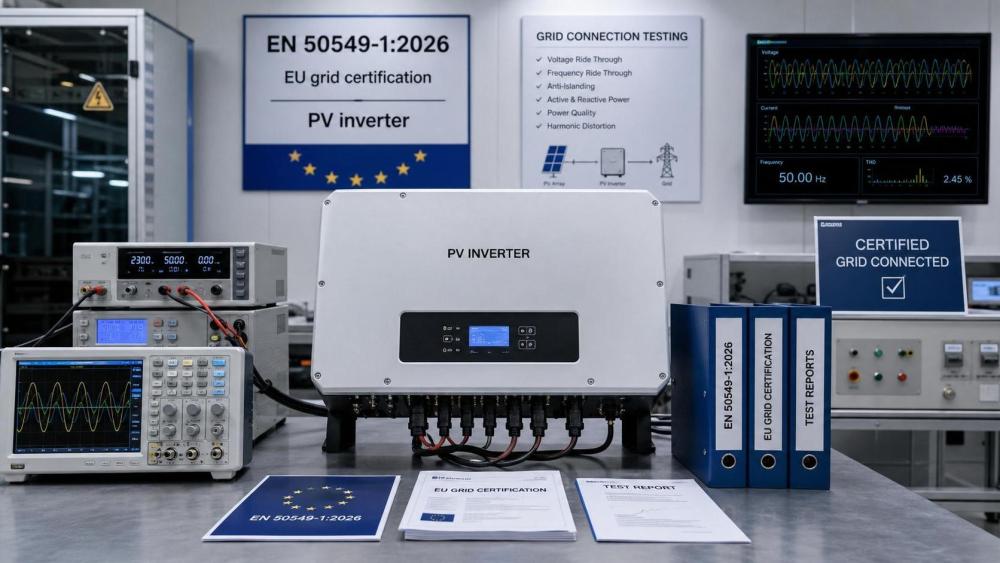
According to the information provided, CEN/CENELEC issued EN 50549-1:2026 on July 10, 2026 as a replacement for the previous version. The revised standard adds 12 key technical requirements, including dynamic reactive power response through the Q(U) curve, low-voltage ride-through (LVRT) with a duration of at least 300 ms, and tolerance to grid frequency disturbances.
From October 1, 2026, all new photovoltaic inverter models sold into the EU must pass certification under the new version. Existing inventory can continue to be sold until March 31, 2027. Chinese inverter exporters are also required to update test reports issued by certification bodies such as TÜV Rheinland and DEKRA.
Where the Immediate Pressure Will Be Felt
For manufacturers preparing new EU-bound models
From an industry perspective, the most immediate effect falls on product manufacturers launching new inverter models for the EU. The reason is straightforward: market access for new products is now tied to compliance with the revised certification basis. The main impact is likely to appear in product validation, certification scheduling, technical documentation, and launch timing.
For exporters and direct trade businesses
Direct trade companies may be affected because the certification status of each model now has a clearer commercial consequence. What deserves closer attention is whether product batches being offered to EU customers are classified as new models subject to the new rule, or existing inventory still within the permitted sales window. This can affect quotation validity, shipment planning, and customer-side compliance confirmation.
For distributors and channel operators handling stock
Distributors and channel businesses may need to focus on the March 31, 2027 deadline for existing inventory. Analysis shows that the issue here is less about abstract regulatory interpretation and more about practical stock management: which products can still be sold under the transition arrangement, and how long channel inventory remains commercially usable in the EU market.
For certification and testing coordination teams
Service providers and internal compliance teams involved in testing and certification may face additional workload because test reports from bodies such as TÜV Rheinland and DEKRA must be updated for affected Chinese exporters. The main business impact is likely to center on report renewal, submission timing, and coordination between engineering, regulatory, and commercial functions.
What Companies Should Track Now
Separate technical revision from sales eligibility
Companies should distinguish between the technical content of EN 50549-1:2026 and the commercial deadlines now in effect. The confirmed facts point to two different clocks: new models must meet the revised standard from October 1, 2026, while existing inventory retains a limited sales window until March 31, 2027.
Review whether current reports remain usable
For Chinese inverter exporters in particular, a practical priority is to review whether current TÜV Rheinland, DEKRA, or related test reports align with the revised standard. This is not just a documentation issue; it can affect order acceptance, customer review, and delivery preparation where updated certification evidence is requested.
Check model classification and shipment timing
Observably, one of the more sensitive operational points is how companies classify products in pipeline. Businesses should pay close attention to whether a unit is being marketed as a new model for EU sale or handled as existing inventory within the transition period, because that distinction can change the certification path and the supporting documents needed in transactions.
Prepare for tighter customer communication
What deserves closer attention is customer-facing communication around compliance status. Buyers, importers, and channel partners may ask for clearer proof that products meet the applicable version of the standard or qualify for transitional sale. In practice, that makes document readiness and timeline clarity more important in ongoing business discussions.
How This Should Be Read at This Stage
Analysis shows that this development should be understood first as an already effective compliance change, not merely as an early policy signal. The October 1, 2026 effective date means the rule has moved into execution for new products. At the same time, it is more appropriate to understand the inventory sell-through period until March 31, 2027 as a transitional buffer rather than a sign that the compliance shift can be deferred indefinitely.
From an industry perspective, the more lasting signal lies in the nature of the revised requirements themselves. Even without extending beyond the confirmed facts, the addition of new metrics covering dynamic reactive power response, LVRT duration, and grid frequency disturbance tolerance indicates that grid-connection certification is becoming more demanding in technical terms. That does not by itself prove a broader market outcome, but it does justify continued attention from companies with EU exposure.
What the Update Means in Practical Terms
In practical terms, this is best read as a standards-driven market access change with a defined transition window, rather than as a routine administrative update. The confirmed information points to immediate relevance for new product launches, a limited adjustment period for existing stock, and a documentation update requirement for Chinese exporters working through recognized certification bodies.
A neutral reading is that the impact is already concrete for compliance and shipment planning, while some business consequences still depend on how companies manage certification timing, inventory treatment, and customer communication in the months around the transition period.
Basis of This Article
This article is based on the user-provided news title, event date, and event summary concerning the entry into force of EN 50549-1:2026 for photovoltaic inverter grid-connection certification in the EU. For this type of industry update, commonly relevant source categories include official notices, standardization body documents, certification body materials, company disclosures, industry association information, and reporting from authoritative trade media.
No specific official source link was provided in the input, so the underlying documents and any later interpretive updates still require ongoing verification. Follow-up attention should remain on any further official wording, certification implementation details, and market-side clarification affecting new models, existing inventory, and updated test report requirements.
Questions about market trends? Contact Market Scope Live for deeper business insights.
We respect your privacy. Your information is strictly confidential.
Related News
 Solar PV SystemsSolar Mounting Structures Pricing: What Drives Costs for PV Projects?Solar mounting structures pricing depends on design, materials and site conditions. Learn how to compare bids, uncover hidden costs and make smarter PV project decisions.MORE+
 Solar PV SystemsIndustrial Parks in Vietnam: Comparing Locations, Costs and InfrastructureCompare industrial parks in Vietnam by location, costs, logistics and power infrastructure. Discover how to shortlist the right site for your business.MORE+
 Solar PV SystemsFloating Solar Systems: How to Assess Reservoir SuitabilityFloating solar systems need the right reservoir. Discover how to assess water levels, grid access, environmental risks, and costs before investing.MORE+
 Solar PV SystemsSmart Solar Tracking Systems: How to Evaluate Energy Gains and Site SuitabilityExplore how smart solar tracking systems can boost energy yield. Compare site suitability, lifecycle costs, and fixed-tilt alternatives to make a confident investment decision.MORE+
 Solar PV SystemsFloating Solar Projects on Industrial Ponds: How to Assess Site SuitabilityAssess floating solar projects on industrial ponds with a practical guide to water levels, mooring, electrical connections, and site risks.MORE+
 Solar PV SystemsTurkey Allocates 785 MW of Grid Capacity in YEKA Solar TenderTurkey's YEKA solar tender allocates 785 MW of grid capacity across 11 sites. Explore what the results could mean for developers and suppliers.MORE+
 Solar PV SystemsChoosing String Inverters for Solar PV: Sizing, MPPT and ShadingChoose string inverters with confidence. Compare DC-to-AC sizing, MPPT allocation and shading impacts to improve solar PV performance.MORE+
 Solar PV SystemsChoosing Solar Racking Systems for Rooftops: Roof Type and Load FactorsChoosing solar racking systems for rooftops? Compare roof types, load factors and mounting options to plan a safer, more reliable installation.MORE+
 Solar PV SystemsSolar Tracking System Pricing: What to Include in a Project BudgetUnderstand solar tracking systems pricing and build a reliable project budget. Compare supplier quotes, uncover hidden costs, and assess long-term value.MORE+
 Solar PV SystemsChina Adds 110.83 GW of Solar in First Nine Months of 2026, Down 53.9%China solar additions reportedly fell 53.9% to 110.83 GW in January–September 2026. Explore pricing reform impacts and practical insights for project planning and procurement.MORE+
 Solar PV SystemsHow to Vet Solar Equipment Manufacturers: Quality, Warranties, and Lead TimesSearching “renewable equipment manufacturers solar”? Learn how to verify quality, compare warranties, and validate lead times to shortlist reliable suppliers and reduce project risk.MORE+
 Solar PV SystemsCommercial Rooftop Solar in India: How to Calculate Costs and PaybackCommercial rooftop solar India guide: calculate installation costs, estimate realistic savings and payback, and compare EPC quotes to make a smarter business investment.MORE+
 Solar PV SystemsSolar EPC Contractor Pricing: How to Compare Quotes and Spot ExclusionsCompare solar EPC contractor pricing with confidence. Learn how to spot exclusions, assess allowances, and uncover hidden costs before choosing the right quote for your project.MORE+
 Solar PV SystemsHow to Assess Site and Grid Feasibility for Solar Power Generation ProjectsAssess solar power generation projects with practical guidance on site suitability, grid capacity, connection costs, and curtailment risks. Make smarter investment decisions before committing capital.MORE+
 Solar PV SystemsPepco Approves ConnectDER Meter Adapters for Solar, Storage and EV Charging in D.C.Pepco approves ConnectDER meter adapters in D.C. for solar, storage and EV charging. Discover how meter-level connections could simplify installation and reduce costs.MORE+
 Solar PV SystemsTOPCon Photovoltaic Modules: Selection Criteria for High-Temperature Utility ProjectsTOPCon photovoltaic modules for hot-climate utility projects: compare temperature performance, bifacial yield, reliability, and electrical compatibility for stronger lifetime returns.MORE+
 Solar PV SystemsHow to Verify PV Module Supplier Capability Before Utility-Scale ProcurementVerify PV module supplier capability before utility-scale procurement with a practical checklist for factory audits, certifications, traceability, capacity, warranties, and risk control.MORE+
 Solar PV SystemsHow to Size Solar Power Generation Systems for Commercial Sites and Peak LoadsSolar power generation systems for commercial sites: learn to size PV for load profiles, peak demand, grid limits, storage, and future growth.MORE+
 Solar PV SystemsSolar Farm Construction: How to Plan Site, Grid Access, and Build RiskSolar farm construction insights for smarter site planning, grid access, procurement, and build-risk control—helping projects reach energization with confidence.MORE+
 Solar PV SystemsWhich Solar Inverter Certifications Are Mandatory in North America?What certifications are mandatory for solar inverters in North American markets? Explore UL 1741, IEEE 1547, CSA rules, and utility approval essentials.MORE+
 Solar PV SystemsWhat Is the Typical Payback Period for Commercial Solar PV in 2026?What is the typical payback period for a commercial solar PV installation in 2026? Explore the key cost, tariff, incentive, and sizing factors that shape returns.MORE+
 Solar PV SystemsWhat Causes Voltage Fluctuations When Large PV Plants Connect to Weak Grids?What causes voltage fluctuation when large solar PV plants connect to weak grids? Explore root causes, diagnostics, and proven mitigation strategies.MORE+
 Solar PV SystemsWhat Determines Solar Power Generation Efficiency in Commercial PV Projects?Solar power generation efficiency in commercial PV projects depends on more than module ratings—explore site resource, design, grid, and O&M factors that maximize long-term energy yield.MORE+
 Solar PV SystemsCommercial Rooftop Solar Financing: Comparing Loans, Leases, and PPAsCommercial rooftop solar financing explained: compare loans, leases, and PPAs to choose the right balance of savings, ownership, flexibility, and risk.MORE+
 Solar PV SystemsPV Bid Evaluation: How to Compare EPC Proposals Beyond the Lowest PricePV bid evaluation helps procurement teams compare EPC proposals beyond price—assess scope, energy yield, schedule, supply chain, warranties, and contract risk to protect long-term solar asset value.MORE+
 Solar PV SystemsWhat Environmental Permits Are Needed for Floating Solar on Reservoirs?What environmental permits are needed for floating solar on reservoirs? Explore water-use, EIA, shoreline, biodiversity, and water-quality approvals for smarter FPV development.MORE+
 Solar PV SystemsHow Long Does Utility-Scale Solar Grid Approval Take in 2026?How long does utility scale solar grid approval typically take in 2026? Explore timelines, queue risks, upgrade costs, and strategies to accelerate project delivery.MORE+
 Solar PV SystemsDo Agrivoltaic Projects Significantly Reduce Crop Yields in Hot Climates?Do agrivoltaic projects reduce crop yield significantly in hot climates? Explore how smart shade, crop selection, irrigation, and solar design can protect yields, improve quality, and strengthen dual-use land value.MORE+
 Solar PV SystemsHow Predictive Solar Plant O&M Reduces Downtime and Protects Energy YieldPredictive solar plant O&M helps cut downtime, detect faults early, prioritize repairs, and protect long-term energy yield with actionable data insights.MORE+
 Solar PV SystemsWhat Grid Connection Requirements Apply to Solar-Powered EV Charging?Solar farm grid connection requirements for EV charging explained: explore import/export limits, protection, storage, grid codes, and smart design strategies.MORE+
 Solar PV SystemsHow Much Solar Farm Capacity Is Needed to Offset Charging Demand in 2026?How to plan solar farm capacity to offset charging station demand in 2026? Explore sizing formulas, grid limits, storage strategies, and scalable EV charging solutions.MORE+
 Solar PV SystemsWhat Are the Actual Maintenance Costs of Solar Canopy Inverters?What are the real maintenance costs of solar inverters on charging canopies? Explore service, monitoring, repairs, downtime, and smarter lifecycle budgeting.MORE+
 Solar PV SystemsWhat Should Building Owners Evaluate Before Installing Rooftop Solar Photovoltaic?Rooftop solar photovoltaic planning starts with the right questions. Learn how to assess roof strength, load profile, grid limits, permits, and ROI before investing.MORE+
 Solar PV SystemsChina’s First Compute-Power and Green Power Direct Supply Project Enters OperationChina’s first compute-power and green power direct supply project begins operation, linking 500 MW solar power with data center demand for higher efficiency and stronger green energy credibility.MORE+
 Solar PV SystemsWhat Should Be Included in Solar Plant Engineering Design for Utility-Scale Projects?Solar plant engineering design for utility-scale projects should cover site constraints, layout, electrical systems, grid compliance, safety, and O&M—see what a complete, bankable design package must include.MORE+
 Solar PV SystemsUSTR Opens CVD Review on Chinese PV ModulesUSTR opens a CVD review on Chinese PV modules, raising questions over tariffs, sourcing, and Southeast Asia supply chains. See what importers and developers should watch now.MORE+
 Solar PV SystemsHow to Evaluate Rooftop Solar EPC Contractors for Commercial PV ProjectsRooftop solar EPC contractors can make or break commercial PV success. Learn how to compare engineering, grid, safety, scope, and risk control before choosing the right partner.MORE+
 Solar PV SystemsFixed Tilt Solar Racking: How to Evaluate Wind Load, Site Layout, and ROIFixed tilt solar racking guide: learn how to assess wind load, site layout, grading, foundations, and ROI to avoid hidden costs and choose a smarter solar structure.MORE+
 Solar PV SystemsHow to Choose Solar Modules for Commercial and Industrial PV Projects?Solar modules for C&I PV projects: learn how to compare efficiency, temperature performance, site suitability, warranty, and bankability to choose the right solution with confidence.MORE+
 Solar PV SystemsUSTR Extends Tariff Relief for Chinese PV ModulesUSTR Extends Tariff Relief for Chinese PV Modules through Dec. 31, 2026. See how the update affects solar procurement costs, project timelines, compliance, and U.S. market planning.MORE+