
What Infrastructure Do Utility-Scale Renewables Need for Grid Connection?
What Infrastructure Do Utility-Scale Renewables Need for Grid Connection?
A utility-scale solar or wind project can be ready to generate power yet remain unable to export it if its grid connection infrastructure is incomplete or noncompliant. Assessing utility renewable energy infrastructure means looking beyond generation equipment to collection networks, step-up transformers, substations, interconnection lines, protection systems, metering, and plant controls.
These assets must work as one electrical system. A transformer with sufficient thermal capacity does not guarantee acceptable voltage performance. An inverter with grid-support functions does not prove that the complete plant will meet requirements at its connection point. The practical question is whether the installed system can export its agreed capacity safely, remain stable during specified disturbances, and demonstrate compliance to the network operator.
Start with the connection point, not the equipment list
The point of interconnection establishes where the project meets the public network. Connection documents should identify its electrical location, voltage, permitted import and export capacity, operating restrictions, and ownership boundaries. The revenue metering point and the point where performance is assessed may differ; those distinctions affect loss calculations, control settings, and acceptance tests.
A useful single-line diagram traces the entire route: generating units, unit transformers where required, medium-voltage collection feeders, the main substation, the interconnection line, and the receiving utility bay. It should also show auxiliary supplies, grounding arrangements, instrument transformers, and switching boundaries.
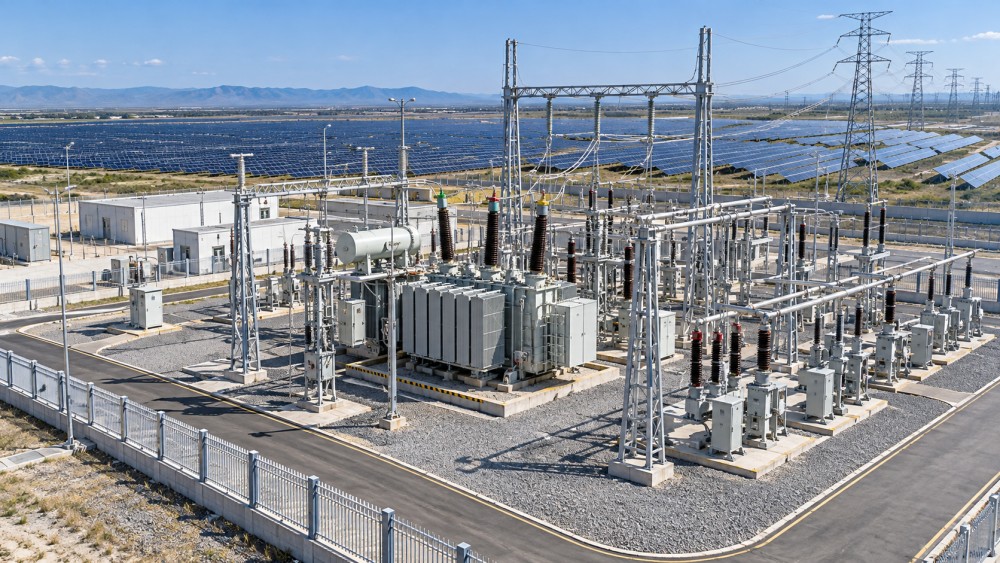
Being close to a transmission line does not establish connection feasibility. The receiving circuit may lack thermal headroom, require an additional substation bay, or need remote protection changes. Upstream reinforcement can therefore become part of the connection scope even when it lies outside the project site.
The physical export path: collection, transformation, and switching
Collection networks must be assessed under actual site conditions
Solar inverter stations and wind turbines generally feed a medium-voltage collection system. Cable selection depends on more than installed megawatts: soil thermal resistivity, burial depth, circuit grouping, ambient conditions, voltage drop, and short-circuit withstand all influence the design. Underground cable capacitance also contributes reactive power, which can matter during low-output operation.
The layout determines how much generation is lost when a feeder trips. Radial arrangements are straightforward, while sectionalized or alternative-feed configurations may improve restoration flexibility at additional cost. Evaluators should distinguish a genuine operational requirement from redundancy that adds equipment without materially reducing the relevant outage risk.
Transformer ratings need an operating envelope
The main step-up transformer links the collection voltage to the receiving network. Its specification should address apparent-power duty, impedance, tap range, cooling, losses, insulation coordination, and neutral grounding. Reactive power obligations can increase current even when active power remains within the export limit.
Tap-changing strategy deserves particular attention. Transformer taps, inverter voltage controls, and external compensation can interact if their response settings are poorly coordinated. For hybrid plants, evaluate charging and discharging cases separately rather than assuming that reversing active-power flow leaves every design condition unchanged.
Substation switchgear must then withstand the specified continuous current and fault duties. Breaker interrupting ratings, busbar arrangements, clearances, surge arresters, and maintenance access belong in the same review. Ground-grid design must address touch and step voltages using site conditions and credible fault-current paths.
Grid studies determine what the equipment list misses
The required study package varies by network operator, voltage level, plant technology, and system conditions. A credible assessment usually examines several different questions rather than relying on one load-flow result.
- Load flow and contingency analysis: Can the network carry the proposed output while respecting applicable thermal and voltage limits, including specified outages?
- Short-circuit analysis: Are equipment ratings adequate, and will the protection system operate correctly with the plant connected?
- Dynamic performance: Can the plant meet voltage and frequency disturbance requirements without unacceptable control interactions?
- Power quality: Will harmonics, flicker, or resonance require mitigation at the agreed assessment point?
- Electromagnetic transient analysis: Where required, do detailed converter controls remain stable under weak-grid conditions, switching events, or interactions with nearby equipment?
Study assumptions matter as much as the report conclusion. Network topology, nearby generation, fault levels, operating scenarios, and inverter firmware can change the result. Validated manufacturer models should represent the equipment and controls being delivered. A generic model used for an early application is not automatically sufficient for final compliance.
The outcome may require a larger connection asset, revised controls, harmonic filtering, or network reinforcement. Such requirements should enter the design before procurement commitments make changes expensive.
Reactive power and stability cannot be bought by nameplate alone
Grid operators commonly specify reactive capability or voltage-control performance at an agreed connection point. Capability at inverter terminals is not equivalent: transformers and cables alter what reaches the network, and inverter current limits constrain simultaneous active and reactive output.
The review should cover maximum export, reduced output, relevant voltage extremes, and any required operation without generation. Depending on the findings, the solution may involve inverter capacity headroom, capacitor banks, shunt reactors, a STATCOM, or other equipment. Switched compensation suits some steady-state needs; fast dynamic support presents a different duty.
A battery energy storage system may provide flexibility and grid services, but storage is not a universal remedy for a weak connection. Its effectiveness depends on converter capability, controls, energy availability, and the specific network constraint. Grid-forming functionality likewise requires project-specific specifications and validation; the label alone does not establish compliance.
Protection, controls, and communications form a second infrastructure layer
Protection must isolate faults while allowing the plant to remain connected through disturbances it is required to withstand. That balance is especially important for inverter-based resources, whose fault-current behavior differs from conventional synchronous machines. Relay selection and settings should use the expected converter response, not assumptions carried over from another generation technology.
The scheme may include transformer and busbar differential protection, line protection, breaker-failure logic, and utility transfer-trip interfaces. Requirements depend on the connection arrangement. Teleprotection channels, station batteries, DC distribution, and reliable auxiliary power are part of the protection system—not secondary accessories.
Above equipment-level controls, the plant power controller coordinates export limits, voltage or reactive-power targets, ramp rates, and frequency response where required. SCADA connects operators to plant status and commands. Revenue meters and instrument transformers need approved accuracy, wiring, testing, and settlement arrangements.
Communication failures also need defined behavior. Loss of a remote setpoint must not leave the plant operating unpredictably. Agree fallback modes, alarm handling, time synchronization, access controls, and cybersecurity responsibilities before commissioning.
Apply the right standards—and establish which requirements prevail
There is no single global certification that makes a renewable plant ready for every grid. Applicable requirements come from local grid codes, connection agreements, utility specifications, equipment standards, and jurisdictional rules. Their editions and contractual precedence must be confirmed for the project.
For example, IEEE 2800 addresses transmission-connected inverter-based resources, while IEEE 1547 addresses distributed energy resource interconnection with associated electric power system interfaces. They are not interchangeable, and applicability depends on the relevant framework. IEC 60076 covers power transformers, IEC 62271 addresses high-voltage switchgear, and IEC 61850 supports power utility automation communications; none independently proves complete plant compliance.
A compliance matrix is more useful than a loose collection of certificates. Map each obligation to the responsible party, design evidence, study, test procedure, and acceptance authority. Equipment conformity supports this process, but plant-level performance still requires verification.
Connection readiness is an evidence and delivery problem
Construction completion, permission to energize, initial synchronization, and unrestricted commercial export are separate milestones. Their sequence depends on approved studies, utility works, outage availability, protection settings, communications readiness, and witnessed testing.
Before committing to a connection date, check these interfaces:
- Who designs, supplies, owns, and maintains the receiving bay, interconnection line, and communications circuits?
- Are transformer manufacturing, route permissions, utility outages, and remote modifications included in the critical-path schedule?
- Do factory and site tests cover protection logic, control commands, metering, and end-to-end signals?
- Are final models, settings, as-built drawings, operating procedures, and compliance records required before export approval?
Global EcoPower & Energy Matrix Intelligence Network (EPEM) examines renewable generation, storage, and grid modernization through these technical and commercial interfaces. For project evaluation, that connected perspective helps separate equipment capability from the infrastructure, approvals, and operating conditions needed to use it.
The strongest review of utility renewable energy infrastructure ends with a traceable connection package: an agreed electrical boundary, study-backed ratings, coordinated controls and protection, clear delivery responsibilities, and an accepted commissioning plan. Any unresolved item should remain visible as a connection risk—not disappear inside a general balance-of-plant allowance.
Questions about market trends? Contact Market Scope Live for deeper business insights.
We respect your privacy. Your information is strictly confidential.
Related News
 Smart Grid TechnologiesChoosing a Grid Monitoring Systems Supplier: Integration and Support CriteriaChoose a grid monitoring systems supplier with confidence. Compare integration, cybersecurity, lifecycle costs, commissioning, and support before you commit.MORE+
 Smart Grid TechnologiesUS Energy Department Announces $237 Million for Grid Supply ChainsUS Department of Energy announces $237 million for grid supply chains. Explore potential impacts on domestic manufacturing, sourcing and procurement.MORE+
 Smart Grid TechnologiesAdvanced Metering Systems in South Africa: Choosing Connectivity for MunicipalitiesExplore advanced metering systems in South Africa. Compare cellular, RF mesh and PLC to choose reliable municipal connectivity, control costs and plan a smarter rollout.MORE+
 Smart Grid TechnologiesVehicle-to-Grid Technology in Europe: EV, Charger and Grid RequirementsExplore vehicle to grid technology Europe-wide. Discover EV compatibility, charger standards and grid approval requirements to reduce risks and plan your V2G deployment with confidence.MORE+
 Smart Grid TechnologiesWhat Infrastructure Do Utility-Scale Renewables Need for Grid Connection?Explore utility renewable energy infrastructure for grid connection, from substations to controls and compliance. Learn how to spot connection risks and keep projects on track.MORE+
 Smart Grid TechnologiesHybrid Power Plants for Microgrids: Sizing Solar, Batteries, and DieselSize hybrid power plants for microgrids with confidence. Learn how to balance solar, batteries, and diesel to cut fuel use, protect critical loads, and meet reliability targets.MORE+
 Smart Grid TechnologiesRenewable Power Systems for Mining: Designing Reliable Off-Grid MicrogridsExplore renewable power systems for mining: design reliable off-grid microgrids with solar, storage, backup power, and smart controls to cut fuel use and protect uptime.MORE+
 Smart Grid TechnologiesCommercial Microgrids in Europe: When Do Energy Savings Justify the Investment?Considering commercial microgrids Europe-wide? Discover when energy savings justify investment, compare solar and storage returns, and avoid costly oversizing.MORE+
 Smart Grid TechnologiesMulti-Site Commercial Energy Planning: Balancing Load, Tariffs, and ResilienceMulti site commercial energy planning: balance load profiles, tariffs, EV charging, storage, and resilience to reduce costs, strengthen operations, and optimize every facility.MORE+
 Smart Grid TechnologiesWhat Should a Partner Deliver Across a Multi-Site Distributed Energy Portfolio?Best partners for distributed energy projects across a multi-site portfolio? Discover how to standardize design, data, commissioning, and lifecycle performance at scale.MORE+
 Smart Grid TechnologiesHow Can Multi-Site Owners Identify the Right Partners for Distributed Energy Projects?“Is it best partners for distributed energy projects across a multi-site portfolio?” Explore a practical framework to assess technical expertise, grid readiness, risk, data access, and lifecycle support.MORE+
 Smart Grid TechnologiesSmart Grid Technologies for Utilities: How to Prioritize Grid Modernization InvestmentsSmart grid technologies for utilities: learn how to prioritize modernization investments, reduce reliability risks, defer capital upgrades, and build a resilient, cost-effective grid.MORE+
 Smart Grid TechnologiesDigital Substations: How IEC 61850 Improves Protection, Control, and Data VisibilityDigital substations powered by IEC 61850 improve protection, flexible control, and data visibility. Explore the design principles that strengthen grid reliability.MORE+
 Smart Grid TechnologiesWhat Is Feeder Automation and How Does It Reduce Outages on Distribution Grids?Feeder automation helps utilities isolate faults, restore healthy sections faster, and reduce distribution grid outages. Explore how FLISR improves reliability.MORE+
 Smart Grid TechnologiesWhat Renewable Integration Studies Should Model Before a Grid Connection DecisionRenewable integration studies reveal grid connection risks before approval—from voltage and protection to curtailment, dynamic stability, and future network constraints.MORE+
 Smart Grid TechnologiesUtility Resilience Planning: How to Prioritize Grid Investments for Extreme WeatherUtility companies resilience planning: learn how to prioritize grid investments for extreme weather, protect critical services, speed restoration, and build a stronger, smarter energy network.MORE+
 Smart Grid TechnologiesWhat Drives Microgrid Controller Costs Across Commercial and Industrial Projects?Microgrid controllers cost depends on asset mix, islanding needs, legacy integration, software, and lifecycle support. Learn how to compare bids and reduce project risk.MORE+
 Smart Grid TechnologiesHow Does Demand Response Work with Battery Storage in Microgrids?How does demand response integrate with battery storage in microgrid operations? Explore coordinated dispatch, peak shaving, renewable use, and resilient backup strategies.MORE+
 Smart Grid TechnologiesWhich Energy Management Systems Integrate Best with Existing SCADA Platforms?Which energy management systems integrate best with existing SCADA platforms? Explore protocols, control authority, and practical selection insights for reliable energy optimization.MORE+
 Smart Grid TechnologiesHow to Plan Clean Energy Infrastructure for Reliable Industrial Power SupplyClean energy infrastructure planning for reliable industrial power: optimize loads, storage, controls, grid integration, and resilience.MORE+
 Smart Grid TechnologiesHow to Size Hybrid Microgrid Systems for Remote Sites With Variable LoadsHybrid microgrid systems for remote sites: learn how to size solar, batteries, inverters, and generators for variable loads, resilience, and lower fuel costs.MORE+
 Smart Grid TechnologiesGrid Resilience Technologies That Prevent Outages During Extreme WeatherGrid resilience technologies for outage prevention help utilities and facilities withstand extreme weather with automation, storage, microgrids, and demand flexibility. Explore practical strategies to protect critical loads and restore power faster.MORE+
 Smart Grid TechnologiesGrid Stability Solutions for Wind: Managing Variability and Power QualityGrid stability solutions for wind: explore practical strategies for voltage control, frequency response, power quality, storage, and reliable PCC compliance.MORE+
 Smart Grid TechnologiesWhich Grid Interconnection Standards Apply to Commercial Rooftop Solar?What grid interconnection standards apply to commercial rooftop solar? Explore utility rules, inverter certifications, export limits, and approval steps to avoid costly delays.MORE+
 Smart Grid TechnologiesHow Demand Response Supports Public EV Charging StationsSmart grid demand response for public charging stations helps operators control peak loads, protect costs, improve reliability, and deliver a clearer EV driver experience.MORE+
 Smart Grid TechnologiesDo Smart Grid Features Reduce Charging Station Electricity Bills?Do smart grid features actually reduce charging station electricity bills? Discover how load balancing, tariff scheduling, solar, and storage can cut peak costs.MORE+
 Smart Grid TechnologiesCan One Energy Management Platform Support Multiple Charger Brands?Can a single energy management platform handle multiple charger brands at one site? Discover how open integration enables scalable, reliable EV charging control.MORE+
 Smart Grid TechnologiesGrid Resilience Technologies Explained: Which Solutions Reduce Outage Risk?Grid resilience technologies explained clearly: compare batteries, microgrids, feeder automation, and digital controls to see which solutions truly reduce outage risk and protect critical loads.MORE+
 Smart Grid TechnologiesHow Utilities Evaluate Renewable Power Systems for Grid Stability and ROIRenewable power systems for utilities: learn how grids assess stability, storage, integration costs, and long-term ROI to choose resilient, high-value renewable investments.MORE+
 Smart Grid TechnologiesWhat Makes a Microgrid Energy Project Bankable for Investors and Lenders?Energy project bankability microgrids explained: learn what investors and lenders check most—revenue certainty, contract strength, risk allocation, and reliable performance.MORE+
 Smart Grid TechnologiesWhat Determines Grid Monitoring Price in Utility and Industrial Projects?Grid monitoring price depends on scope, accuracy, software, and integration complexity. Learn what drives costs in utility and industrial projects before you compare quotes.MORE+
 Smart Grid TechnologiesUrban Energy Infrastructure Planning: Key Factors for Resilient and Scalable CitiesUrban energy infrastructure planning for resilient, scalable cities: discover how grids, storage, EV charging, and smart forecasting reduce risk, cut costs, and support cleaner urban growth.MORE+
 Smart Grid TechnologiesHow Grid Infrastructure in the USA Is Evolving to Support Renewables and Grid ReliabilityGrid infrastructure USA is evolving fast to integrate renewables, storage, and EV charging while protecting reliability. Explore key trends, risks, and business opportunities shaping the market.MORE+
 Smart Grid TechnologiesGrid Power Infrastructure Investment: How to Compare ROI Across Utility-Scale ProjectsGrid power infrastructure investment explained: learn how to compare ROI across utility-scale projects using NPV, lifecycle cost, grid risk, and performance metrics to make smarter investment decisions.MORE+
 Smart Grid TechnologiesWhat Drives Substation Digitalization Cost? Hardware, Software, and Retrofit FactorsSubstation digitalization cost explained: compare hardware, software, retrofit risks, and lifecycle factors to budget smarter, avoid hidden costs, and choose higher-value upgrades.MORE+
 Smart Grid TechnologiesIndustrial Microgrids EMS Explained: Core Functions, Controls, and Use CasesIndustrial microgrids EMS explained: discover core functions, control priorities, and real-world use cases to improve resilience, cut energy costs, and evaluate platforms with confidence.MORE+
 Smart Grid TechnologiesSCADA for Power Systems Vendor Selection: Integration, Cybersecurity, and Lifecycle CostSCADA for power systems vendor selection made practical: compare integration, cybersecurity, and lifecycle cost to reduce risk, avoid hidden expenses, and choose a platform built to scale.MORE+
 Smart Grid TechnologiesVehicle-to-Grid Technology for Depots: How It Works and When It Makes Business SenseVehicle to grid technology for depots explained: learn how V2G works, where savings and revenue come from, and when it makes real business sense for fleet operators.MORE+
 Smart Grid TechnologiesSmart Digital Energy for Commercial Sites: When Integrated Control Improves Load ManagementSmart digital energy helps commercial sites cut peak demand, optimize solar, storage, EV charging, and HVAC, while improving resilience, visibility, and ROI through integrated control.MORE+
 Smart Grid TechnologiesWhat Are Digital Grid Technologies for Substations and Which Functions Matter Most?Digital grid technologies for substations explained: discover the functions that matter most for reliability, renewable integration, cybersecurity, and smarter asset decisions.MORE+


