
Renewable Power Systems for Mining: Designing Reliable Off-Grid Microgrids
Renewable Power Systems for Mining: Designing Reliable Off-Grid Microgrids
For remote mining operations, reliable power is a production requirement—not just an energy cost. Designing renewable power systems for mining means balancing variable solar and wind generation with battery storage, dispatchable backup, and controls that protect critical loads. The challenge is to reduce fuel dependence without compromising uptime, power quality, or lifecycle economics.
A mine microgrid should therefore be designed around operational consequences, not a headline renewable percentage. A short interruption to accommodation loads is different from losing underground ventilation, dewatering, or a processing circuit that takes hours to restart. Those differences determine the architecture, reserve strategy, and acceptance tests.
Start with the mine’s operating envelope
Monthly electricity consumption is useful for budgeting but insufficient for microgrid engineering. Obtain time-series demand data covering representative production cycles, maintenance shutdowns, seasonal changes, and expansion plans. Supplement interval metering with faster measurements where motor starts, abrupt load changes, or power-quality problems matter.
Separate the load register into three practical categories:
- Safety-critical loads: equipment whose interruption creates unacceptable safety or environmental consequences. Required continuity and dedicated backup must be established through the site’s risk assessment and applicable requirements.
- Production-critical loads: crushers, mills, conveyors, and process systems where interruption damages throughput, equipment, or restart capability.
- Flexible loads: selected pumping, workshops, accommodation services, or fleet charging that can shift or reduce demand within defined operating limits.
Do not assume a large motor is simply a large steady load. Starting current, acceleration time, drive configuration, and reactive-power demand can determine whether a battery inverter and generator combination can support it. Equally, a plant-wide trip can leave excess generation on the bus. Both load pickup and load rejection belong in the design basis.
Mine life also changes the answer. Construction, full production, expansion, and closure have different demand profiles. A modular power plant may be preferable when the resource plan is uncertain or equipment will need relocation.
Choose an architecture that can survive credible failures
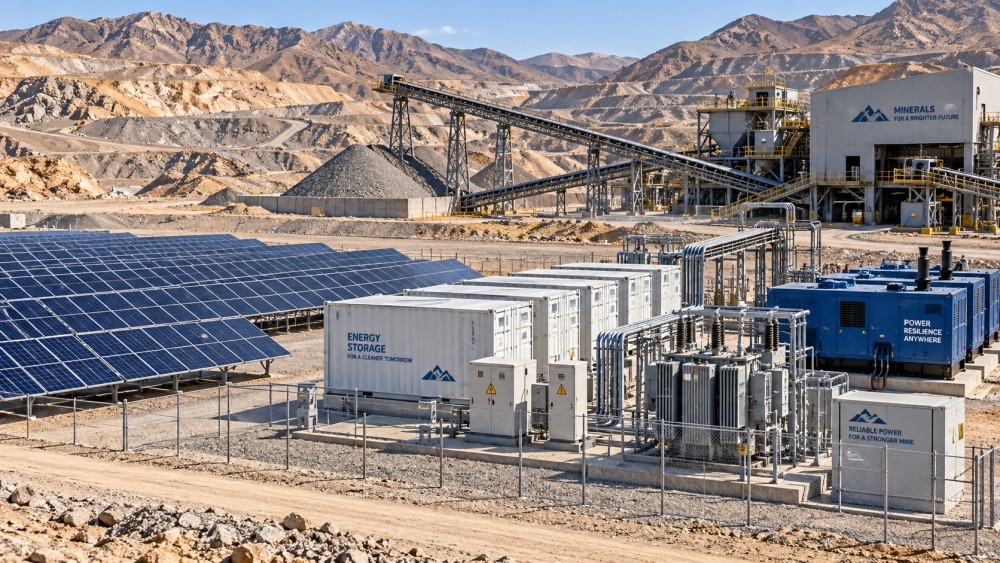
An off-grid hybrid power plant commonly combines solar PV, potentially wind, a battery energy storage system, and dispatchable generators on a shared distribution network. The configuration must explain which assets establish voltage and frequency, which follow that reference, and what happens when the reference source disconnects.
If generators are intended to shut down during renewable-rich periods, the system needs a capable grid-forming source. A conventional grid-following solar inverter cannot independently maintain an islanded network. Grid-forming battery equipment must be assessed for overload capability, reactive-power support, fault behavior, and interaction with other sources—not merely its advertised operating mode.
The electrical layout should also make failures containable. Bus sectionalization, feeder protection, transformer redundancy, and dedicated supplies for essential services can prevent a single equipment fault from becoming a mine-wide outage. An N-1 criterion, where required, should identify the actual contingencies to be survived and the loads that must remain supplied.
Black start deserves a separate sequence. Specify how control power, communications, cooling, and switchgear operate after a total outage; how the first source energizes the bus; and how loads reconnect in stages. A battery with sufficient stored energy may still be unable to energize a transformer if its short-duration current capability is inadequate.
Size energy supply and stability support separately
Renewable generation sizing starts with site-specific resource assessment. Solar yield depends on irradiation, temperature, dust, shading, and cleaning access. Wind requires credible hub-height resource data, terrain assessment, and consideration of turbulence, transport, crane access, and maintenance logistics. Favorable annual energy estimates alone do not establish suitability.
Model generation and demand together using chronological simulation. Include seasonal conditions, prolonged low-resource periods, equipment outages, renewable curtailment, generator constraints, and battery degradation. Annual averages conceal the hours that determine reliability.
Battery power is not battery endurance
Battery power capacity, expressed in MW, determines how much demand or reserve it can support at an instant. Energy capacity, expressed in MWh, determines how long that support lasts. A system optimized for rapid frequency response may need substantial power but relatively little energy; shifting solar output into the night requires a different balance.
For an initial endurance calculation, divide usable AC-delivered energy by the load to be supported. Detailed sizing must then account for the permitted state-of-charge window, conversion losses, auxiliary demand, temperature effects, aging, and reserve held for contingencies. Avoid counting the same stored energy simultaneously as production supply and emergency reserve.
Dispatchable capacity should cover the required loads under defined low-renewable and outage scenarios. Check generator derating, minimum stable loading, ramp limits, starting reliability, and fuel delivery constraints. Keeping a generator running lightly loaded may reduce the economic benefit of additional solar; shutting it down without sufficient reserve can introduce operational risk.
Make controls part of the engineering scope
The energy management system schedules generation, storage, and flexible demand. Fast local controls maintain electrical stability. These functions operate on different timescales and should not depend on a remote cloud connection for essential protection or frequency control.
Operating rules must be explicit. Define the battery reserve floor, generator start and stop thresholds, available spinning or fast-response reserve, renewable curtailment logic, and prioritized load shedding. Determine whether the battery can bridge the loss of the largest online generator until another unit starts and accepts load.
Protection coordination needs particular attention as the generation mix changes. Inverter-based sources typically provide limited, controlled fault current, so protection designed around synchronous generators may not behave as expected in generator-off operation. Study each intended operating mode, including grounding arrangements, relay sensitivity, selectivity, and breaker duties.
Require steady-state and dynamic studies, with electromagnetic transient analysis where interactions justify it. Test communications loss, controller failure, abrupt renewable reduction, generator trips, and large motor starts. Cybersecurity provisions should include controlled remote access, network segmentation, event logging, and recoverable configuration backups.
Evaluate equipment against the site, not only the datasheet
Remote mining conditions can turn a small maintenance issue into prolonged downtime. Dust affects PV yield and cooling systems; heat and altitude affect equipment ratings; corrosion, flooding, lightning, and difficult roads influence both installation and serviceability. Procurement specifications should state the actual environmental envelope and require vendors to identify associated derating.
Battery selection must include thermal management, degradation assumptions, fire detection, isolation, emergency access, and local response capability. Lithium-ion, flow batteries, and other storage technologies have different footprint, efficiency, maintenance, and duration characteristics. Suitability depends on duty cycle and project constraints rather than chemistry alone.
Check practical support arrangements before placing orders: spare power modules, replacement cooling components, specialist travel time, software support, and the ability of site technicians to diagnose faults. A containerized system may arrive factory assembled, but its foundations, earthing, drainage, fire provisions, and electrical interfaces still require site engineering.
Compare economics at the microgrid boundary
Comparing solar generation cost with diesel fuel cost is too narrow. Evaluate the complete delivered-power system: generation, storage, controls, distribution upgrades, civil works, fuel logistics, maintenance, financing, replacements, and decommissioning. Include the operational consequences of unserved energy and production interruptions using assumptions agreed with the mine operator.
Run sensitivities for fuel price, mine life, demand growth, renewable resource uncertainty, financing cost, and battery replacement or augmentation. A longer-lived energy asset does not automatically suit a shorter-lived mine. Ownership and power-purchase arrangements should address early closure, expansion, asset relocation, and responsibility for performance shortfalls.
Define renewable penetration carefully. Installed capacity, instantaneous renewable contribution, and annual renewable energy share are different measures. A high annual share can coexist with substantial backup capacity. That is not inherently a design failure: energy displacement and firm capacity serve different purposes.
Turn the design into measurable delivery obligations
Interface gaps are a common project risk. The PV supplier, battery integrator, generator provider, and electrical contractor may each satisfy their own scope while leaving overall performance unresolved. Assign responsibility for system integration, protection settings, controller coordination, and model validation to a clearly identified party.
Tender and commissioning documents should establish:
- Power-quality limits and recovery requirements at identified load buses.
- Demonstrated load acceptance, contingency response, black start, and restoration sequences.
- Battery usable capacity and power guarantees under defined environmental and operating conditions.
- Metering boundaries, availability definitions, exclusions, and performance-test methods.
- Operator training, spare-parts obligations, maintenance access, and handover documentation.
Factory testing can verify controls and interfaces before shipment, including simulated abnormal conditions. Site testing must then confirm actual equipment behavior without exposing personnel or production to uncontrolled risk. After handover, track curtailment, generator loading, battery state of health, reserve violations, and power-quality events—not just renewable output.
Move forward with a defensible design basis
Global EcoPower & Energy Matrix Intelligence Network (EPEM) connects renewable generation, storage, grid controls, and project economics through structured B2B industry information. For mining projects, that cross-technology perspective helps teams frame equipment comparisons and tender questions around system performance rather than isolated product ratings.
Before requesting firm proposals for renewable power systems for mining, assemble the load register, resource data, electrical single-line diagram, continuity requirements, expansion forecast, and site constraints. Agree on the credible failures the microgrid must survive. Without those inputs, suppliers may quote very different systems against the same request—and the lowest price may simply reflect the least demanding interpretation.
Questions about market trends? Contact Market Scope Live for deeper business insights.
We respect your privacy. Your information is strictly confidential.
Related News
 Smart Grid TechnologiesChoosing a Grid Monitoring Systems Supplier: Integration and Support CriteriaChoose a grid monitoring systems supplier with confidence. Compare integration, cybersecurity, lifecycle costs, commissioning, and support before you commit.MORE+
 Smart Grid TechnologiesUS Energy Department Announces $237 Million for Grid Supply ChainsUS Department of Energy announces $237 million for grid supply chains. Explore potential impacts on domestic manufacturing, sourcing and procurement.MORE+
 Smart Grid TechnologiesAdvanced Metering Systems in South Africa: Choosing Connectivity for MunicipalitiesExplore advanced metering systems in South Africa. Compare cellular, RF mesh and PLC to choose reliable municipal connectivity, control costs and plan a smarter rollout.MORE+
 Smart Grid TechnologiesVehicle-to-Grid Technology in Europe: EV, Charger and Grid RequirementsExplore vehicle to grid technology Europe-wide. Discover EV compatibility, charger standards and grid approval requirements to reduce risks and plan your V2G deployment with confidence.MORE+
 Smart Grid TechnologiesWhat Infrastructure Do Utility-Scale Renewables Need for Grid Connection?Explore utility renewable energy infrastructure for grid connection, from substations to controls and compliance. Learn how to spot connection risks and keep projects on track.MORE+
 Smart Grid TechnologiesHybrid Power Plants for Microgrids: Sizing Solar, Batteries, and DieselSize hybrid power plants for microgrids with confidence. Learn how to balance solar, batteries, and diesel to cut fuel use, protect critical loads, and meet reliability targets.MORE+
 Smart Grid TechnologiesRenewable Power Systems for Mining: Designing Reliable Off-Grid MicrogridsExplore renewable power systems for mining: design reliable off-grid microgrids with solar, storage, backup power, and smart controls to cut fuel use and protect uptime.MORE+
 Smart Grid TechnologiesCommercial Microgrids in Europe: When Do Energy Savings Justify the Investment?Considering commercial microgrids Europe-wide? Discover when energy savings justify investment, compare solar and storage returns, and avoid costly oversizing.MORE+
 Smart Grid TechnologiesMulti-Site Commercial Energy Planning: Balancing Load, Tariffs, and ResilienceMulti site commercial energy planning: balance load profiles, tariffs, EV charging, storage, and resilience to reduce costs, strengthen operations, and optimize every facility.MORE+
 Smart Grid TechnologiesWhat Should a Partner Deliver Across a Multi-Site Distributed Energy Portfolio?Best partners for distributed energy projects across a multi-site portfolio? Discover how to standardize design, data, commissioning, and lifecycle performance at scale.MORE+
 Smart Grid TechnologiesHow Can Multi-Site Owners Identify the Right Partners for Distributed Energy Projects?“Is it best partners for distributed energy projects across a multi-site portfolio?” Explore a practical framework to assess technical expertise, grid readiness, risk, data access, and lifecycle support.MORE+
 Smart Grid TechnologiesSmart Grid Technologies for Utilities: How to Prioritize Grid Modernization InvestmentsSmart grid technologies for utilities: learn how to prioritize modernization investments, reduce reliability risks, defer capital upgrades, and build a resilient, cost-effective grid.MORE+
 Smart Grid TechnologiesDigital Substations: How IEC 61850 Improves Protection, Control, and Data VisibilityDigital substations powered by IEC 61850 improve protection, flexible control, and data visibility. Explore the design principles that strengthen grid reliability.MORE+
 Smart Grid TechnologiesWhat Is Feeder Automation and How Does It Reduce Outages on Distribution Grids?Feeder automation helps utilities isolate faults, restore healthy sections faster, and reduce distribution grid outages. Explore how FLISR improves reliability.MORE+
 Smart Grid TechnologiesWhat Renewable Integration Studies Should Model Before a Grid Connection DecisionRenewable integration studies reveal grid connection risks before approval—from voltage and protection to curtailment, dynamic stability, and future network constraints.MORE+
 Smart Grid TechnologiesUtility Resilience Planning: How to Prioritize Grid Investments for Extreme WeatherUtility companies resilience planning: learn how to prioritize grid investments for extreme weather, protect critical services, speed restoration, and build a stronger, smarter energy network.MORE+
 Smart Grid TechnologiesWhat Drives Microgrid Controller Costs Across Commercial and Industrial Projects?Microgrid controllers cost depends on asset mix, islanding needs, legacy integration, software, and lifecycle support. Learn how to compare bids and reduce project risk.MORE+
 Smart Grid TechnologiesHow Does Demand Response Work with Battery Storage in Microgrids?How does demand response integrate with battery storage in microgrid operations? Explore coordinated dispatch, peak shaving, renewable use, and resilient backup strategies.MORE+
 Smart Grid TechnologiesWhich Energy Management Systems Integrate Best with Existing SCADA Platforms?Which energy management systems integrate best with existing SCADA platforms? Explore protocols, control authority, and practical selection insights for reliable energy optimization.MORE+
 Smart Grid TechnologiesHow to Plan Clean Energy Infrastructure for Reliable Industrial Power SupplyClean energy infrastructure planning for reliable industrial power: optimize loads, storage, controls, grid integration, and resilience.MORE+
 Smart Grid TechnologiesHow to Size Hybrid Microgrid Systems for Remote Sites With Variable LoadsHybrid microgrid systems for remote sites: learn how to size solar, batteries, inverters, and generators for variable loads, resilience, and lower fuel costs.MORE+
 Smart Grid TechnologiesGrid Resilience Technologies That Prevent Outages During Extreme WeatherGrid resilience technologies for outage prevention help utilities and facilities withstand extreme weather with automation, storage, microgrids, and demand flexibility. Explore practical strategies to protect critical loads and restore power faster.MORE+
 Smart Grid TechnologiesGrid Stability Solutions for Wind: Managing Variability and Power QualityGrid stability solutions for wind: explore practical strategies for voltage control, frequency response, power quality, storage, and reliable PCC compliance.MORE+
 Smart Grid TechnologiesWhich Grid Interconnection Standards Apply to Commercial Rooftop Solar?What grid interconnection standards apply to commercial rooftop solar? Explore utility rules, inverter certifications, export limits, and approval steps to avoid costly delays.MORE+
 Smart Grid TechnologiesHow Demand Response Supports Public EV Charging StationsSmart grid demand response for public charging stations helps operators control peak loads, protect costs, improve reliability, and deliver a clearer EV driver experience.MORE+
 Smart Grid TechnologiesDo Smart Grid Features Reduce Charging Station Electricity Bills?Do smart grid features actually reduce charging station electricity bills? Discover how load balancing, tariff scheduling, solar, and storage can cut peak costs.MORE+
 Smart Grid TechnologiesCan One Energy Management Platform Support Multiple Charger Brands?Can a single energy management platform handle multiple charger brands at one site? Discover how open integration enables scalable, reliable EV charging control.MORE+
 Smart Grid TechnologiesGrid Resilience Technologies Explained: Which Solutions Reduce Outage Risk?Grid resilience technologies explained clearly: compare batteries, microgrids, feeder automation, and digital controls to see which solutions truly reduce outage risk and protect critical loads.MORE+
 Smart Grid TechnologiesHow Utilities Evaluate Renewable Power Systems for Grid Stability and ROIRenewable power systems for utilities: learn how grids assess stability, storage, integration costs, and long-term ROI to choose resilient, high-value renewable investments.MORE+
 Smart Grid TechnologiesWhat Makes a Microgrid Energy Project Bankable for Investors and Lenders?Energy project bankability microgrids explained: learn what investors and lenders check most—revenue certainty, contract strength, risk allocation, and reliable performance.MORE+
 Smart Grid TechnologiesWhat Determines Grid Monitoring Price in Utility and Industrial Projects?Grid monitoring price depends on scope, accuracy, software, and integration complexity. Learn what drives costs in utility and industrial projects before you compare quotes.MORE+
 Smart Grid TechnologiesUrban Energy Infrastructure Planning: Key Factors for Resilient and Scalable CitiesUrban energy infrastructure planning for resilient, scalable cities: discover how grids, storage, EV charging, and smart forecasting reduce risk, cut costs, and support cleaner urban growth.MORE+
 Smart Grid TechnologiesHow Grid Infrastructure in the USA Is Evolving to Support Renewables and Grid ReliabilityGrid infrastructure USA is evolving fast to integrate renewables, storage, and EV charging while protecting reliability. Explore key trends, risks, and business opportunities shaping the market.MORE+
 Smart Grid TechnologiesGrid Power Infrastructure Investment: How to Compare ROI Across Utility-Scale ProjectsGrid power infrastructure investment explained: learn how to compare ROI across utility-scale projects using NPV, lifecycle cost, grid risk, and performance metrics to make smarter investment decisions.MORE+
 Smart Grid TechnologiesWhat Drives Substation Digitalization Cost? Hardware, Software, and Retrofit FactorsSubstation digitalization cost explained: compare hardware, software, retrofit risks, and lifecycle factors to budget smarter, avoid hidden costs, and choose higher-value upgrades.MORE+
 Smart Grid TechnologiesIndustrial Microgrids EMS Explained: Core Functions, Controls, and Use CasesIndustrial microgrids EMS explained: discover core functions, control priorities, and real-world use cases to improve resilience, cut energy costs, and evaluate platforms with confidence.MORE+
 Smart Grid TechnologiesSCADA for Power Systems Vendor Selection: Integration, Cybersecurity, and Lifecycle CostSCADA for power systems vendor selection made practical: compare integration, cybersecurity, and lifecycle cost to reduce risk, avoid hidden expenses, and choose a platform built to scale.MORE+
 Smart Grid TechnologiesVehicle-to-Grid Technology for Depots: How It Works and When It Makes Business SenseVehicle to grid technology for depots explained: learn how V2G works, where savings and revenue come from, and when it makes real business sense for fleet operators.MORE+
 Smart Grid TechnologiesSmart Digital Energy for Commercial Sites: When Integrated Control Improves Load ManagementSmart digital energy helps commercial sites cut peak demand, optimize solar, storage, EV charging, and HVAC, while improving resilience, visibility, and ROI through integrated control.MORE+
 Smart Grid TechnologiesWhat Are Digital Grid Technologies for Substations and Which Functions Matter Most?Digital grid technologies for substations explained: discover the functions that matter most for reliability, renewable integration, cybersecurity, and smarter asset decisions.MORE+


