Advanced Metering Systems in South Africa: Choosing Connectivity for Municipalities
Municipalities evaluating advanced metering systems in South Africa should shortlist connectivity by service area and operational requirement. Cellular can suit dispersed meters where indoor coverage is dependable; RF mesh can suit dense neighbourhoods with enough powered nodes to maintain alternative routes; power-line communication (PLC) can suit electrically coherent networks where signal quality has been demonstrated. A municipality with varied settlement patterns may need more than one communications technology.
The initial decision should remain conditional until field testing shows that the proposed architecture can deliver usable readings, execute required commands and recover after power interruptions. Coverage maps, radio range claims and successful laboratory demonstrations provide useful screening evidence. Municipal acceptance should depend on performance at installed meter locations, through the full path to billing and operational systems.
Define the service before choosing the network
A monthly billing read, an interval-data service and a remote switching command place different demands on connectivity. A connection that eventually retrieves accumulated consumption may be adequate for one billing process but unsuitable for time-sensitive operational work. Technical teams need to define these differences before comparing proposals.
Start with the workflows the municipality intends to operate. For each, specify the required delivery window, acceptable missing-data level, retry behaviour and response to communication failure. Include the number of meters involved: retrieving one reading during a demonstration says little about whether a fleet can complete its scheduled upload within the available window.
- Billing: How many valid readings must reach the billing system before the billing run, and how will exceptions be resolved?
- Interval data: How much information must each meter retain locally, and how quickly must a backlog clear after an interruption?
- Remote commands: What acknowledgement proves that a command reached the intended meter and that the requested action occurred?
- Outage reporting: Which devices must remain powered to transmit an event, and what information remains available if communications infrastructure also fails?
Separate communication availability from electricity availability. A meter may continue recording locally while its communications path is unavailable. Conversely, a working network cannot provide a fresh reading from an unpowered meter unless that meter has the necessary backup capability. These distinctions determine what the municipality can reasonably expect during an interruption.
South African municipal evaluations should explicitly include load shedding and other supply interruptions as operating conditions. Check the backup arrangements for meters, collectors, gateways and backhaul equipment separately. An end-to-end service depends on every necessary link, including equipment operated by a telecommunications provider.
Match cellular, RF mesh and PLC to the installation conditions
Cellular: a practical candidate for dispersed assets
Direct cellular connectivity can reduce the need for municipality-owned neighbourhood communications equipment. It is a useful candidate for scattered commercial meters, remote installations and areas where building a dedicated network would be difficult to justify. Its suitability depends on the signal available to the selected modem and antenna at the actual installation position.
Outdoor handset reception provides limited evidence for a meter inside a metal cabinet, basement or service enclosure. Surveys should use representative hardware and examine connection stability, upload success and recovery after loss of service. Where alternative operators are proposed, establish how switching works, which networks the modem supports and whether the commercial agreement permits the intended roaming or fallback behaviour.
Ask bidders to identify the proposed cellular technology and its supported functions. LTE-based options, including LTE-M or NB-IoT where available and supported, have different deployment and device characteristics. Suitability for frequent reporting, remote commands and firmware transfer must be demonstrated on the offered service. Any proposal relying on older cellular generations needs a documented migration path and a clear allocation of replacement costs.
Cellular concentrates part of the operating dependency outside the municipality. Evaluate subscription management, SIM provisioning, service escalation, network changes and performance during widespread power interruptions. Direct-to-meter cellular and cellular backhaul for a group of meters also create different failure patterns: a shared backhaul failure can disconnect many otherwise functioning local links.
RF mesh: density helps, but powered routes matter
RF mesh allows participating devices to relay traffic through neighbouring nodes toward a gateway. Dense meter populations can provide several possible routes, making mesh a credible option for compact urban areas. The useful density is the density of reachable, operational devices; a high number of accounts within a suburb does not guarantee a reliable radio network.
Building materials, terrain, antenna placement and cabinet construction affect which nodes can communicate. A deployment may need additional routers or gateways to bridge difficult sections. Include their installation access, power supply, maintenance and replacement in the assessment, particularly where equipment must be placed outside existing municipal premises.
Mesh resilience requires specific examination during outages. If relay nodes lose power together, alternative routes may disappear at the same time. Backup energy may support an outage notification without sustaining extended forwarding. Require the supplier to explain what remains operational, for how long under the proposed configuration, and how routes rebuild when supply returns.
Capacity deserves equal attention. A network that handles routine readings may behave differently when thousands of meters reconnect, upload stored intervals or receive firmware. Test these conditions across representative numbers of hops and gateways. Additional gateways can improve capacity or resilience, but their backhaul and maintenance requirements must remain visible in the proposal.
PLC: assess the electrical path feeder by feeder
PLC uses power conductors to carry communications and can be attractive where the electrical topology supports dependable links to a concentrator. Its performance depends on cable characteristics, connected equipment, electrical noise, branching and the position of communications equipment. These conditions can differ substantially between feeders.
Transformer boundaries, phase arrangements and coupling requirements need explicit design treatment. Ask where concentrators will be installed, which meters each will serve and what additional equipment is necessary. A supplier should explain how the design will accommodate feeder changes and how technicians will distinguish communications faults from electrical-network issues.
Test PLC while representative loads are operating, including inverter-connected equipment where present. A short trial under favourable conditions may miss disturbances that occur at other times. Local generation and storage can alter operating conditions, so trials should reflect the equipment mix expected in the service area.
PLC also requires a separate route from the concentrator into municipal systems, often through cellular or another backhaul service. Assess that complete architecture. Where part of the electrical path is de-energised, communication over that section may be unavailable; the recovery plan should explain how stored data is retrieved when supply returns.
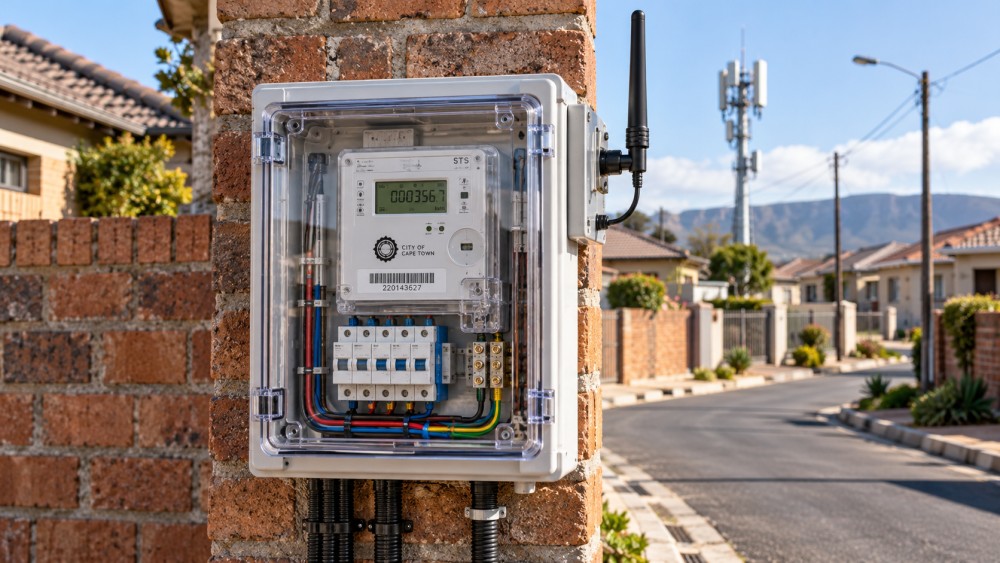
A useful shortlist follows these boundaries: assess cellular first for dispersed sites with verified coverage, mesh for dense areas with viable radio paths, and PLC for suitable electrical networks supported by feeder-level measurements. Exceptions should follow evidence from the site. A hybrid deployment can accommodate these differences, provided the municipality can manage its integration and support requirements.
Keep interoperability and operational control in the evaluation
Connectivity determines how information travels; interoperability determines whether municipal systems can use it consistently. A successful meter read still needs the correct account association, timestamp, unit and validation status before it becomes billable data. Missing or inconsistent mappings can create manual work even when the communications network performs well.
Require bidders to describe the complete path from meter to head-end system, meter-data management and billing. Where DLMS/COSEM is proposed, identify the supported profiles, objects, security settings and tested combinations. Support for a named standard does not establish that every meter function will work across different suppliers’ systems.
Demonstrate the workflows that matter: meter replacement, account reassignment, clock synchronisation, missing-data recovery, tariff updates and export of historical records. If embedded generation is within scope, include import and export registers and their treatment in downstream systems. Communication cannot compensate for a meter configuration or billing interface that omits required data.
Remote disconnection and reconnection warrant particular care. The system should authenticate and authorise the command, preserve an audit trail and distinguish command receipt from confirmed execution. Procedures also need to address delayed commands, repeated requests and uncertain device status. A timeout must lead to a defined exception process rather than an assumed successful action.
Security requirements should cover device identity, protected communications, key management, administrator access and firmware updates. Private network arrangements can reduce exposure, but they do not replace application security. Establish who controls credentials and cryptographic material, how compromised devices are handled and how access is removed when contractors change.
Meter records linked to identifiable customers also require appropriate handling under South Africa’s Protection of Personal Information Act. Procurement should establish data-access responsibilities, hosting arrangements, retention rules and support access. Ask who can export the information and whether the municipality can retain usable records when a service contract ends.
Use the pilot to expose operating cost and failure behaviour
A pilot should test the conditions most likely to affect the rollout decision. Include difficult cabinets, weak coverage locations, different building types and representative feeders. For mesh, include sparse edges and obstructed paths. For PLC, include electrically challenging sections. Assess all technologies through supply interruptions and restoration where these conditions can be observed or safely simulated.
Agree acceptance measures before installation. Average read success alone can conceal a persistent group of unreachable meters. Report performance by location, feeder and installation type, alongside the effort required to resolve failures. The municipality needs to know whether exceptions can be handled within its staffing and billing constraints.
- Data delivery: Measure valid records received within the required window, including completeness after backlog recovery.
- Command performance: Record delivery time, confirmed execution, failed attempts and cases needing field intervention.
- Recovery: Measure reconnection behaviour after outages, gateway loss and backhaul interruption.
- Maintenance: Record diagnostic effort, site visits, equipment changes and the skills needed to restore service.
Price the architecture that passes these tests over the municipality’s chosen evaluation period. Include modems, antennas, gateways, concentrators, backhaul, subscriptions, software licences, hosting, security maintenance and replacement work. Allow for firmware distribution and recurring diagnostics as well as normal readings. A low communications tariff can be outweighed by frequent site visits; shared infrastructure can become expensive if it serves fewer reliable connections than expected.
Compare costs per meter delivering the required service, alongside total expenditure. Also test the effect of network expansion, operator changes and supplier exit. Contract terms should make data export, replacement equipment, configuration access and migration responsibilities explicit. A hybrid architecture remains manageable when interfaces and ownership are clear; fragmented operating tools can erode its local performance advantages.
The final selection should connect each service area to demonstrated performance, defined recovery behaviour and an affordable support model. Where a pilot reveals a small cluster of persistent failures, resolve the cluster’s cause before extending the same design. That evidence is more useful for rollout approval than a favourable municipality-wide average that leaves the hardest meters unread.
Questions about market trends? Contact Market Scope Live for deeper business insights.
We respect your privacy. Your information is strictly confidential.
Related News
 Smart Grid TechnologiesPower System Automation Prices: What Drives Project Costs?Power system automation price depends on integration, software, testing, and support. Explore the key cost drivers and compare bids with confidence.MORE+
 Smart Grid TechnologiesGrid Flexibility Costs: Comparing Storage, Demand Response and Peaker PlantsCompare grid flexibility cost across battery storage, demand response and peaker plants. Discover key cost drivers and choose the right solution for your reliability needs.MORE+
 Smart Grid TechnologiesChoosing a Grid Monitoring Systems Supplier: Integration and Support CriteriaChoose a grid monitoring systems supplier with confidence. Compare integration, cybersecurity, lifecycle costs, commissioning, and support before you commit.MORE+
 Smart Grid TechnologiesUS Energy Department Announces $237 Million for Grid Supply ChainsUS Department of Energy announces $237 million for grid supply chains. Explore potential impacts on domestic manufacturing, sourcing and procurement.MORE+
 Smart Grid TechnologiesAdvanced Metering Systems in South Africa: Choosing Connectivity for MunicipalitiesExplore advanced metering systems in South Africa. Compare cellular, RF mesh and PLC to choose reliable municipal connectivity, control costs and plan a smarter rollout.MORE+
 Smart Grid TechnologiesVehicle-to-Grid Technology in Europe: EV, Charger and Grid RequirementsExplore vehicle to grid technology Europe-wide. Discover EV compatibility, charger standards and grid approval requirements to reduce risks and plan your V2G deployment with confidence.MORE+
 Smart Grid TechnologiesWhat Infrastructure Do Utility-Scale Renewables Need for Grid Connection?Explore utility renewable energy infrastructure for grid connection, from substations to controls and compliance. Learn how to spot connection risks and keep projects on track.MORE+
 Smart Grid TechnologiesHybrid Power Plants for Microgrids: Sizing Solar, Batteries, and DieselSize hybrid power plants for microgrids with confidence. Learn how to balance solar, batteries, and diesel to cut fuel use, protect critical loads, and meet reliability targets.MORE+
 Smart Grid TechnologiesRenewable Power Systems for Mining: Designing Reliable Off-Grid MicrogridsExplore renewable power systems for mining: design reliable off-grid microgrids with solar, storage, backup power, and smart controls to cut fuel use and protect uptime.MORE+
 Smart Grid TechnologiesCommercial Microgrids in Europe: When Do Energy Savings Justify the Investment?Considering commercial microgrids Europe-wide? Discover when energy savings justify investment, compare solar and storage returns, and avoid costly oversizing.MORE+
 Smart Grid TechnologiesMulti-Site Commercial Energy Planning: Balancing Load, Tariffs, and ResilienceMulti site commercial energy planning: balance load profiles, tariffs, EV charging, storage, and resilience to reduce costs, strengthen operations, and optimize every facility.MORE+
 Smart Grid TechnologiesWhat Should a Partner Deliver Across a Multi-Site Distributed Energy Portfolio?Best partners for distributed energy projects across a multi-site portfolio? Discover how to standardize design, data, commissioning, and lifecycle performance at scale.MORE+
 Smart Grid TechnologiesHow Can Multi-Site Owners Identify the Right Partners for Distributed Energy Projects?“Is it best partners for distributed energy projects across a multi-site portfolio?” Explore a practical framework to assess technical expertise, grid readiness, risk, data access, and lifecycle support.MORE+
 Smart Grid TechnologiesSmart Grid Technologies for Utilities: How to Prioritize Grid Modernization InvestmentsSmart grid technologies for utilities: learn how to prioritize modernization investments, reduce reliability risks, defer capital upgrades, and build a resilient, cost-effective grid.MORE+
 Smart Grid TechnologiesDigital Substations: How IEC 61850 Improves Protection, Control, and Data VisibilityDigital substations powered by IEC 61850 improve protection, flexible control, and data visibility. Explore the design principles that strengthen grid reliability.MORE+
 Smart Grid TechnologiesWhat Is Feeder Automation and How Does It Reduce Outages on Distribution Grids?Feeder automation helps utilities isolate faults, restore healthy sections faster, and reduce distribution grid outages. Explore how FLISR improves reliability.MORE+
 Smart Grid TechnologiesWhat Renewable Integration Studies Should Model Before a Grid Connection DecisionRenewable integration studies reveal grid connection risks before approval—from voltage and protection to curtailment, dynamic stability, and future network constraints.MORE+
 Smart Grid TechnologiesUtility Resilience Planning: How to Prioritize Grid Investments for Extreme WeatherUtility companies resilience planning: learn how to prioritize grid investments for extreme weather, protect critical services, speed restoration, and build a stronger, smarter energy network.MORE+
 Smart Grid TechnologiesWhat Drives Microgrid Controller Costs Across Commercial and Industrial Projects?Microgrid controllers cost depends on asset mix, islanding needs, legacy integration, software, and lifecycle support. Learn how to compare bids and reduce project risk.MORE+
 Smart Grid TechnologiesHow Does Demand Response Work with Battery Storage in Microgrids?How does demand response integrate with battery storage in microgrid operations? Explore coordinated dispatch, peak shaving, renewable use, and resilient backup strategies.MORE+
 Smart Grid TechnologiesWhich Energy Management Systems Integrate Best with Existing SCADA Platforms?Which energy management systems integrate best with existing SCADA platforms? Explore protocols, control authority, and practical selection insights for reliable energy optimization.MORE+
 Smart Grid TechnologiesHow to Plan Clean Energy Infrastructure for Reliable Industrial Power SupplyClean energy infrastructure planning for reliable industrial power: optimize loads, storage, controls, grid integration, and resilience.MORE+
 Smart Grid TechnologiesHow to Size Hybrid Microgrid Systems for Remote Sites With Variable LoadsHybrid microgrid systems for remote sites: learn how to size solar, batteries, inverters, and generators for variable loads, resilience, and lower fuel costs.MORE+
 Smart Grid TechnologiesGrid Resilience Technologies That Prevent Outages During Extreme WeatherGrid resilience technologies for outage prevention help utilities and facilities withstand extreme weather with automation, storage, microgrids, and demand flexibility. Explore practical strategies to protect critical loads and restore power faster.MORE+
 Smart Grid TechnologiesGrid Stability Solutions for Wind: Managing Variability and Power QualityGrid stability solutions for wind: explore practical strategies for voltage control, frequency response, power quality, storage, and reliable PCC compliance.MORE+
 Smart Grid TechnologiesWhich Grid Interconnection Standards Apply to Commercial Rooftop Solar?What grid interconnection standards apply to commercial rooftop solar? Explore utility rules, inverter certifications, export limits, and approval steps to avoid costly delays.MORE+
 Smart Grid TechnologiesHow Demand Response Supports Public EV Charging StationsSmart grid demand response for public charging stations helps operators control peak loads, protect costs, improve reliability, and deliver a clearer EV driver experience.MORE+
 Smart Grid TechnologiesDo Smart Grid Features Reduce Charging Station Electricity Bills?Do smart grid features actually reduce charging station electricity bills? Discover how load balancing, tariff scheduling, solar, and storage can cut peak costs.MORE+
 Smart Grid TechnologiesCan One Energy Management Platform Support Multiple Charger Brands?Can a single energy management platform handle multiple charger brands at one site? Discover how open integration enables scalable, reliable EV charging control.MORE+
 Smart Grid TechnologiesGrid Resilience Technologies Explained: Which Solutions Reduce Outage Risk?Grid resilience technologies explained clearly: compare batteries, microgrids, feeder automation, and digital controls to see which solutions truly reduce outage risk and protect critical loads.MORE+
 Smart Grid TechnologiesHow Utilities Evaluate Renewable Power Systems for Grid Stability and ROIRenewable power systems for utilities: learn how grids assess stability, storage, integration costs, and long-term ROI to choose resilient, high-value renewable investments.MORE+
 Smart Grid TechnologiesWhat Makes a Microgrid Energy Project Bankable for Investors and Lenders?Energy project bankability microgrids explained: learn what investors and lenders check most—revenue certainty, contract strength, risk allocation, and reliable performance.MORE+
 Smart Grid TechnologiesWhat Determines Grid Monitoring Price in Utility and Industrial Projects?Grid monitoring price depends on scope, accuracy, software, and integration complexity. Learn what drives costs in utility and industrial projects before you compare quotes.MORE+
 Smart Grid TechnologiesUrban Energy Infrastructure Planning: Key Factors for Resilient and Scalable CitiesUrban energy infrastructure planning for resilient, scalable cities: discover how grids, storage, EV charging, and smart forecasting reduce risk, cut costs, and support cleaner urban growth.MORE+
 Smart Grid TechnologiesHow Grid Infrastructure in the USA Is Evolving to Support Renewables and Grid ReliabilityGrid infrastructure USA is evolving fast to integrate renewables, storage, and EV charging while protecting reliability. Explore key trends, risks, and business opportunities shaping the market.MORE+
 Smart Grid TechnologiesGrid Power Infrastructure Investment: How to Compare ROI Across Utility-Scale ProjectsGrid power infrastructure investment explained: learn how to compare ROI across utility-scale projects using NPV, lifecycle cost, grid risk, and performance metrics to make smarter investment decisions.MORE+
 Smart Grid TechnologiesWhat Drives Substation Digitalization Cost? Hardware, Software, and Retrofit FactorsSubstation digitalization cost explained: compare hardware, software, retrofit risks, and lifecycle factors to budget smarter, avoid hidden costs, and choose higher-value upgrades.MORE+
 Smart Grid TechnologiesIndustrial Microgrids EMS Explained: Core Functions, Controls, and Use CasesIndustrial microgrids EMS explained: discover core functions, control priorities, and real-world use cases to improve resilience, cut energy costs, and evaluate platforms with confidence.MORE+
 Smart Grid TechnologiesSCADA for Power Systems Vendor Selection: Integration, Cybersecurity, and Lifecycle CostSCADA for power systems vendor selection made practical: compare integration, cybersecurity, and lifecycle cost to reduce risk, avoid hidden expenses, and choose a platform built to scale.MORE+
 Smart Grid TechnologiesVehicle-to-Grid Technology for Depots: How It Works and When It Makes Business SenseVehicle to grid technology for depots explained: learn how V2G works, where savings and revenue come from, and when it makes real business sense for fleet operators.MORE+