Renewable Energy Project Procurement: A Practical Bid Evaluation Checklist
A bid can look complete on paper and still create problems after award: a solar inverter may meet its nominal output rating but fail a local grid-code requirement; a battery supplier may quote an attractive price while excluding essential fire-safety interfaces; an EV charging contractor may offer hardware without a credible plan for utility coordination or site commissioning. These gaps often surface when the project schedule is already committed.
Effective renewable energy project procurement should therefore evaluate whether a bid can be delivered, connected, operated, and supported over the asset’s intended life—not simply whether it has the lowest initial price. The most reliable approach is to screen compliance first, compare technically acceptable offers on a common basis, and then assess commercial, delivery, and lifecycle risks before selecting a preferred bidder.
Start with a bid basis that makes proposals comparable
Procurement teams cannot evaluate bids consistently when each supplier is responding to a different interpretation of the scope. Before scoring begins, establish a bid comparison file that identifies what is mandatory, what is preferred, and what remains open for supplier design. This prevents a bidder from appearing cheaper simply because it has omitted an item that another bidder has included.
For a utility-scale solar plant, this basis may define module technology assumptions, inverter configuration, tracker or fixed-tilt requirements, civil works boundaries, SCADA interfaces, grid-connection obligations, testing responsibilities, and spare-parts expectations. For battery energy storage, it should clarify usable energy, power duration, point of measurement, augmentation assumptions, power conversion equipment, HVAC, fire detection and suppression scope, controls integration, and site acceptance criteria.
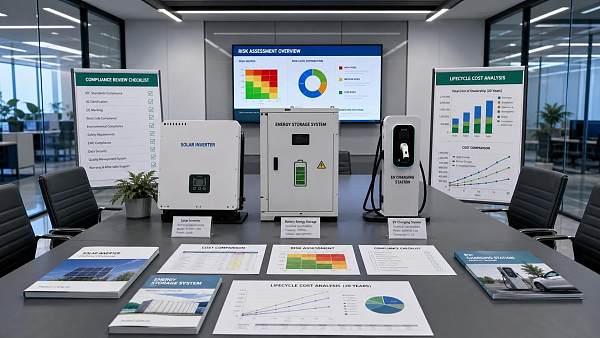
Ask each bidder to submit a compliance matrix against the same requirements. The response should use clear status labels such as “compliant,” “compliant with clarification,” “deviation,” or “not included.” A generic statement that the supplier “understands the requirements” is not enough. Every deviation should refer to a specific specification clause and explain its technical, commercial, and schedule effect.
Separate mandatory gates from scored preferences
Not every criterion should be treated as a weighted scoring item. Some conditions are pass-or-fail gates because accepting them would expose the owner to an unacceptable risk. Examples include required grid-code functionality, legal authorization to supply equipment in the project market, minimum electrical safety documentation, a defined warranty position, or the ability to meet a fixed energization date.
Other features can be scored after the gate review, such as efficiency, footprint, maintainability, delivery flexibility, monitoring functions, or enhanced training. This distinction matters. A bid that does not meet a critical requirement should not rise to the top because it scored well on price or presentation quality.
- Mandatory: technical parameters that cannot change without redesign or approval.
- Conditional: items that may be accepted with a documented mitigation plan.
- Optional: improvements that may add value but are not necessary for project execution.
Check technical compliance where operational risk actually sits
Technical evaluation should move beyond nameplate ratings. The key question is whether the proposed system will perform as an integrated asset under the project’s site, grid, and operating conditions. A component can be technically sound in isolation and still create poor outcomes when its controls, communications, protection settings, or physical design do not fit the rest of the plant.
For solar and wind procurements, examine the interface between generation equipment, collection systems, substation design, plant controller, meteorological instruments, and remote monitoring. Verify the assumed ambient conditions, corrosion environment, wind or snow loads where applicable, cable routing assumptions, access for maintenance, and curtailment capability. Confirm that the offer identifies which party is responsible for demonstrating plant-level performance after commissioning.
Storage projects require particular discipline because the advertised capacity can be measured in different ways. Compare usable versus nominal energy, beginning-of-life versus end-of-warranty capability, AC-side versus DC-side measurement, operating temperature limitations, auxiliary consumption, and degradation assumptions. A battery bid should also state how it handles state-of-charge limits, emergency shutdown, thermal events, isolation monitoring, communications loss, and replacement of failed modules.
In EV charging projects, charging power alone is not a sufficient comparison point. Review connector compatibility, simultaneous charging behavior, dynamic load management, payment and user-authentication capability, network communications, service access, and how chargers respond to grid constraints. A depot or fleet site may need a control strategy that prioritizes vehicles by departure time; a public site may place greater weight on uptime visibility, payment flow, and fault-response arrangements.

Grid connection and controls deserve their own review
Grid-related obligations are often distributed across electrical specifications, utility correspondence, engineering drawings, and commercial schedules. Bring them together before award. The bidder should demonstrate how the proposed equipment supports required voltage and frequency operating ranges, reactive power, power-factor control, ramp-rate limits, fault ride-through behavior, protection coordination, metering, and remote dispatch signals where relevant.
Do not assume that equipment marketed as “grid compliant” is automatically suitable for the project. Compliance depends on the applicable connection agreement, point of interconnection, plant capacity, network characteristics, and control architecture. Request a responsibility matrix that shows who provides settings, who validates them, who attends utility tests, and who resolves failed commissioning tests. This is especially important where an EPC contractor supplies the balance of plant while another party supplies inverters, storage controls, or charging management software.
Evaluate the supplier’s ability to execute, not just its product brochure
A strong bid should show that the supplier has planned the work between purchase order and handover. Review the proposed project organization, engineering deliverables, manufacturing or sourcing plan, logistics approach, site installation sequence, commissioning method, and escalation contacts. The purpose is not to demand a lengthy narrative; it is to identify whether the bidder understands the dependencies that could interrupt progress.
Look for vague schedule commitments such as “delivery subject to availability” or “commissioning support to be agreed.” These phrases can conceal substantial exposure. Require a milestone schedule that identifies design release, procurement of long-lead items, factory testing where applicable, shipment, site readiness, installation, energization, performance testing, and documentation handover. Each milestone should have named dependencies and a clear owner.
Supplier capability also includes interface management. Renewable projects commonly involve civil contractors, grid operators, control-system integrators, equipment suppliers, and owner representatives. A bidder should identify interfaces it controls directly and the information it needs from others. Where two bids assign the same task to different parties, the procurement team should resolve the gap before contract award rather than relying on later coordination meetings.
Compare commercial offers on a normalized lifecycle basis
Lowest evaluated cost is more useful than lowest quoted price. Normalize proposals by adjusting for exclusions, scope gaps, assumed quantities, shipping terms, taxes or duties where relevant, commissioning support, training, software licenses, mandatory spares, and extended warranty requirements. The result should show both the bidder’s quoted amount and the estimated cost required to make the offer equivalent to the requested scope.
Lifecycle review does not require speculative financial modeling. It requires identifying cost drivers that are already visible in the proposal. These may include auxiliary energy consumption, replacement intervals, warranty limitations, proprietary software fees, required inspection frequency, special lifting or access needs, spare-parts stocking, or dependency on a single service provider. A less expensive battery system may have a higher operational burden if its maintenance access is restricted or if essential monitoring functions require recurring fees. Likewise, a low-cost inverter offer may be less attractive if field replacement requires extensive rewiring or a long shutdown.
Review payment terms alongside delivery risk. Large advance payments, unclear title transfer, payment milestones unrelated to verifiable deliverables, or retention provisions that end before performance testing can shift too much exposure to the buyer. The appropriate structure depends on the project and contract model, but the principle remains consistent: payment should follow evidence of progress, and acceptance should be tied to defined tests and documentation.
Read warranty language as an operating document
Warranty comparison is often reduced to duration, which is rarely enough. Examine what triggers a claim, which party diagnoses the fault, whether labor and transport are included, how replacement parts are supplied, what response times are stated, and whether the warranty contains performance conditions that are difficult to verify. For generation assets, distinguish product defect coverage from energy-yield or availability obligations. For storage, determine whether capacity retention, throughput, operating window, and control settings affect coverage.
Also check whether warranty protection survives assignment to a project owner, lender, or future asset purchaser where this may be relevant. A warranty that cannot be transferred, or that becomes invalid when a third-party service provider performs routine work, can materially reduce long-term value.
Use a scoring model, but keep the decision traceable
A weighted evaluation model can improve consistency when several disciplines are involved. Typical categories include technical compliance, delivery and execution, commercial position, operations and maintenance, warranty, and sustainability or local-content requirements where they are part of the bid conditions. The exact weighting should reflect the project’s constraints. A project approaching a fixed grid-connection deadline may place more weight on schedule certainty; a long-duration asset may give greater prominence to serviceability and warranty quality.
Scores should be supported by written comments and evidence references, not just numbers. A score of “3 out of 5” has little value unless the evaluator records why the offer is acceptable, what remains unproven, and whether a clarification could change the result. This record is useful when technical and commercial teams disagree, when approval committees challenge the recommendation, or when negotiations alter a bidder’s commitments.
A practical sequence is to complete the technical gate review before opening detailed commercial comparison, issue clarifications to all affected bidders on an equal basis, then score only the revised and documented proposals. Avoid changing requirements informally during one bidder’s meeting. Any material clarification should be shared consistently so that the final evaluation remains defensible.
Questions that should be resolved before recommendation
Before moving from preferred bidder status to contract award, test whether the proposal can withstand the questions that arise during execution. Can every major interface be assigned to one party? Are all deviations either closed or explicitly accepted? Does the schedule reflect actual lead times and site dependencies? Are commissioning tests defined well enough to determine acceptance? Is the supplier’s service commitment specific enough to manage a fault after handover?
Where answers remain uncertain, convert the uncertainty into a contract deliverable, a condition precedent, a priced option, or a documented exclusion with an owner. Leaving it as an informal assumption is usually the weakest outcome. The final procurement recommendation should state not only which bid is preferred, but also the residual risks, required negotiations, and items that must be verified before notice to proceed.
The strongest bid is not necessarily the most detailed-looking submission. It is the offer that demonstrates clear compliance, realistic execution, accountable interfaces, transparent commercial terms, and a support model aligned with the asset’s operating needs. That standard gives procurement teams a firmer basis for award and reduces the number of expensive questions that emerge after the contract is signed.
Questions about market trends? Contact Market Scope Live for deeper business insights.
We respect your privacy. Your information is strictly confidential.
Related News
 Global Energy Policy & SourcingEBRD Plans $6 Billion for Turkish Clean Energy Projects Over Five YearsEBRD plans $6 billion for Turkish clean energy projects over five years. Explore potential supply chain opportunities and what businesses should watch.MORE+
 Global Energy Policy & SourcingCOP31 Focuses on Grid Upgrades as Aging Networks Hinder Clean Energy TransitionCOP31 grid upgrades could reshape the clean energy transition. Explore how aging networks and cross-border connections may affect renewable energy projects and suppliers.MORE+
 Global Energy Policy & SourcingIndia Approves 145 Billion Rupee Plan to Support 92 GWh of Energy StorageIndia's energy storage plan commits 145 billion rupees to support 92 GWh by 2030–31. Explore the funding and what it could mean for projects.MORE+
 Global Energy Policy & SourcingChina's Wind and Solar Capacity Reaches 2 Billion kW; 170 Million kW AddedChina's wind and solar capacity reportedly reached 2 billion kW. Explore what the milestone could mean for project procurement, grid integration and suppliers.MORE+
 Global Energy Policy & SourcingSolarPower Europe Urges EU Ministers to Address Root Causes of High Energy PricesSolarPower Europe urges EU ministers to tackle high energy prices through consumer relief, electrification and renewables. Explore its call for action.MORE+
 Global Energy Policy & SourcingAustralia’s Clean Energy Investment Surges as H1 2026 Storage and Generation Hit RecordsAustralia’s clean energy investment hits H1 2026 records in generation financing and battery storage operations. Explore what this means for procurement, project delivery and suppliers.MORE+
 Global Energy Policy & SourcingHow Variable Steam Demand Affects Turbine Sizing in Process PlantsChoosing a steam turbine supplier? Learn how variable steam demand, pressure limits, and part-load efficiency affect turbine sizing—and avoid costly oversizing in your process plant.MORE+
 Global Energy Policy & SourcingSteam Turbine Lifecycle Costs: What to Include Beyond Purchase PriceCompare steam turbine supplier offers beyond purchase price. Explore installation, energy, maintenance and downtime costs to make a smarter lifecycle investment.MORE+
 Global Energy Policy & SourcingGrid Operators in South Africa: Who Runs Transmission and Distribution?Discover the grid operators South Africa relies on, from NTCSA to Eskom and municipalities. Find the right connection route and avoid costly project delays with this practical guide.MORE+
 Global Energy Policy & SourcingChoosing a Medium Voltage Switchgear Factory: Quality Checks Before OrderingChoosing a medium voltage switchgear factory? Discover essential quality checks, test evidence, and acceptance terms to reduce procurement risks before you order.MORE+
 Global Energy Policy & SourcingK9 Ductile Iron Pipe Specifications: Pressure Class and Buyer ChecksBuying K9 ductile iron pipe? Learn how thickness differs from pressure class and which standards, joints, and quality checks to verify before ordering. Avoid costly procurement mistakes.MORE+
 Global Energy Policy & SourcingRenewable Energy Project Procurement: A Practical Bid Evaluation ChecklistRenewable energy project procurement: use this practical bid evaluation checklist to compare compliance, grid readiness, delivery risk, lifecycle cost, and warranties before award.MORE+
 Global Energy Policy & SourcingStrategic Energy Procurement: Which Contract Terms Reduce Price Volatility?Strategic energy procurement insights on contract terms that reduce price volatility, protect budgets, and strengthen financial control. Explore practical risk-management strategies.MORE+
 Global Energy Policy & SourcingEnergy Strategic Sourcing Frameworks for Cost Control and Supply SecurityEnergy strategic sourcing frameworks help control lifetime costs, strengthen supply security, qualify resilient suppliers, and protect energy projects from delays and operational risk.MORE+
 Global Energy Policy & SourcingIOU Strategic Sourcing: Managing Supplier Risk in Utility Energy ContractsIOU strategic sourcing helps investor-owned utilities manage supplier risk, strengthen energy contracts, and protect long-term grid reliability.MORE+
 Global Energy Policy & SourcingPublic Power Strategic Sourcing: Building Transparent Energy Procurement ProgramsPublic power strategic sourcing guide for transparent, resilient energy procurement—improve lifecycle value, supplier accountability, and grid-ready decisions.MORE+
 Global Energy Policy & SourcingU.S. Infrastructure Investors in Clean Energy: Who Funds What Projects?Infrastructure investors in USA are reshaping clean energy funding. Discover who finances solar, storage, grid modernization, and EV charging—and what makes projects investable.MORE+
 Global Energy Policy & SourcingDistribution Transformer Efficiency Regulation Updates: Compliance Steps for UtilitiesDistribution transformer energy efficiency regulation update: learn practical compliance steps, loss-test requirements, and procurement controls for utilities.MORE+
 Global Energy Policy & SourcingEU Grid Code Compliance for Solar and BESS Projects: Key Tests and RequirementsGrid code compliance Europe for solar and BESS projects: discover essential voltage, frequency, ride-through, protection, telemetry and testing requirements for faster connection approval.MORE+
 Global Energy Policy & SourcingKey Technical Parameters That Determine Steam Turbine Suitability for Industrial Cogeneration Projectssteam turbine supplier? Discover the 5 critical technical parameters—exhaust pressure, steam quality tolerance, part-load efficiency & more—that truly determine suitability for industrial cogeneration projects.MORE+
 Global Energy Policy & SourcingSoutheast Asia Energy Project Pipeline: Key Markets, Timelines, and Investment SignalsExplore the energy project pipeline Southeast Asia: key markets, project timelines, grid risks, and investment signals for smarter renewable energy decisions.MORE+
 Global Energy Policy & SourcingIndustrial Energy Users in South Africa: Costs, Supply Risks and TrendsIndustrial energy users in South Africa: explore cost pressures, supply risks, solar, storage and practical strategies to improve resilience and control energy spend.MORE+
 Global Energy Policy & SourcingSteam Turbine Maintenance Checks to Confirm Before Finalizing a PurchaseSteam turbine supplier checklist: confirm maintenance access, spares, oil systems, controls, and service support before purchase to reduce outage risk.MORE+
 Global Energy Policy & SourcingDoes EPEM Provide Regional Data on Clean Energy Project Financing?Does EPEM cover clean energy project financing data by region? Explore regional market, grid, policy, and risk insights to support smarter clean energy investment screening.MORE+
 Global Energy Policy & SourcingDuctile Iron Pipe Acceptance Testing for Water Infrastructure ProjectsDuctile iron pipe acceptance testing guide for water projects: verify standards, traceability, coatings, joints, and hydrostatic tests for reliable compliance.MORE+
 Global Energy Policy & SourcingShould Fleet Charging Depots Use On-Site Solar or Buy Green Power?Should I integrate solar generation directly at a fleet charging depot or buy green power? Explore costs, reliability, storage, and smarter charging strategies.MORE+
 Global Energy Policy & SourcingGlobal Energy Project Pipeline: Where Investment Is Moving Across Solar, Wind, BESS, and EV ChargingGlobal energy project pipeline insights: see where investment is shifting across solar, wind, BESS, and EV charging, and what makes projects bankable, grid-ready, and worth backing.MORE+
 Global Energy Policy & SourcingWhat Does Grid Decarbonization Consulting Cover for Utility-Scale Power Projects?Grid decarbonization consulting helps utility-scale power projects cut emissions, stay grid-compliant, and improve long-term returns. Discover how it supports planning, flexibility, and execution.MORE+
 Global Energy Policy & SourcingWhich Decarbonization Technologies for Industry Deliver the Best ROI by Process Type?Decarbonization technologies for industry deliver the best ROI when matched to process type. Explore electrification, waste heat recovery, fuel switching, and digital upgrades.MORE+
 Global Energy Policy & SourcingChina Launches Green Certificate Price IndexChina Launches Green Certificate Price Index: learn how the new benchmark affects CBAM, ESG compliance, green electricity tracing, and carbon reporting for exporters and global buyers.MORE+
 Global Energy Policy & SourcingHow to Evaluate Renewable Equipment Tenders for Risk, Compliance, and Total CostRenewable equipment tenders require more than price checks. Learn how to assess risk, compliance, and total cost to avoid hidden project issues and choose smarter bids.MORE+
 Global Energy Policy & SourcingCommon Water Waste and Hygiene Issues in Poultry Nipple Drinking SystemsNipple drinking system poultry issues often start with leaks, pressure errors, and hidden biofilm. Learn how to cut water waste, improve hygiene, and protect flock performance.MORE+
 Global Energy Policy & SourcingRenewable Energy Infrastructure Development: Key Policy, Grid, and Financing TrendsRenewable energy infrastructure development is being reshaped by policy reform, grid constraints, and smarter financing—discover the trends driving bankable, future-ready projects.MORE+
 Global Energy Policy & SourcingEquipment Bankability Supplier Review: What Buyers Should Check Before ShortlistingEquipment bankability supplier review: learn what buyers should check before shortlisting, from financial strength and certifications to service support, warranty risk, and real project performance.MORE+
 Global Energy Policy & SourcingPower Project Permitting in Saudi Arabia: Key Approvals, Timelines, and Common DelaysPower project permitting Saudi Arabia explained: key approvals, realistic timelines, and the most common delay risks—plus practical steps to keep energy projects bankable and on schedule.MORE+
 Global Energy Policy & SourcingHow to Evaluate Clean Energy Investment Utility Scale Projects Before Committing CapitalClean energy investment utility scale decisions require more than headline capacity. Discover how to assess grid access, revenue quality, execution risk, and long-term returns before committing capital.MORE+
 Global Energy Policy & SourcingUtility Renewable Energy Infrastructure Explained: Key Assets, Risks, and Build-Out PrioritiesUtility renewable energy infrastructure explained: explore key assets, grid and storage risks, and build-out priorities to improve project bankability, resilience, and long-term value.MORE+
 Global Energy Policy & SourcingAgrivoltaic Systems in France: Land Use Rules, Crop Fit, and Project Planning BasicsAgrivoltaic systems France explained: learn land use rules, crop fit, permitting, and grid basics to assess smarter, more bankable solar-agriculture projects.MORE+
![]() Global Energy Policy & SourcingMicrogrid Project Permitting Checklist: Key Approvals, Studies, and Common DelaysMicrogrid project permitting made practical: explore key approvals, required studies, and the most common delays to keep projects bankable, compliant, and on schedule.MORE+
 Global Energy Policy & SourcingProject Owners Financing Options for Energy Projects: Loans, Leasing, or EPC Credit?Project owners financing options explained: compare loans, leasing, and EPC credit for energy projects to reduce risk, protect cash flow, and choose the smartest funding path.MORE+