K9 Ductile Iron Pipe Specifications: Pressure Class and Buyer Checks
A purchase order that specifies only “K9 pipe” leaves a significant engineering question unanswered: what pressure can the delivered pipeline safely withstand? K9 is a wall-thickness classification, not a universal pressure rating. Working pressure depends on pipe diameter, the applicable standard, joint design, fittings, and the manufacturer’s declared performance. Treating K9 as interchangeable with C40, C30, or C25 can produce quotations that look comparable but cover different products.
For procurement teams, the practical task is to turn a short product description into an auditable specification. That means separating thickness requirements from pressure requirements, defining the operating conditions, and agreeing on evidence before shipment—not after the pipes arrive.
What K9 means—and what it does not
In the thickness-class approach used in ISO 2531:1998, nominal ductile iron pipe wall thickness is related to nominal diameter through the expression e = K × (0.5 + 0.001 × DN), where e is expressed in millimetres and K is the thickness-class coefficient. K9 uses a coefficient of nine. The standard’s dimensional tables, minimum thickness provisions, and manufacturing tolerances must also be applied; the formula alone is not a complete acceptance specification. [1]
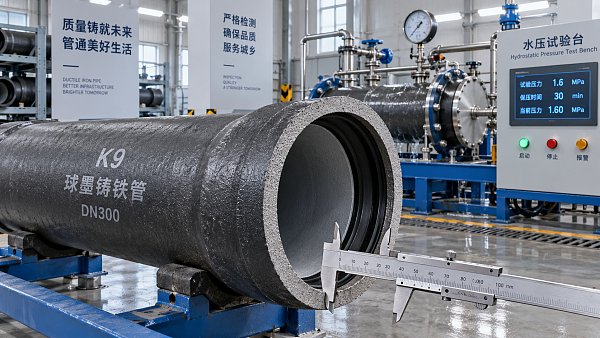
For example, that expression gives a nominal thickness of 7.2 mm at DN 300 and 9.9 mm at DN 600 for K9. These are illustrations of the legacy calculation, not guaranteed dimensions for any particular supplier’s product. An order must identify the governing standard and edition, then obtain the applicable dimensional schedule. [1]
The important procurement distinction is that the same K designation does not establish one allowable pressure across every diameter. Nor does nominal wall thickness establish the capacity of a socket, restrained joint, flange, or valve connection. A pipe barrel and its connecting components need separate verification against the project’s pressure requirements.
ISO 2531:2009 and EN 545:2010 provide pressure-class provisions for ductile iron water pipelines. Their classification and performance requirements should not be mixed casually with a legacy K-class specification. A quotation described as “K9/C40” needs clarification: does it offer two alternatives, claim compliance with both classifications, or merely use familiar catalogue terminology? [2][3]
When reviewing a listing for K9 ductile iron pipe, buyers should use the product designation as a starting point for technical questions. Request a diameter-specific schedule showing the standard edition, nominal and permitted minimum wall thickness, joint type, and declared pressure capability. A catalogue label is not a substitute for that schedule.
Read pressure ratings as operating limits, not interchangeable numbers
Pressure documentation should distinguish normal service, occasional maximum conditions, and site testing. EN 545:2010 uses the following terms; buyers should confirm that a supplier’s schedule uses them in the same sense. [3]
Within the EN 545 pressure-class system, C40 identifies an allowable operating pressure of 40 bar for the relevant pipe classification. It does not automatically make an assembled pipeline suitable for every 40-bar application. Joint limitations, fittings, accessories, and the selected configuration still require verification. The same distinction applies when evaluating C30 or C25 offers. [3]
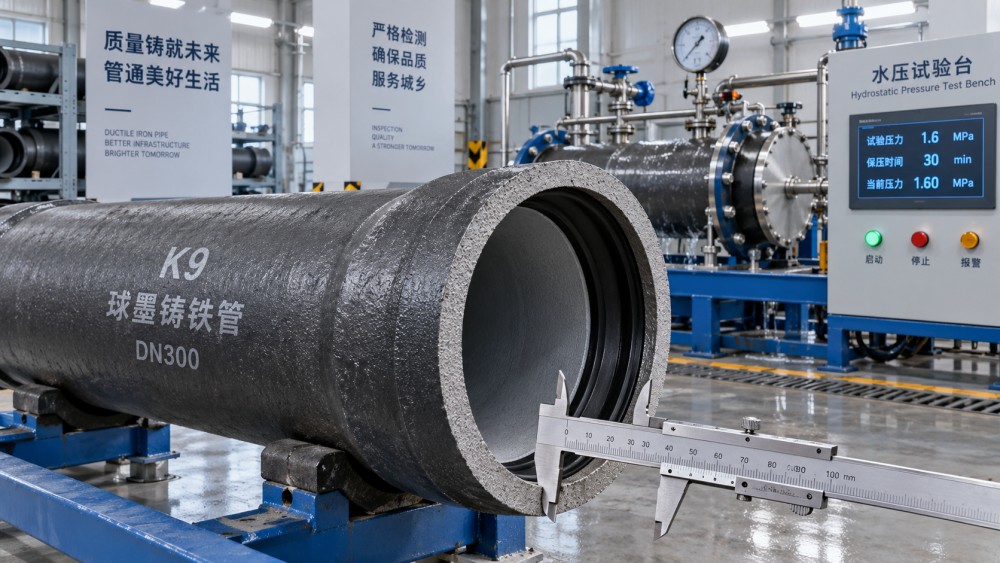
A factory hydrostatic test report answers a different question from a service-pressure declaration. It records testing under specified manufacturing conditions; it should not be interpreted as permission to operate continuously at the factory test pressure. Factory testing and site testing also have different purposes and acceptance arrangements. [2][3]
Ask the designer to provide the maximum steady pressure, surge envelope, and field test pressure before comparing bids. Where these remain unresolved, record them as open technical conditions rather than accepting the supplier’s proposed class as the design basis.
Define the application before choosing the pipe class
A pumping main and a gravity-fed distribution line may have similar nominal operating pressures but different transient behaviour. Pump trips, valve movement, and elevation changes can alter the pressure envelope. Procurement should therefore obtain the designer’s pressure requirements by pipeline section, particularly where the route includes substantial elevation differences.
Buried-pipe selection also requires more than an internal-pressure check. Cover depth, traffic loading, bedding, trench conditions, and groundwater can affect the structural assessment. ISO 2531 and EN 545 establish product requirements, but compliance with a product standard does not replace the project’s installation design. [2][3]
Joint selection deserves a separate decision. A conventional push-in joint should not be assumed to provide axial restraint. Bends, tees, reducers, closed valves, and terminal points can require an engineered thrust-management arrangement. If restrained joints are specified, ask for their pressure capability, permitted angular deflection, and installation conditions—not simply the rating of the plain pipe barrel.
For potable water, identify the jurisdiction’s material-contact requirements and the approvals accepted by the asset owner. NSF/ANSI/CAN 61, for example, addresses drinking-water system component health effects; it is not a pipe pressure-rating standard. Any certification claim should be checked for scope, including the relevant lining, coating, gasket, and product configuration. [4]
Where the conveyed fluid is wastewater or chemically aggressive process water, do not assume that a drinking-water specification covers the application. The fluid chemistry, temperature range, and exposure conditions should be supplied to the party responsible for selecting the lining and sealing materials.
Write an RFQ that produces comparable quotations
A useful request for quotation separates mandatory requirements from supplier-proposed options. Otherwise, one bidder may price standard push-in joints and another restrained joints, or one may include a particular coating system while another leaves it undefined. The apparent price difference then reflects different scopes rather than purchasing efficiency.
The technical schedule should include:
- Standard and edition: identify the governing product standard, classification system, and any owner-specific requirements.
- Dimensions: list DN, quantity, effective laying length, outside-diameter requirements, wall-thickness criteria, and relevant tolerances.
- Pressure envelope: state required PFA, PMA, and PEA, or clearly defined equivalent project requirements.
- Connections: specify joint type, restraint requirements, flange interfaces where applicable, and compatibility with existing assets.
- Protection and seals: define the internal lining, external protection, gasket material, and applicable water-contact requirements.
- Evidence and delivery: state inspection documents, traceability, packing, delivery sequence, and treatment of nonconforming material.
Require bidders to list deviations explicitly. “Equivalent” should be supported by dimensions, pressure declarations, joint details, and compliance evidence. A proposed pressure-class pipe may be acceptable in place of a K-class pipe, but substitution needs engineering approval rather than a purchasing assumption.
Effective laying length is particularly useful when comparing delivered cost. Different supplied lengths can change the number of joints and handling operations required. Buyers should calculate cost against the accepted pipeline scope, including gaskets, fittings, restraint components, and any special installation equipment.
Check quality evidence against the actual shipment
A generic certificate can support supplier screening, but shipment acceptance requires documents connected to the delivered material. Ask how markings and production identifiers link individual pipes or batches to inspection records. The traceability arrangement should be agreed before production, especially where deliveries will be split across several shipments.
Under the applicable ISO 2531 or EN 545 requirements, the inspection package should address relevant dimensional checks, mechanical properties, and leak-tightness testing. Buyers should confirm the sampling basis and acceptance criteria in the governing edition rather than inventing a blanket requirement that every property be tested on every pipe. [2][3]
Wall-thickness acceptance needs precise language. “K9 thickness” does not tell an inspector whether to assess nominal thickness, permitted minimum thickness, or a project-specific minimum. Agree on measurement locations, method, and treatment of disputed results. A single convenient reading should not be presented as evidence for an entire shipment.
Linings, coatings, and sealing rings also require identifiable specifications. For elastomeric seals, EN 681-1 provides material requirements for seals used in water and drainage applications; compliance should be assessed against the specified seal category and service conditions. It does not establish that every gasket formulation suits every conveyed fluid. [5]
At receipt, practical checks include pipe identification, socket and spigot condition, visible lining or coating damage, cleanliness, and gasket packaging. Photographs and a receiving log help distinguish transport damage from manufacturing nonconformities. Any repair should follow an agreed procedure with defined acceptance criteria.
Evaluate delivery risk alongside unit price
A lower pipe price can lose its advantage if the shipment does not match the installation sequence. Procurement should align deliveries with the required diameters, fittings, joints, and accessories. Receiving straight pipe without the connecting components can leave a workfront blocked while storage and handling costs continue.
Confirm how pipes will be supported and secured during transport, which lifting arrangements are permitted, and how gaskets will be protected and stored. These details affect the condition of the material available for installation, even when the factory inspection package is complete.
For a proposed alternative, compare total installed scope rather than weight alone. Additional restraint, different fittings, altered handling requirements, or extra inspection can offset a lower material price. Conversely, specifying a heavier wall without an engineering need can add cost without resolving the actual risk, such as surge pressure or an unsuitable joint.
Release the order only after the interfaces are resolved
Before approval, the buyer should be able to answer four questions: Which standard and edition govern the pipe? What pressure requirements apply at each relevant diameter and location? Are the joints, fittings, seals, and protective systems compatible with the service? What evidence will demonstrate conformity at receipt?
Any unresolved answer should become a documented hold point, clarification, or approved deviation. The defensible purchasing decision is not “K9 is stronger” or “C40 is equivalent.” It is that the specified pipe and its interfaces satisfy the agreed operating, installation, and acceptance requirements.
Sources
- [1] ISO 2531:1998, Ductile iron pipes, fittings, accessories and their joints for water or gas applications. Source for the legacy thickness-class expression and dimensional provisions.
- [2] ISO 2531:2009, Ductile iron pipes, fittings, accessories and their joints for water applications. Source for product classification, performance, and testing requirements.
- [3] EN 545:2010, Ductile iron pipes, fittings, accessories and their joints for water pipelines — Requirements and test methods. Source for pressure terminology, pressure classes, and conformity requirements.
- [4] NSF/ANSI/CAN 61, Drinking Water System Components — Health Effects. Source for the stated health-effects assessment scope.
- [5] EN 681-1, Elastomeric seals — Materials requirements for pipe joint seals used in water and drainage applications — Part 1: Vulcanized rubber.
Questions about market trends? Contact Market Scope Live for deeper business insights.
We respect your privacy. Your information is strictly confidential.
Related News
 Global Energy Policy & SourcingEBRD Plans $6 Billion for Turkish Clean Energy Projects Over Five YearsEBRD plans $6 billion for Turkish clean energy projects over five years. Explore potential supply chain opportunities and what businesses should watch.MORE+
 Global Energy Policy & SourcingCOP31 Focuses on Grid Upgrades as Aging Networks Hinder Clean Energy TransitionCOP31 grid upgrades could reshape the clean energy transition. Explore how aging networks and cross-border connections may affect renewable energy projects and suppliers.MORE+
 Global Energy Policy & SourcingIndia Approves 145 Billion Rupee Plan to Support 92 GWh of Energy StorageIndia's energy storage plan commits 145 billion rupees to support 92 GWh by 2030–31. Explore the funding and what it could mean for projects.MORE+
 Global Energy Policy & SourcingChina's Wind and Solar Capacity Reaches 2 Billion kW; 170 Million kW AddedChina's wind and solar capacity reportedly reached 2 billion kW. Explore what the milestone could mean for project procurement, grid integration and suppliers.MORE+
 Global Energy Policy & SourcingSolarPower Europe Urges EU Ministers to Address Root Causes of High Energy PricesSolarPower Europe urges EU ministers to tackle high energy prices through consumer relief, electrification and renewables. Explore its call for action.MORE+
 Global Energy Policy & SourcingAustralia’s Clean Energy Investment Surges as H1 2026 Storage and Generation Hit RecordsAustralia’s clean energy investment hits H1 2026 records in generation financing and battery storage operations. Explore what this means for procurement, project delivery and suppliers.MORE+
 Global Energy Policy & SourcingHow Variable Steam Demand Affects Turbine Sizing in Process PlantsChoosing a steam turbine supplier? Learn how variable steam demand, pressure limits, and part-load efficiency affect turbine sizing—and avoid costly oversizing in your process plant.MORE+
 Global Energy Policy & SourcingSteam Turbine Lifecycle Costs: What to Include Beyond Purchase PriceCompare steam turbine supplier offers beyond purchase price. Explore installation, energy, maintenance and downtime costs to make a smarter lifecycle investment.MORE+
 Global Energy Policy & SourcingGrid Operators in South Africa: Who Runs Transmission and Distribution?Discover the grid operators South Africa relies on, from NTCSA to Eskom and municipalities. Find the right connection route and avoid costly project delays with this practical guide.MORE+
 Global Energy Policy & SourcingChoosing a Medium Voltage Switchgear Factory: Quality Checks Before OrderingChoosing a medium voltage switchgear factory? Discover essential quality checks, test evidence, and acceptance terms to reduce procurement risks before you order.MORE+
 Global Energy Policy & SourcingK9 Ductile Iron Pipe Specifications: Pressure Class and Buyer ChecksBuying K9 ductile iron pipe? Learn how thickness differs from pressure class and which standards, joints, and quality checks to verify before ordering. Avoid costly procurement mistakes.MORE+
 Global Energy Policy & SourcingRenewable Energy Project Procurement: A Practical Bid Evaluation ChecklistRenewable energy project procurement: use this practical bid evaluation checklist to compare compliance, grid readiness, delivery risk, lifecycle cost, and warranties before award.MORE+
 Global Energy Policy & SourcingStrategic Energy Procurement: Which Contract Terms Reduce Price Volatility?Strategic energy procurement insights on contract terms that reduce price volatility, protect budgets, and strengthen financial control. Explore practical risk-management strategies.MORE+
 Global Energy Policy & SourcingEnergy Strategic Sourcing Frameworks for Cost Control and Supply SecurityEnergy strategic sourcing frameworks help control lifetime costs, strengthen supply security, qualify resilient suppliers, and protect energy projects from delays and operational risk.MORE+
 Global Energy Policy & SourcingIOU Strategic Sourcing: Managing Supplier Risk in Utility Energy ContractsIOU strategic sourcing helps investor-owned utilities manage supplier risk, strengthen energy contracts, and protect long-term grid reliability.MORE+
 Global Energy Policy & SourcingPublic Power Strategic Sourcing: Building Transparent Energy Procurement ProgramsPublic power strategic sourcing guide for transparent, resilient energy procurement—improve lifecycle value, supplier accountability, and grid-ready decisions.MORE+
 Global Energy Policy & SourcingU.S. Infrastructure Investors in Clean Energy: Who Funds What Projects?Infrastructure investors in USA are reshaping clean energy funding. Discover who finances solar, storage, grid modernization, and EV charging—and what makes projects investable.MORE+
 Global Energy Policy & SourcingDistribution Transformer Efficiency Regulation Updates: Compliance Steps for UtilitiesDistribution transformer energy efficiency regulation update: learn practical compliance steps, loss-test requirements, and procurement controls for utilities.MORE+
 Global Energy Policy & SourcingEU Grid Code Compliance for Solar and BESS Projects: Key Tests and RequirementsGrid code compliance Europe for solar and BESS projects: discover essential voltage, frequency, ride-through, protection, telemetry and testing requirements for faster connection approval.MORE+
 Global Energy Policy & SourcingKey Technical Parameters That Determine Steam Turbine Suitability for Industrial Cogeneration Projectssteam turbine supplier? Discover the 5 critical technical parameters—exhaust pressure, steam quality tolerance, part-load efficiency & more—that truly determine suitability for industrial cogeneration projects.MORE+
 Global Energy Policy & SourcingSoutheast Asia Energy Project Pipeline: Key Markets, Timelines, and Investment SignalsExplore the energy project pipeline Southeast Asia: key markets, project timelines, grid risks, and investment signals for smarter renewable energy decisions.MORE+
 Global Energy Policy & SourcingIndustrial Energy Users in South Africa: Costs, Supply Risks and TrendsIndustrial energy users in South Africa: explore cost pressures, supply risks, solar, storage and practical strategies to improve resilience and control energy spend.MORE+
 Global Energy Policy & SourcingSteam Turbine Maintenance Checks to Confirm Before Finalizing a PurchaseSteam turbine supplier checklist: confirm maintenance access, spares, oil systems, controls, and service support before purchase to reduce outage risk.MORE+
 Global Energy Policy & SourcingDoes EPEM Provide Regional Data on Clean Energy Project Financing?Does EPEM cover clean energy project financing data by region? Explore regional market, grid, policy, and risk insights to support smarter clean energy investment screening.MORE+
 Global Energy Policy & SourcingDuctile Iron Pipe Acceptance Testing for Water Infrastructure ProjectsDuctile iron pipe acceptance testing guide for water projects: verify standards, traceability, coatings, joints, and hydrostatic tests for reliable compliance.MORE+
 Global Energy Policy & SourcingShould Fleet Charging Depots Use On-Site Solar or Buy Green Power?Should I integrate solar generation directly at a fleet charging depot or buy green power? Explore costs, reliability, storage, and smarter charging strategies.MORE+
 Global Energy Policy & SourcingGlobal Energy Project Pipeline: Where Investment Is Moving Across Solar, Wind, BESS, and EV ChargingGlobal energy project pipeline insights: see where investment is shifting across solar, wind, BESS, and EV charging, and what makes projects bankable, grid-ready, and worth backing.MORE+
 Global Energy Policy & SourcingWhat Does Grid Decarbonization Consulting Cover for Utility-Scale Power Projects?Grid decarbonization consulting helps utility-scale power projects cut emissions, stay grid-compliant, and improve long-term returns. Discover how it supports planning, flexibility, and execution.MORE+
 Global Energy Policy & SourcingWhich Decarbonization Technologies for Industry Deliver the Best ROI by Process Type?Decarbonization technologies for industry deliver the best ROI when matched to process type. Explore electrification, waste heat recovery, fuel switching, and digital upgrades.MORE+
 Global Energy Policy & SourcingChina Launches Green Certificate Price IndexChina Launches Green Certificate Price Index: learn how the new benchmark affects CBAM, ESG compliance, green electricity tracing, and carbon reporting for exporters and global buyers.MORE+
 Global Energy Policy & SourcingHow to Evaluate Renewable Equipment Tenders for Risk, Compliance, and Total CostRenewable equipment tenders require more than price checks. Learn how to assess risk, compliance, and total cost to avoid hidden project issues and choose smarter bids.MORE+
 Global Energy Policy & SourcingCommon Water Waste and Hygiene Issues in Poultry Nipple Drinking SystemsNipple drinking system poultry issues often start with leaks, pressure errors, and hidden biofilm. Learn how to cut water waste, improve hygiene, and protect flock performance.MORE+
 Global Energy Policy & SourcingRenewable Energy Infrastructure Development: Key Policy, Grid, and Financing TrendsRenewable energy infrastructure development is being reshaped by policy reform, grid constraints, and smarter financing—discover the trends driving bankable, future-ready projects.MORE+
 Global Energy Policy & SourcingEquipment Bankability Supplier Review: What Buyers Should Check Before ShortlistingEquipment bankability supplier review: learn what buyers should check before shortlisting, from financial strength and certifications to service support, warranty risk, and real project performance.MORE+
 Global Energy Policy & SourcingPower Project Permitting in Saudi Arabia: Key Approvals, Timelines, and Common DelaysPower project permitting Saudi Arabia explained: key approvals, realistic timelines, and the most common delay risks—plus practical steps to keep energy projects bankable and on schedule.MORE+
 Global Energy Policy & SourcingHow to Evaluate Clean Energy Investment Utility Scale Projects Before Committing CapitalClean energy investment utility scale decisions require more than headline capacity. Discover how to assess grid access, revenue quality, execution risk, and long-term returns before committing capital.MORE+
 Global Energy Policy & SourcingUtility Renewable Energy Infrastructure Explained: Key Assets, Risks, and Build-Out PrioritiesUtility renewable energy infrastructure explained: explore key assets, grid and storage risks, and build-out priorities to improve project bankability, resilience, and long-term value.MORE+
 Global Energy Policy & SourcingAgrivoltaic Systems in France: Land Use Rules, Crop Fit, and Project Planning BasicsAgrivoltaic systems France explained: learn land use rules, crop fit, permitting, and grid basics to assess smarter, more bankable solar-agriculture projects.MORE+
![]() Global Energy Policy & SourcingMicrogrid Project Permitting Checklist: Key Approvals, Studies, and Common DelaysMicrogrid project permitting made practical: explore key approvals, required studies, and the most common delays to keep projects bankable, compliant, and on schedule.MORE+
 Global Energy Policy & SourcingProject Owners Financing Options for Energy Projects: Loans, Leasing, or EPC Credit?Project owners financing options explained: compare loans, leasing, and EPC credit for energy projects to reduce risk, protect cash flow, and choose the smartest funding path.MORE+