How to Size Solar Backup Energy Systems for Critical Commercial Loads
Start With the Load That Must Survive, Not the Solar Array You Want to Install
For commercial facilities, sizing backup energy systems with solar is fundamentally a business-continuity exercise. The question is not simply how many kilowatt-hours a battery can store or how much annual energy a rooftop PV system can produce. It is whether the site can continue performing its critical functions through a grid outage, under realistic operating conditions, for a defined period of time.
That distinction matters because a monthly electricity bill describes energy consumption, while backup design must address the timing, priority, and starting characteristics of loads. A warehouse may consume substantial electricity over a month but only need emergency lighting, communications, access control, selected refrigeration circuits, and a small office network during an outage. A data-intensive office may have a modest overall load yet require uninterrupted power for IT equipment, cooling, security, and telecoms. A food-processing facility may need to preserve a cold chain, but may not need every production line to run.
A solar-plus-storage system that is sized against aggregate site consumption often becomes either unnecessarily expensive or dangerously inadequate. Project managers should begin with a clear operational statement: what must continue, what may be curtailed, what can restart later, and what must never lose power.
Define “Critical” With Operations, Not Only With Electrical Drawings
The electrical single-line diagram is essential, but it does not determine business criticality on its own. The most useful early workshop includes operations, facilities, IT, health and safety, security, maintenance, and finance. Each group will identify different consequences of losing power, and those consequences determine the backup hierarchy.
A practical classification normally separates loads into at least three groups:
- Life-safety and legally required loads: emergency lighting, fire alarm interfaces, egress systems, safety monitoring, and other circuits governed by local code or insurance requirements.
- Business-critical loads: servers, communications, security systems, pumps, refrigeration, process controls, selected medical or laboratory equipment, and essential production assets.
- Deferrable loads: comfort cooling, nonessential lighting, general plug loads, EV charging, discretionary process equipment, and other consumption that can be shed during an event.
This exercise usually reveals that “full facility backup” is not the right target. It may be appropriate for a highly automated manufacturing plant or a mission-critical operating site, but it is rarely the most economical default. A dedicated critical-load panel or segmented microgrid can reduce battery, inverter, switchgear, and control-system requirements substantially while improving the chance that essential functions will actually remain available.
Load priority must also be dynamic. During the first hour of an outage, a facility may require broad operational coverage to secure people, products, and systems. After that, it may be able to move into a lower-power preservation mode. Conversely, a site with refrigerated inventory may need more power after several hours because refrigeration equipment must cycle more heavily to maintain temperature. The load model should therefore use time-series profiles rather than a single average demand value.
Establish the Outage Design Basis Before Selecting Equipment
Battery duration is often discussed as if it were a universal specification: two hours, four hours, or eight hours. In commercial backup applications, duration should follow the outage design basis. That basis is a documented assumption about the events the system is expected to manage.
Relevant questions include:
- Are outages typically brief switching events, multi-hour weather-related outages, or infrequent but extended regional disruptions?
- Does the grid connection have a history of voltage dips, momentary interruptions, feeder faults, or planned curtailment?
- Can critical operations stop safely, or must they remain live until normal supply returns?
- Is there an existing generator, and is the battery intended to bridge generator startup, reduce fuel consumption, or replace generation for selected events?
- How quickly can the organization acceptably restore noncritical operations?
- What level of autonomy is required if poor weather reduces solar output?
There is no defensible way to promise resilience against every conceivable outage without accepting a very high cost. A project should instead define performance targets, such as sustaining a specified critical-load profile for a stated number of hours under a conservative solar assumption. For sites with severe consequences of downtime, the target may include an N+1 approach to key components or a separate generator connection. For less critical locations, controlled shutdown and data protection may be a more appropriate outcome than uninterrupted operation.
The seasonal dimension cannot be ignored. Solar generation is not available overnight, and output can be materially lower during cloudy periods or winter months depending on the location. A system that performs well in an annual energy simulation may still leave the facility exposed during the exact conditions that lead to grid outages. Storms, heatwaves, smoke events, and winter weather can affect both grid reliability and PV generation. The project team should request simulations using hourly or sub-hourly weather data, including conservative scenarios rather than relying on annual averages alone.
Energy Capacity Is Only Half of the Sizing Exercise
Battery capacity, expressed in kilowatt-hours or megawatt-hours, determines how long a load can be supplied. Power capacity, expressed in kilowatts or megawatts, determines whether the system can supply the load at a given moment. Both must be sized correctly.
A commercial system can have adequate stored energy but still fail to support the site because its inverter or power conversion system cannot meet the instantaneous load. This is particularly relevant where motors, compressors, pumps, elevators, HVAC equipment, and refrigeration systems are involved. Their startup or inrush demand may be several times their running power, depending on the motor type and control method. Variable-frequency drives, soft starters, staged restart logic, and operational sequencing can reduce this requirement, but they must be assessed as part of the engineering design rather than assumed.
Consider a facility with a 150 kW critical-load target and a desired four-hour backup period. At a basic level, the energy requirement appears to be 600 kWh. In practice, the usable battery requirement will be higher because of conversion losses, auxiliary consumption, allowable depth of discharge, end-of-life capacity degradation, temperature effects, operating reserve, and a margin for forecast error or unexpected loads. The AC-side power rating must also accommodate the highest expected coincident demand, not merely the average 150 kW figure.
Inverter performance during islanded operation deserves careful scrutiny. Not every solar inverter can continue operating when the utility grid is absent. Many grid-following inverters are designed to disconnect during an outage for safety and grid-code compliance. A backup system needs a grid-forming source, typically a suitably configured battery inverter or power conversion system, to establish a stable local voltage and frequency reference. Solar generation can then operate within that controlled island, subject to compatibility, protection settings, and the system’s ability to manage rapid changes in generation and load.
Solar Helps Extend Runtime, but It Should Not Be Treated as Guaranteed Backup
Solar PV can materially improve resilience, particularly for daytime outages and facilities with predictable daytime critical loads. It can recharge batteries, reduce battery discharge rates, and support essential operations for longer than storage alone. In certain climates and load profiles, it can also lower lifetime operating costs by serving normal behind-the-meter demand, reducing peak imports, or supporting demand-response strategies where available.
However, solar should not be counted at its nameplate output during an outage. Available generation depends on irradiance, module temperature, soiling, shading, curtailment settings, equipment availability, and the time of day. A 500 kW DC array might produce very little in early morning, late afternoon, or heavily overcast conditions. A backup design that relies on solar production without modeling those conditions is effectively relying on an untested assumption.
Project teams should distinguish between three questions:
- How much solar energy will the site generate over a year?
- How much solar power is likely to be available during the outage conditions used for resilience planning?
- Can the controls safely use that solar power while isolated from the grid?
The third question is frequently underestimated. When critical loads are low and solar generation is high, the system must avoid overfrequency or overvoltage conditions. When a large load starts, the battery and inverter must stabilize the local microgrid quickly enough to prevent trips. The energy management system may need to curtail PV output, control battery charging, shed lower-priority loads, or coordinate with a standby generator. These are control and commissioning issues, not just equipment-sizing issues.
Use a Scenario Model Instead of a Single “Typical Day” Calculation
A robust design process evaluates several operating scenarios. At minimum, project managers should ask the engineering team to model normal grid-connected operation, an outage during peak business demand, an outage at night, an outage following a low-solar day, and restoration of utility service. Where operations are seasonal, peak-season and low-season profiles should both be included.
The model should show load, solar generation, battery state of charge, battery charge and discharge power, curtailment, and any generator contribution over time. It should also make assumptions visible. For example, does the model assume the battery starts at 100% state of charge? If so, what operational policy keeps it charged before an outage while still allowing daily peak shaving or electricity-arbitrage activity? A battery that is routinely discharged for bill savings may not be available when resilience is needed unless a minimum reserve state of charge is enforced.
This creates a commercial tradeoff. Holding a large reserve improves outage readiness but can reduce revenue or savings from daily battery operation. The right balance depends on the cost of interruption, expected outage frequency, electricity tariff structure, and contractual obligations. A facility with expensive downtime may reasonably preserve a high emergency reserve. A less critical site may accept a lower reserve and use the battery more actively for demand management.
Future load growth should be handled explicitly rather than by simply oversizing everything. New refrigeration units, data racks, production equipment, electrified heating, or fleet charging may change the critical-load profile. Yet EV charging or other flexible demand may also be intentionally excluded during outages. A good procurement specification identifies the expected expansion path: spare inverter capacity, battery-container space, switchboard provisions, communications capacity, transformer headroom, and controls that can accommodate additional assets.
Design the Electrical Boundary and Protection Scheme Early
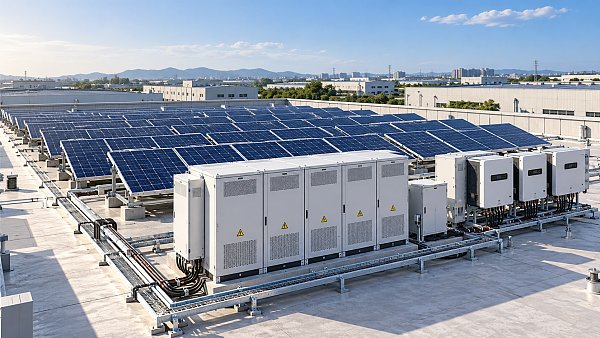
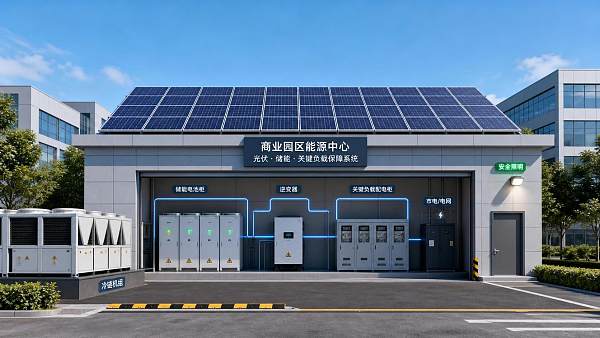
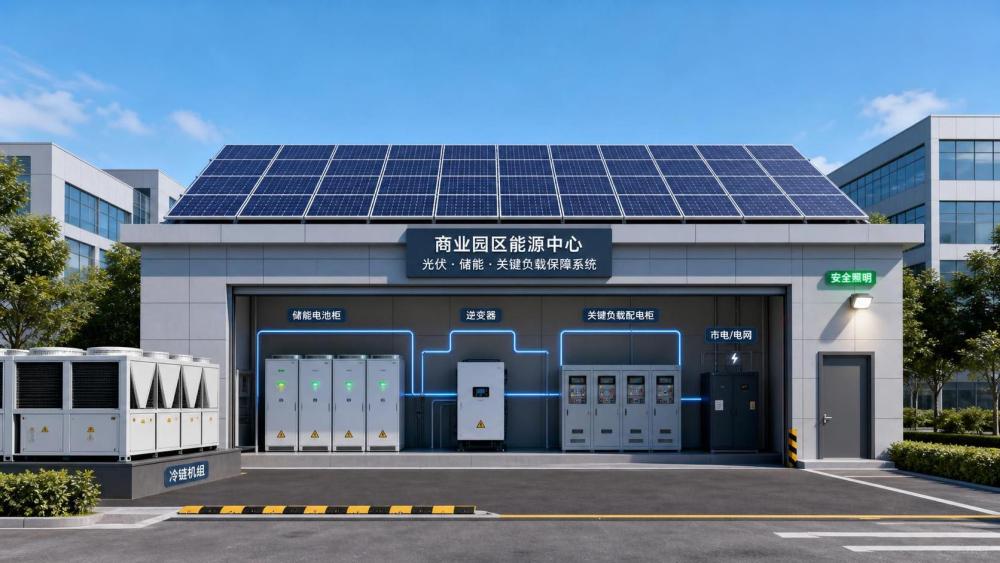
Backup capability depends on more than the solar array, battery containers, and inverters. The electrical architecture determines which loads can be supported, how quickly transfer occurs, and whether the system can operate safely in parallel with the utility or in island mode.
Key decisions include the location of the point of common coupling, the arrangement of the critical-load bus, use of automatic transfer equipment, protection coordination, grounding method, fault-current contribution, black-start requirements, and utility anti-islanding obligations. Local electrical codes and utility interconnection requirements vary significantly, so assumptions should be validated with the relevant authority and grid operator early in the project. Specific standards, permitting routes, and fire-safety requirements should be confirmed for the project jurisdiction【待核实】.
For larger commercial systems, it is also important to assess whether the battery can support selective coordination and protection performance under islanded conditions. Inverter-based sources may provide lower fault current than conventional rotating generation, which can affect how breakers and relays detect and isolate faults. This is an engineering issue that should not be left until construction, when changes to switchgear or protection settings become expensive and disruptive.
Where a diesel or gas generator already exists, hybrid design deserves serious consideration. Storage can provide immediate no-break or near-no-break support, absorb solar variability, reduce generator run hours, and allow the generator to operate closer to an efficient loading range. But hybrid systems need a clear control hierarchy. Without it, the battery, PV inverters, generator controller, and building management system can issue conflicting commands during abnormal events.
Account for Degradation, Climate, and Maintainability
Battery nameplate capacity is not the capacity that will necessarily be available throughout the project life. Cycling, calendar aging, ambient temperature, charging strategy, and discharge rate all influence usable capacity. A system designed to meet a four-hour target at commissioning may fall short later if degradation allowances are omitted.
Procurement documents should therefore define the required end-of-life performance, not only the initial installed capacity. They should clarify the assumed operating profile, warranty conditions, minimum retained capacity, augmentation strategy, availability commitments, and responsibilities for monitoring and corrective action. It is also worth asking whether the warranty aligns with the actual resilience duty cycle. A battery used sparingly for backup may age differently from one used daily for peak shaving, even if both have the same nominal duration.
Thermal management and site conditions require equal attention. High ambient temperatures can affect battery life and cooling energy use. Flood exposure, dust, corrosion, fire access, vehicle impact risk, equipment lifting routes, and acoustic constraints may determine the feasible location of battery and inverter equipment. The best electrical layout on paper is not necessarily the best buildable or maintainable layout.
Maintenance planning must include periodic testing under representative load conditions. A system that has never been tested in island mode is not proven backup capacity. Operators should have defined procedures for emergency operation, planned maintenance, alarm escalation, manual override, and post-event review. Remote monitoring is useful, but it does not replace functional testing, equipment inspection, or trained site personnel.
Procurement Should Focus on Demonstrable System Behavior
Commercial buyers often receive proposals that make comparison difficult because suppliers use different assumptions for usable capacity, PV contribution, backup duration, system boundaries, and exclusions. The solution is to issue a disciplined basis of design before requesting firm pricing.
Ask bidders to state the critical-load schedule, outage duration, starting state of charge, solar assumptions, battery usable capacity at commissioning and end of warranty, round-trip efficiency basis, maximum islanded power, motor-start capability, transfer sequence, load-shedding logic, and restrictions on simultaneous PV and generator operation. They should identify all equipment needed for an operational backup system, including switchgear modifications, controls integration, communications, fire detection or suppression interfaces where required, civil works, commissioning, training, and long-term service.
Lowest initial price is a weak decision metric when the system’s actual role is continuity of operations. A lower-cost proposal may exclude critical switchgear work, use an optimistic solar profile, assume a fully charged battery at every outage, or provide limited support for islanded controls. Conversely, the largest battery proposal is not automatically the most resilient one if power limits, protection design, or operational procedures remain unresolved.
The strongest projects treat solar backup as an operational system rather than a collection of assets. They establish a realistic outage basis, isolate the loads that genuinely matter, validate both energy and power requirements, test solar behavior in island mode, and preserve enough flexibility for future changes. That process gives project managers a clearer investment case: not a claim that solar and storage eliminate every outage risk, but a defined and testable level of resilience for the commercial functions the business cannot afford to lose.
Questions about market trends? Contact Market Scope Live for deeper business insights.
We respect your privacy. Your information is strictly confidential.
Related News
 Energy Storage Systems / BESSCroatia’s First Transmission-Connected Standalone Battery Project Enters OperationCroatia’s first transmission-connected standalone battery project is operational. Discover how the 60 MW Šibenik facility could support grid flexibility.MORE+
 Energy Storage Systems / BESSAustralia's NEM Battery Storage Hits Record 20.17 GWh, Up 203% Year on YearAustralia's NEM battery storage reportedly hits 20.17 GWh, up 203% year on year. Explore what the record could mean for grid-scale projects and procurement.MORE+
 Energy Storage Systems / BESSC&I Energy Storage in Germany: What Drives Project ROI?C&I energy storage in Germany: discover what drives project ROI, from peak shaving and solar savings to costs, tariffs and smarter battery sizing.MORE+
 Energy Storage Systems / BESSChoosing Energy Storage Containers: Capacity, Power and Safety CriteriaCompare energy storage containers by usable capacity, power, safety and grid integration. Learn what to ask suppliers before choosing a system.MORE+
 Energy Storage Systems / BESSNeoen, Frontier Energy and Lightyears Secure Funding for Renewable ProjectsNeoen, Frontier Energy and Lightyears secure renewable energy financing. Explore what the funding means for solar, wind and battery storage projects.MORE+
 Energy Storage Systems / BESSChoosing a Battery Energy Storage Container Manufacturer: Key Supplier ChecksChoosing a battery energy storage containers manufacturer? Learn how to assess safety, integration, warranties and total costs before you buy.MORE+
 Energy Storage Systems / BESSCATL Introduces Grid Connection and Financing Commitments in AustraliaCATL introduces energy storage with 25-year grid connection and financing commitments in Australia. Explore what the proposed model means for projects.MORE+
 Energy Storage Systems / BESSPortugal Mandates Grid-Forming Capability for Large Storage and Launches 1 GW TenderPortugal grid-forming rules target large standalone energy storage projects as a 1 GW tender launches. Explore the implications for developers and suppliers.MORE+
 Energy Storage Systems / BESSAdding Battery Storage to Rooftop Solar: When to Use AC vs. DC CouplingExplore rooftop solar storage integration: compare AC vs. DC coupling, inverter compatibility, backup power, and lifecycle costs to choose the right battery setup.MORE+
 Energy Storage Systems / BESSHeron Power and NiSource Announce US Data Center Deals Involving BESSHeron Power and NiSource announce US data center deals involving BESS. Explore how transformer integration and long-term power supply are shaping data center energy plans.MORE+
 Energy Storage Systems / BESSPeak Energy Raises $108 Million as GM Ventures Leads Sodium-Ion Storage RoundPeak Energy raises $108 million in a GM Ventures-led round to scale sodium-ion storage for grids and AI data centers. Explore what buyers should assess before committing.MORE+
 Energy Storage Systems / BESSRondo Energy and Rio Tinto Begin Design of Australia's Largest Thermal Storage ProjectRondo Energy and Rio Tinto begin design of a 30 MW/360 MWh thermal storage project at Yarwun. Explore its potential for industrial decarbonization and future procurement.MORE+
 Energy Storage Systems / BESSCATL Nine-Month Net Profit Rises 31.6% as Energy Storage Emerges as a Growth DriverCATL’s reported nine-month net profit rose 31.6% as energy storage gains momentum. Explore what this shift could mean for battery buyers, overseas orders and procurement planning.MORE+
 Energy Storage Systems / BESSScalable Power Solutions for Commercial Facilities with Uneven Site DemandScalable power solutions for multi-site commercial facilities: optimize uneven demand, resilience, storage, solar, and controls with a repeatable portfolio strategy.MORE+
 Energy Storage Systems / BESSWhen Do Commercial Property Owners Face Peak Demand for On-Site Energy?Commercial property owners peak demand often occurs when HVAC, occupancy, EV charging, and equipment loads coincide. Discover practical strategies to manage costs, capacity, and on-site energy resilience.MORE+
 Energy Storage Systems / BESSWhen Does a Containerized Hybrid Solar-Storage System Make Sense for Remote Sites?containerized hybrid solar storage for remote sites: discover when it cuts diesel costs, improves reliability, and simplifies deployment with smarter sizing and design.MORE+
 Energy Storage Systems / BESSHow to Specify Steel Battery Enclosures for Outdoor BESS Fire and Corrosion RisksSteel battery enclosures: learn how to specify corrosion protection, fire-ready interfaces, drainage, and durable outdoor BESS performance.MORE+
 Energy Storage Systems / BESSBattery Energy Storage Cost: What Drives $/kWh and Project ROI?Battery energy storage cost explained: compare usable $/kWh, system scope, grid connection, warranty, and lifecycle factors to build a stronger storage ROI.MORE+
 Energy Storage Systems / BESSWhat Drives BESS Fire Protection Costs in Utility-Scale Storage Projects?Energy storage fire protection cost drivers explained: compare BESS safety systems, site design, compliance, and integration to budget smarter.MORE+
 Energy Storage Systems / BESSHow to Size Grid-Scale Energy Storage for Peak Shaving and Renewable FirmingGrid scale energy storage sizing guide for peak shaving and renewable firming—learn how to model MW, MWh, dispatch, degradation, and grid limits.MORE+
 Energy Storage Systems / BESSWhat Drives Battery Energy Management System Costs in BESS Projects?Battery energy management systems cost depends on controls, integration, grid compliance, cybersecurity, and lifecycle support. Learn how to evaluate BESS EMS proposals wisely.MORE+
 Energy Storage Systems / BESSHow to Size a Commercial Microgrid Battery System for Peak Shaving and Backup PowerCommercial microgrid battery system sizing guide for peak shaving and backup power—optimize kW, kWh, reserve SOC, controls, and resilience.MORE+
 Energy Storage Systems / BESSHow to Select a Battery Storage EPC Partner for Utility-Scale Projects in EuropeBattery storage EPC Europe: choose the right utility-scale partner with proven grid expertise, safety leadership, supply-chain control, and reliable commissioning.MORE+
 Energy Storage Systems / BESSHow to Evaluate a Stationary Battery Storage Manufacturer for Critical Backup PowerStationary battery storage manufacturer evaluation guide: compare safety, usable capacity, integration, warranties, lifecycle cost, and service support for reliable critical backup power.MORE+
 Energy Storage Systems / BESSDo Utilities Prefer Centralized or Distributed Energy Storage Models?Do utility companies prefer centralized or distributed energy storage models? Explore how grid constraints, costs, resilience, and control shape the best storage strategy.MORE+
 Energy Storage Systems / BESSWhat Fire Safety Requirements Apply to Containerized Battery Storage?What are the fire safety requirements for containerized battery storage systems? Explore codes, detection, suppression, ventilation, shutdown, and site design essentials.MORE+
 Energy Storage Systems / BESSIs EPEM Useful for Benchmarking Energy Storage Project Performance?Is EPEM useful for benchmarking energy storage project performance data? Explore how it helps normalize efficiency, availability, degradation, dispatch, and lifecycle risks.MORE+
 Energy Storage Systems / BESSBehind-the-Meter Energy Systems for Industrial Parks: Sizing Solar, Storage, and LoadsBehind the meter energy systems for industrial parks: learn how to size solar, storage, and loads for lower costs, resilient operations, and scalable growth.MORE+
 Energy Storage Systems / BESSAerosol Fire Protection for Energy Storage: Key Design Factors for BESS SafetyAerosol fire protection for energy storage: explore key BESS design factors for detection, ventilation, thermal runaway risk, and safer system integration.MORE+
 Energy Storage Systems / BESSHow to Size Solar Backup Energy Systems for Critical Commercial LoadsBackup energy systems with solar: learn how to size critical commercial loads, balance battery power and runtime, and build resilient operations.MORE+
 Energy Storage Systems / BESSWhat Criteria Should You Use to Shortlist Battery Storage EPC Contractors?What criteria should be used to shortlist battery storage EPC contractors? Explore essential checks for engineering, safety, grid integration, delivery, and lifecycle value.MORE+
 Energy Storage Systems / BESSCan Battery Storage Be Added to Existing Solar Farms Without Replacing Inverters?Can battery storage be integrated into existing solar farms without replacing inverters? Explore AC-coupled retrofits, grid limits, controls, costs, and value.MORE+
 Energy Storage Systems / BESSAre Containerized Battery Storage Systems Safe for Urban Deployment?Are containerized battery storage systems safe for urban deployment? Explore key safety factors, fire planning, standards, and site design for reliable urban BESS projects.MORE+
 Energy Storage Systems / BESSSodium-Ion vs Lithium-Ion: Which Is Better for Long-Duration Storage?Is sodium-ion battery better than lithium-ion for long duration storage? Explore cost, safety, energy density, warranties, and the best fit for your storage project.MORE+
 Energy Storage Systems / BESSHow to Size Grid-Scale Battery Energy Storage for Peak Shaving and Grid SupportGrid scale battery energy storage sizing made practical: learn how to match MW, MWh, dispatch, degradation, and grid constraints for reliable peak shaving and grid support.MORE+
 Energy Storage Systems / BESSHow to Integrate Solar and Battery Storage for Reliable Commercial Power ProjectsSolar storage project integration for commercial sites: learn to align load analysis, battery sizing, controls, safety, and grid compliance for reliable power.MORE+
 Energy Storage Systems / BESSHow Does Battery Thermal Management Affect Charger Uptime in Hot Climates?How does battery thermal management affect charger uptime in hot climates? Explore cooling strategies that reduce derating, protect assets, and keep EV charging reliable.MORE+
 Energy Storage Systems / BESSAre Sodium-Ion Batteries Ready for Commercial Charging Storage in 2026?Are sodium-ion batteries ready for commercial charging station storage in 2026? Explore costs, safety, footprint trade-offs, and project-fit insights.MORE+
 Energy Storage Systems / BESSHow to Size Energy Storage Containers for Reliable Microgrid PerformanceEnergy storage containers for microgrids: learn how to size capacity, power, backup duration, and reserve margins to improve reliability, cut costs, and support smarter project decisions.MORE+
 Energy Storage Systems / BESSHow to Evaluate a Fast Frequency Response Inverter for Grid-Scale BESS?Fast frequency response inverter evaluation for grid-scale BESS: learn how to assess control speed, thermal stability, grid-code behavior, and procurement-critical performance before you buy.MORE+