
How Does Battery Thermal Management Affect Charger Uptime in Hot Climates?
How does battery thermal management affect charger uptime in hot climates? For charging operators, EPC contractors, and fleet managers, it directly influences availability, charging speed, maintenance cost, and asset life.
In high-temperature regions, heat affects more than vehicle batteries. It also stresses charger-side battery storage, power electronics, cables, connectors, cooling equipment, and site control systems.
When thermal control is inadequate, chargers may derate power, suspend sessions, generate repeated faults, or require emergency maintenance during periods of highest customer demand.
Effective battery thermal management is therefore an uptime strategy, not simply a battery protection feature. It keeps critical equipment within operating limits while reducing operational uncertainty.
For decision-makers, the priority is identifying where heat-related risks originate, selecting suitable cooling architecture, and measuring whether thermal investments improve commercial performance.
Why Hot Climates Create a Charger Uptime Problem
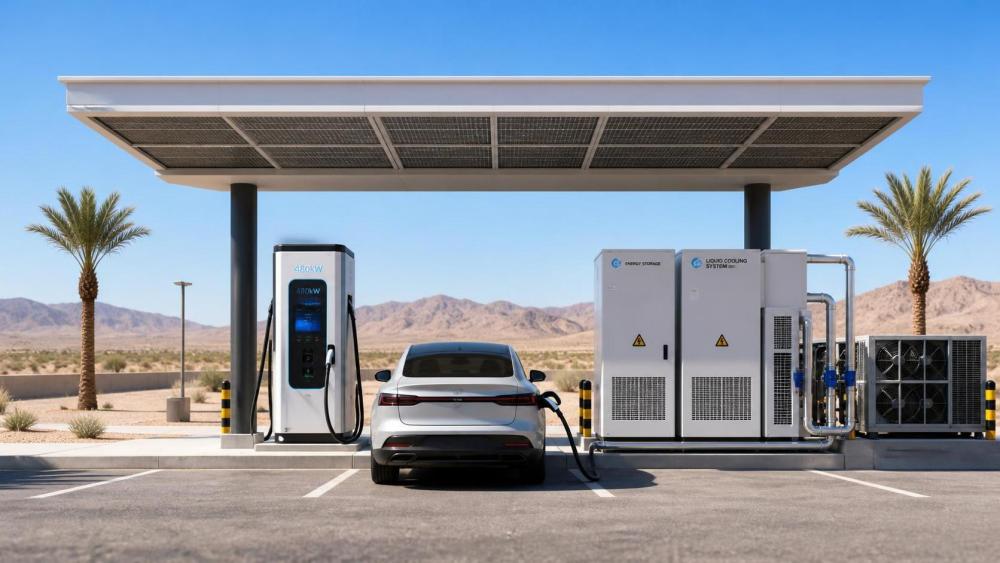
High ambient temperature reduces the margin between normal operating conditions and equipment limits. This becomes especially important at charging sites handling continuous DC fast-charging demand.
Solar radiation can make enclosure temperatures significantly higher than reported air temperature. Dark cabinets, poor ventilation, and inadequate shading can intensify this effect during afternoon peaks.
Battery systems generate internal heat while charging and discharging. In a hot environment, that heat cannot dissipate efficiently, increasing cell temperature and accelerating degradation.
Power conversion systems also produce heat through switching losses. If fans, filters, liquid loops, or heat exchangers cannot remove it, chargers may automatically reduce output.
Power derating protects equipment, but it can undermine the charging experience. A charger rated for high power may deliver substantially less when drivers and fleets need it most.
For public charging operators, lower power can mean longer queues, lower customer satisfaction, and weaker revenue per charger. For fleets, it can disrupt vehicle dispatch schedules.
Repeated thermal alarms can also cause nuisance shutdowns. Although some faults clear automatically, recurring events increase remote support workload and may require technician visits.
Heat-related failures are often cumulative rather than immediate. A site may appear stable initially, then experience declining availability after months of sustained high-temperature operation.
How Battery Temperature Affects Charging Performance
Battery cells operate best within a defined temperature range. Outside that range, battery management systems limit current to protect cells from accelerated wear or safety risks.
In charger-integrated storage systems, this restriction can reduce the battery's ability to support peak power. The charger may then depend more heavily on the grid connection.
That creates a commercial problem where grid capacity is constrained. Storage is often installed specifically to avoid expensive upgrades or to support high-power charging demand.
If battery temperature rises too far, the battery management system may command reduced charging or discharging power. This is a controlled limitation, not necessarily a hardware failure.
However, users experience it as reduced charger performance. A site may show available connectors while delivering lower power than the advertised charging capability.
High cell temperature also increases chemical aging. Faster degradation reduces usable capacity, raises internal resistance, and eventually limits the battery's contribution during peak load periods.
As resistance rises, more heat is generated during operation. This feedback loop can make aging batteries increasingly difficult to manage in consistently hot climates.
Operators should distinguish between temporary thermal derating and long-term capacity loss. Both affect uptime, but they require different responses, budgets, and replacement planning.
What Thermal Management Must Protect Beyond the Battery
Battery thermal management cannot be evaluated in isolation. Charger uptime depends on the combined thermal behavior of batteries, power modules, cabinets, cables, connectors, and controls.
DC power modules are particularly sensitive because they operate continuously at high loads. Excessive temperature can reduce efficiency, trigger derating, or shorten component service life.
Liquid-cooled charging cables help manage heat at high current levels, especially where compact cable design and frequent utilization create substantial thermal loading.
Connector temperature sensors are also important. A poor contact, damaged pin, or loose connection can create localized heating that causes a charging session to stop.
Communication equipment, payment terminals, networking hardware, and displays may have different temperature tolerances than power equipment. Their failure can still make a charger unavailable.
Air filters deserve close attention in dusty hot regions. Restricted airflow reduces cooling performance and can cause failures that appear unrelated to routine maintenance practices.
Site design matters as much as product specification. Equipment spacing, cabinet orientation, shade structures, airflow clearance, and drainage all influence real-world thermal performance.
A charger should therefore be assessed as a thermal system. Selecting an individually capable battery or cabinet does not guarantee reliable site-level operation.
Choosing Between Air Cooling and Liquid Cooling
Air cooling remains common because it is familiar, relatively simple, and usually less expensive to install. It can work well in moderate climates and lower-power applications.
Its limitations become clear when ambient temperatures remain high for long periods. Air cooling depends on intake air being sufficiently cooler than the equipment it protects.
When outside air is already hot, fans may move large volumes without providing enough heat rejection. Dust accumulation and filter blockage further reduce system effectiveness.
Liquid cooling provides higher heat-transfer capability and can maintain more stable temperatures under high-power, high-utilization conditions. It is often suitable for demanding charging hubs.
It also introduces additional components, including pumps, coolant lines, heat exchangers, sensors, and leak detection. These require clear maintenance responsibilities and reliable monitoring.
For many operators, the correct choice depends on duty cycle rather than charger rating alone. A lightly used high-power charger may have lower thermal risk than a continuously used lower-power unit.
Battery storage systems may use forced-air cooling, direct liquid cooling, or integrated HVAC solutions. The choice should reflect cell chemistry, enclosure design, and local climate conditions.
Procurement teams should request validated performance data at actual site temperatures. Standard ratings measured under mild laboratory conditions can be misleading for desert or tropical projects.
How Heat Reduces Availability and Raises Operating Cost
Charger uptime is often measured as the percentage of time a charger is available for use. Thermal problems reduce this metric through derating, alarms, shutdowns, and repairs.
Derating can be commercially damaging even when the charger remains technically available. A connector delivering insufficient power may fail to meet fleet turnaround or customer expectations.
Heat also increases maintenance frequency. Fans, filters, compressors, pumps, seals, and sensors are exposed to more demanding conditions and may require earlier replacement.
Emergency technician visits are particularly expensive for remote sites. Travel time, spare-parts logistics, restricted access, and lost charging revenue can exceed the cost of preventive measures.
Battery replacement costs may rise if thermal management is neglected. High temperature can shorten battery life, reducing the return expected from storage-backed charging infrastructure.
There is also an energy penalty. Cooling equipment consumes electricity, but inadequate cooling can create larger losses through inefficient operation, reduced throughput, and premature component replacement.
Operators should compare lifecycle cost rather than only initial equipment cost. A lower-cost cooling arrangement may become more expensive if it cannot sustain required availability.
Reliable thermal control can protect service-level commitments. This matters for charging networks serving logistics fleets, buses, emergency vehicles, delivery operators, and commercial tenants.
What to Check During Charger and Storage System Procurement
Procurement specifications should define the expected ambient temperature range, solar exposure, humidity, dust level, altitude, and anticipated daily charging profile for each site.
Ask suppliers for continuous operation data at high ambient temperatures, not merely maximum survival temperature. Equipment may survive extreme heat without delivering rated power reliably.
Request clear derating curves for chargers, battery systems, and power modules. These curves show when output falls as ambient or internal temperatures rise.
Battery suppliers should provide cell operating limits, thermal control setpoints, cooling capacity, fault logic, and expected capacity retention under relevant climate conditions.
Confirm whether the cooling system has redundancy. A single failed fan, pump, compressor, or controller should not automatically disable an entire high-value charging site.
Serviceability should be evaluated early. Filters, coolant, pumps, sensors, and heat exchangers must be accessible without excessive disassembly or long site downtime.
Site acceptance testing should include high-load scenarios. Testing only during cool weather or at partial load can hide thermal issues that emerge during normal summer operation.
Contracts should define accountability for thermal derating, recurring alarms, warranty exclusions, remote monitoring data access, response times, and availability guarantees.
Operational Practices That Improve Heat Resilience
Thermal resilience begins with monitoring. Operators need visibility into battery temperature, cabinet temperature, coolant temperature, power module temperature, fan speed, and derating events.
Alarm thresholds should be configured to identify deteriorating conditions before shutdown occurs. A gradual rise in temperature can indicate blocked airflow or declining cooling performance.
Preventive maintenance schedules should reflect local conditions. Dusty locations may require more frequent filter inspections than manufacturer schedules designed for cleaner environments.
Shade structures can reduce solar gain significantly when designed correctly. They should not obstruct airflow, maintenance access, vehicle movement, lighting, or charger visibility.
Equipment cabinets should be positioned to avoid recirculating hot exhaust air. Tight layouts may save space initially while creating chronic heat problems later.
Load management can also reduce thermal stress. Smart controls can distribute charging demand across connectors, limit simultaneous peaks, and use storage strategically during critical periods.
For fleet sites, charging schedules may be adjusted where operations allow. Avoiding unnecessary simultaneous high-power sessions can reduce peak thermal loading without affecting vehicle readiness.
Operators should review seasonal performance trends. Comparing summer derating events, session duration, fault frequency, and maintenance records reveals whether heat is affecting availability.
How to Build a Business Case for Better Thermal Management
The business case should begin with the cost of unavailable charging capacity. This includes lost charging revenue, delayed fleet operations, customer dissatisfaction, and contractual penalties.
Next, estimate the frequency and duration of heat-related derating or outages. Remote monitoring records, service tickets, and session data provide a more reliable baseline than assumptions.
Compare potential solutions against this baseline. Options may include improved shading, upgraded HVAC, liquid cooling, higher-temperature-rated equipment, additional storage, or redesigned equipment layouts.
Evaluate capital cost alongside maintenance savings and avoided replacement costs. Thermal improvements that extend battery life can materially improve total project economics.
For grid-constrained sites, calculate the value of maintaining battery discharge capability during high-demand periods. This may protect charging throughput without requiring immediate grid reinforcement.
Risk-adjusted analysis is especially useful for fleet and critical-service applications. A small number of outages can have consequences far larger than ordinary public charging revenue loss.
Decision-makers should also consider expansion plans. Designing for current heat loads alone can leave insufficient cooling capacity when more chargers or larger batteries are added later.
A resilient design usually costs more upfront, but it can support predictable utilization, stronger service performance, and lower lifecycle disruption in demanding climates.
Conclusion: Treat Thermal Management as an Uptime Investment
Battery thermal management affects charger uptime in hot climates by controlling the conditions that cause power derating, battery degradation, equipment alarms, and avoidable shutdowns.
The most reliable approach combines suitable cooling technology, heat-aware site design, realistic procurement requirements, continuous monitoring, and preventive maintenance tailored to local conditions.
Operators should focus on actual operating temperature, charging duty cycle, and service consequences rather than relying only on nameplate charger power or maximum temperature ratings.
For high-utilization charging hubs and fleet depots, thermal management is a practical investment in availability, asset life, customer confidence, and long-term charging infrastructure economics.


