
Fire Protection Systems for Energy Storage: Key Design Options and Code Considerations
Fire protection systems for energy storage have moved from a supporting detail to a central project decision. As battery energy storage expands across utility, commercial, and hybrid renewable projects, fire risk management now shapes design approval, insurance review, operational continuity, and public acceptance.
That shift matters because an energy storage site is not just a battery enclosure. It is a tightly integrated asset where cells, modules, HVAC, power conversion, controls, monitoring, and emergency response logic must work together under normal and abnormal conditions.
In practical terms, fire protection systems for energy storage are about detecting failure early, limiting escalation, protecting nearby equipment, and supporting safe intervention. For projects tracked across platforms such as EPEM, this topic sits at the intersection of engineering quality, compliance, and long-term asset reliability.
Why fire protection now defines project quality
Battery energy storage is growing faster in more demanding locations. Systems are being installed beside substations, solar plants, industrial facilities, logistics sites, and urban load centers. Each setting changes the fire exposure profile.
The strongest concern is thermal runaway. Once an individual cell fails, heat and flammable gases can spread within modules, racks, or containers. A delayed response can turn a localized defect into a system-level incident.
More attention is also coming from authorities having jurisdiction, insurers, financiers, and local communities. They increasingly expect evidence that fire protection systems for energy storage were selected through a documented hazard analysis rather than copied from a generic equipment package.
This is one reason modern project reviews no longer separate performance and safety. A storage project with high round-trip efficiency but weak gas detection, poor isolation logic, or unclear emergency procedures is not a robust asset.
What these systems actually include
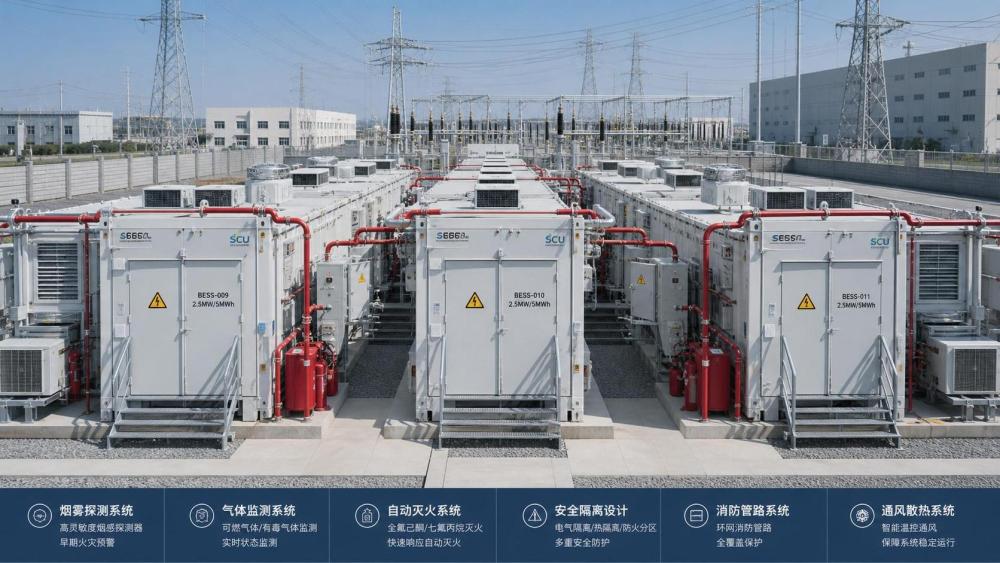
Fire protection systems for energy storage are often misunderstood as a single suppression device. In reality, they are a layered safety architecture built around prevention, detection, control, and consequence reduction.
Core protection layers
- Battery management functions that identify abnormal voltage, temperature, and state-of-charge behavior.
- Thermal management systems that prevent overheating during operation, charging, and standby conditions.
- Gas and smoke detection that can identify off-gassing before open flame appears.
- Automatic shutdown and isolation logic for modules, strings, PCS, and auxiliary loads.
- Suppression or cooling measures designed for the battery chemistry and enclosure type.
- Ventilation and deflagration control measures where flammable gas accumulation is possible.
Simple compliance language can hide important differences. A clean-agent system, for example, may help manage enclosure conditions, but it does not always stop internal cell-to-cell propagation. Water-based approaches may support cooling, yet they require strong drainage and runoff planning.
Key design options and where they fit
The right design depends on chemistry, enclosure layout, project scale, and local code expectations. There is no universal package that works equally well for every battery system.
Containerized lithium-ion systems often use a combination of smoke or gas detection, BMS alarms, HVAC shutdown, and targeted suppression. Indoor battery rooms may add stronger compartmentation, mechanical exhaust, and building fire system integration.
Flow batteries and some non-lithium chemistries can change the hazard profile, but they do not remove the need for engineered fire protection systems for energy storage. Pumps, electrolytes, cabling, inverters, and balance-of-plant equipment still require coordinated protection.
Code considerations that shape real projects
Code compliance is rarely a single checklist item. It usually involves product certification, installation rules, fire service access, separation distances, ventilation requirements, and site-specific approval conditions.
Across many markets, the most referenced frameworks include NFPA 855, UL 9540, UL 9540A, IFC provisions, and local building and electrical codes. Their role is different, and confusing them creates avoidable risk.
How these references differ
- UL 9540 addresses the safety of the complete energy storage system product.
- UL 9540A evaluates thermal runaway fire propagation characteristics through testing.
- NFPA 855 provides installation requirements for stationary energy storage systems.
- Local codes determine what is accepted on the actual project site.
This matters during procurement. A supplier may present certified equipment, yet the project can still fail review if clearances, ventilation, emergency shutdown interfaces, or site layouts do not match local authority expectations.
For multinational project portfolios, the safer approach is to treat compliance as a design input from the first concept stage. EPEM’s broader market perspective is useful here because regional rules, insurer preferences, and utility interconnection practices do not move at the same speed.
Where failures usually start
Many storage fire events are linked less to one dramatic defect and more to weak integration. A technically acceptable component can become risky when it is installed in the wrong thermal environment or connected to poor control logic.
Common problem areas include inconsistent wiring quality, blocked airflow, delayed sensor response, poor commissioning records, software alarm masking, and incomplete maintenance procedures. These are quality issues as much as fire issues.
Another recurring mistake is assuming factory-installed suppression solves the whole problem. Fire protection systems for energy storage need validation at site level, including enclosure arrangement, cable routing, transformer distance, access roads, and emergency isolation points.
A practical review framework for project teams
A useful review starts with the hazard pathway rather than the vendor brochure. The key question is how the project detects, contains, communicates, and recovers from an abnormal battery event.
Points worth checking early
- Battery chemistry, cell format, and tested propagation behavior.
- Trigger logic for alarms, shutdown, suppression release, and ventilation control.
- Integration between BMS, EMS, PCS, HVAC, and fire alarm systems.
- Site drainage, runoff handling, and re-ignition monitoring procedures.
- Commissioning evidence, maintenance intervals, and spare parts strategy.
- Emergency response documentation aligned with local fire authorities.
It also helps to separate product claims from project performance. A battery container can pass certification tests and still require design changes when deployed in a hot climate, a constrained urban yard, or a solar-plus-storage site with shared infrastructure.
What to evaluate next
The next step is not simply choosing a suppression medium. It is building a decision matrix that links chemistry, enclosure design, local code, insurer requirements, and operating conditions.
For new projects, that means reviewing fire protection systems for energy storage alongside layout, thermal management, SCADA integration, and lifecycle maintenance planning. For operating assets, it means rechecking alarms, ventilation logic, records, and response procedures against current standards.
In a market where storage is becoming essential to renewable integration, grid flexibility, and resilient power infrastructure, fire safety can no longer be treated as an attachment. It is part of how project quality is defined, measured, and trusted over time.
Questions about market trends? Contact Market Scope Live for deeper business insights.
We respect your privacy. Your information is strictly confidential.
Related News
 Energy Storage Systems / BESSAustralia's NEM Battery Storage Hits Record 20.17 GWh, Up 203% Year on YearAustralia's NEM battery storage reportedly hits 20.17 GWh, up 203% year on year. Explore what the record could mean for grid-scale projects and procurement.MORE+
 Energy Storage Systems / BESSC&I Energy Storage in Germany: What Drives Project ROI?C&I energy storage in Germany: discover what drives project ROI, from peak shaving and solar savings to costs, tariffs and smarter battery sizing.MORE+
 Energy Storage Systems / BESSChoosing Energy Storage Containers: Capacity, Power and Safety CriteriaCompare energy storage containers by usable capacity, power, safety and grid integration. Learn what to ask suppliers before choosing a system.MORE+
 Energy Storage Systems / BESSNeoen, Frontier Energy and Lightyears Secure Funding for Renewable ProjectsNeoen, Frontier Energy and Lightyears secure renewable energy financing. Explore what the funding means for solar, wind and battery storage projects.MORE+
 Energy Storage Systems / BESSChoosing a Battery Energy Storage Container Manufacturer: Key Supplier ChecksChoosing a battery energy storage containers manufacturer? Learn how to assess safety, integration, warranties and total costs before you buy.MORE+
 Energy Storage Systems / BESSCATL Introduces Grid Connection and Financing Commitments in AustraliaCATL introduces energy storage with 25-year grid connection and financing commitments in Australia. Explore what the proposed model means for projects.MORE+
 Energy Storage Systems / BESSPortugal Mandates Grid-Forming Capability for Large Storage and Launches 1 GW TenderPortugal grid-forming rules target large standalone energy storage projects as a 1 GW tender launches. Explore the implications for developers and suppliers.MORE+
 Energy Storage Systems / BESSAdding Battery Storage to Rooftop Solar: When to Use AC vs. DC CouplingExplore rooftop solar storage integration: compare AC vs. DC coupling, inverter compatibility, backup power, and lifecycle costs to choose the right battery setup.MORE+
 Energy Storage Systems / BESSHeron Power and NiSource Announce US Data Center Deals Involving BESSHeron Power and NiSource announce US data center deals involving BESS. Explore how transformer integration and long-term power supply are shaping data center energy plans.MORE+
 Energy Storage Systems / BESSPeak Energy Raises $108 Million as GM Ventures Leads Sodium-Ion Storage RoundPeak Energy raises $108 million in a GM Ventures-led round to scale sodium-ion storage for grids and AI data centers. Explore what buyers should assess before committing.MORE+
 Energy Storage Systems / BESSRondo Energy and Rio Tinto Begin Design of Australia's Largest Thermal Storage ProjectRondo Energy and Rio Tinto begin design of a 30 MW/360 MWh thermal storage project at Yarwun. Explore its potential for industrial decarbonization and future procurement.MORE+
 Energy Storage Systems / BESSCATL Nine-Month Net Profit Rises 31.6% as Energy Storage Emerges as a Growth DriverCATL’s reported nine-month net profit rose 31.6% as energy storage gains momentum. Explore what this shift could mean for battery buyers, overseas orders and procurement planning.MORE+
 Energy Storage Systems / BESSScalable Power Solutions for Commercial Facilities with Uneven Site DemandScalable power solutions for multi-site commercial facilities: optimize uneven demand, resilience, storage, solar, and controls with a repeatable portfolio strategy.MORE+
 Energy Storage Systems / BESSWhen Do Commercial Property Owners Face Peak Demand for On-Site Energy?Commercial property owners peak demand often occurs when HVAC, occupancy, EV charging, and equipment loads coincide. Discover practical strategies to manage costs, capacity, and on-site energy resilience.MORE+
 Energy Storage Systems / BESSWhen Does a Containerized Hybrid Solar-Storage System Make Sense for Remote Sites?containerized hybrid solar storage for remote sites: discover when it cuts diesel costs, improves reliability, and simplifies deployment with smarter sizing and design.MORE+
 Energy Storage Systems / BESSHow to Specify Steel Battery Enclosures for Outdoor BESS Fire and Corrosion RisksSteel battery enclosures: learn how to specify corrosion protection, fire-ready interfaces, drainage, and durable outdoor BESS performance.MORE+
 Energy Storage Systems / BESSBattery Energy Storage Cost: What Drives $/kWh and Project ROI?Battery energy storage cost explained: compare usable $/kWh, system scope, grid connection, warranty, and lifecycle factors to build a stronger storage ROI.MORE+
 Energy Storage Systems / BESSWhat Drives BESS Fire Protection Costs in Utility-Scale Storage Projects?Energy storage fire protection cost drivers explained: compare BESS safety systems, site design, compliance, and integration to budget smarter.MORE+
 Energy Storage Systems / BESSHow to Size Grid-Scale Energy Storage for Peak Shaving and Renewable FirmingGrid scale energy storage sizing guide for peak shaving and renewable firming—learn how to model MW, MWh, dispatch, degradation, and grid limits.MORE+
 Energy Storage Systems / BESSWhat Drives Battery Energy Management System Costs in BESS Projects?Battery energy management systems cost depends on controls, integration, grid compliance, cybersecurity, and lifecycle support. Learn how to evaluate BESS EMS proposals wisely.MORE+
 Energy Storage Systems / BESSHow to Size a Commercial Microgrid Battery System for Peak Shaving and Backup PowerCommercial microgrid battery system sizing guide for peak shaving and backup power—optimize kW, kWh, reserve SOC, controls, and resilience.MORE+
 Energy Storage Systems / BESSHow to Select a Battery Storage EPC Partner for Utility-Scale Projects in EuropeBattery storage EPC Europe: choose the right utility-scale partner with proven grid expertise, safety leadership, supply-chain control, and reliable commissioning.MORE+
 Energy Storage Systems / BESSHow to Evaluate a Stationary Battery Storage Manufacturer for Critical Backup PowerStationary battery storage manufacturer evaluation guide: compare safety, usable capacity, integration, warranties, lifecycle cost, and service support for reliable critical backup power.MORE+
 Energy Storage Systems / BESSDo Utilities Prefer Centralized or Distributed Energy Storage Models?Do utility companies prefer centralized or distributed energy storage models? Explore how grid constraints, costs, resilience, and control shape the best storage strategy.MORE+
 Energy Storage Systems / BESSWhat Fire Safety Requirements Apply to Containerized Battery Storage?What are the fire safety requirements for containerized battery storage systems? Explore codes, detection, suppression, ventilation, shutdown, and site design essentials.MORE+
 Energy Storage Systems / BESSIs EPEM Useful for Benchmarking Energy Storage Project Performance?Is EPEM useful for benchmarking energy storage project performance data? Explore how it helps normalize efficiency, availability, degradation, dispatch, and lifecycle risks.MORE+
 Energy Storage Systems / BESSBehind-the-Meter Energy Systems for Industrial Parks: Sizing Solar, Storage, and LoadsBehind the meter energy systems for industrial parks: learn how to size solar, storage, and loads for lower costs, resilient operations, and scalable growth.MORE+
 Energy Storage Systems / BESSAerosol Fire Protection for Energy Storage: Key Design Factors for BESS SafetyAerosol fire protection for energy storage: explore key BESS design factors for detection, ventilation, thermal runaway risk, and safer system integration.MORE+
 Energy Storage Systems / BESSHow to Size Solar Backup Energy Systems for Critical Commercial LoadsBackup energy systems with solar: learn how to size critical commercial loads, balance battery power and runtime, and build resilient operations.MORE+
 Energy Storage Systems / BESSWhat Criteria Should You Use to Shortlist Battery Storage EPC Contractors?What criteria should be used to shortlist battery storage EPC contractors? Explore essential checks for engineering, safety, grid integration, delivery, and lifecycle value.MORE+
 Energy Storage Systems / BESSCan Battery Storage Be Added to Existing Solar Farms Without Replacing Inverters?Can battery storage be integrated into existing solar farms without replacing inverters? Explore AC-coupled retrofits, grid limits, controls, costs, and value.MORE+
 Energy Storage Systems / BESSAre Containerized Battery Storage Systems Safe for Urban Deployment?Are containerized battery storage systems safe for urban deployment? Explore key safety factors, fire planning, standards, and site design for reliable urban BESS projects.MORE+
 Energy Storage Systems / BESSSodium-Ion vs Lithium-Ion: Which Is Better for Long-Duration Storage?Is sodium-ion battery better than lithium-ion for long duration storage? Explore cost, safety, energy density, warranties, and the best fit for your storage project.MORE+
 Energy Storage Systems / BESSHow to Size Grid-Scale Battery Energy Storage for Peak Shaving and Grid SupportGrid scale battery energy storage sizing made practical: learn how to match MW, MWh, dispatch, degradation, and grid constraints for reliable peak shaving and grid support.MORE+
 Energy Storage Systems / BESSHow to Integrate Solar and Battery Storage for Reliable Commercial Power ProjectsSolar storage project integration for commercial sites: learn to align load analysis, battery sizing, controls, safety, and grid compliance for reliable power.MORE+
 Energy Storage Systems / BESSHow Does Battery Thermal Management Affect Charger Uptime in Hot Climates?How does battery thermal management affect charger uptime in hot climates? Explore cooling strategies that reduce derating, protect assets, and keep EV charging reliable.MORE+
 Energy Storage Systems / BESSAre Sodium-Ion Batteries Ready for Commercial Charging Storage in 2026?Are sodium-ion batteries ready for commercial charging station storage in 2026? Explore costs, safety, footprint trade-offs, and project-fit insights.MORE+
 Energy Storage Systems / BESSHow to Size Energy Storage Containers for Reliable Microgrid PerformanceEnergy storage containers for microgrids: learn how to size capacity, power, backup duration, and reserve margins to improve reliability, cut costs, and support smarter project decisions.MORE+
 Energy Storage Systems / BESSHow to Evaluate a Fast Frequency Response Inverter for Grid-Scale BESS?Fast frequency response inverter evaluation for grid-scale BESS: learn how to assess control speed, thermal stability, grid-code behavior, and procurement-critical performance before you buy.MORE+
 Energy Storage Systems / BESSChina Expands Cross-Border RMB and FX Cash Pooling, Easing BESS and PV Export SettlementsChina expands cross-border RMB and FX cash pooling nationwide, easing BESS and PV export settlements with faster multi-currency payments, lower FX costs, and smoother buyer-supplier coordination.MORE+


