Battery Energy Management Systems Analytics: Which KPIs Matter for BESS Performance?
Battery energy management systems analytics now sits at the center of serious BESS evaluation. A storage project may look strong on paper, yet weak KPI interpretation can hide thermal stress, uneven aging, poor dispatch response, or avoidable revenue loss.
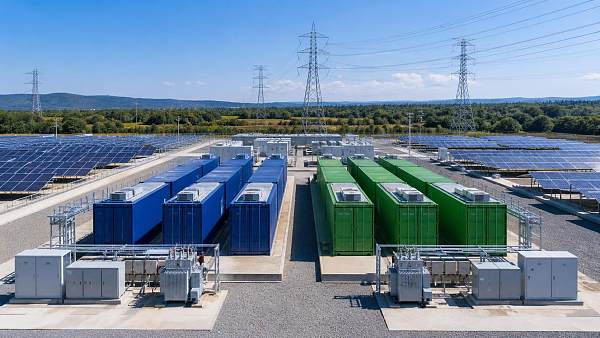
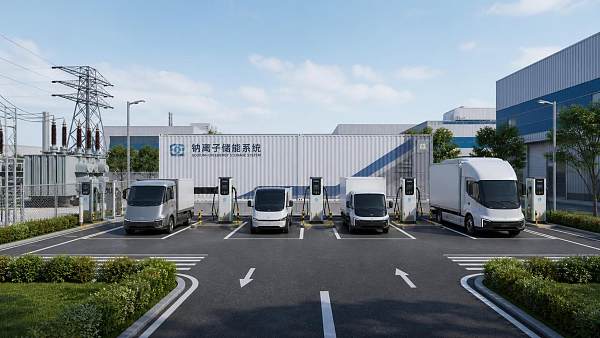
That matters across today’s energy landscape. Grid-scale storage, solar-plus-storage plants, microgrids, EV charging hubs, and commercial energy systems all depend on batteries behaving predictably under real operating conditions.
For platforms such as EPEM, the value of battery energy management systems analytics is not only technical visibility. It also helps connect asset health, project economics, operational flexibility, and long-term investment confidence.
Why analytics matters beyond basic monitoring
A modern BESS generates large volumes of operational data. Voltage, current, temperature, state estimation, alarms, power conversion behavior, and dispatch records all flow through digital control layers.
Basic monitoring tells operators what happened. Battery energy management systems analytics goes further. It explains whether the battery is performing within design expectations and where hidden degradation or control inefficiency is emerging.
This distinction is increasingly important in renewable power markets. Storage is no longer a passive backup asset. It is expected to shift energy, manage peaks, support voltage and frequency, and respond quickly to grid signals.
When those duties increase, poor KPI selection becomes a risk. Looking only at headline availability or nameplate energy can create an overly optimistic view of project quality.
The KPIs that reveal real BESS performance
Not every metric deserves equal attention. The most useful battery energy management systems analytics frameworks usually focus on a smaller set of indicators that explain performance, aging, and operational control together.
State of charge accuracy
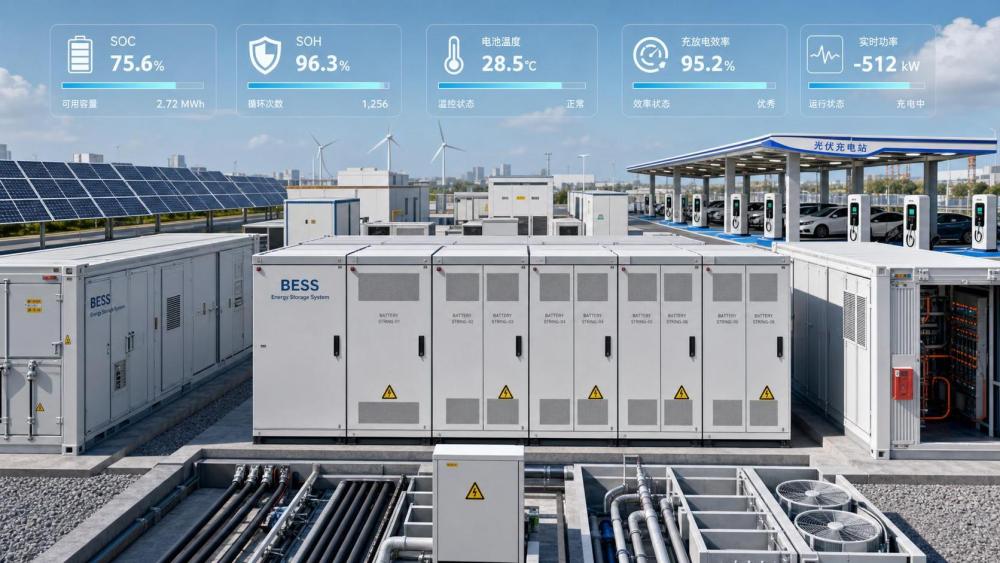
State of charge, or SOC, is widely reported, but the key issue is accuracy. If SOC estimation drifts, dispatch decisions become unreliable and available energy may be overstated.
SOC error also affects reserve commitments, peak shaving windows, and battery warranty compliance. In practical terms, an inaccurate SOC model can distort both operational planning and asset valuation.
State of health and degradation rate
State of health, or SOH, shows how much usable performance remains compared with the original condition. On its own, SOH is useful. The more revealing KPI is the rate of change over time.
A battery can still show acceptable SOH while degrading faster than expected. That pattern often points to excessive cycling depth, poor thermal control, or an aggressive operating strategy.
Round-trip efficiency
Round-trip efficiency measures how much energy returns after charging and discharging. It directly influences revenue, especially in arbitrage, renewable firming, and behind-the-meter savings models.
This KPI should be examined at system level, not only cell level. Losses may come from thermal loads, inverter behavior, auxiliary power, or suboptimal control settings.
Temperature spread and thermal stability
Average temperature matters, but temperature spread across racks or modules often matters more. Uneven temperature accelerates imbalance, uneven aging, and safety exposure.
Battery energy management systems analytics should identify repeated hot zones, seasonal cooling weakness, and thermal recovery speed after high-load events.
Cell balancing performance
Cell imbalance reduces usable capacity and can trigger premature protection events. A healthy balancing strategy limits voltage deviation and keeps string behavior aligned over repeated cycles.
If balancing activity becomes frequent or ineffective, it may indicate deeper issues in cell quality, thermal design, or operating range.
Availability and response quality
Availability should not be treated as a simple uptime number. A BESS may be online but still unable to deliver committed power, sustain duration, or meet response timing requirements.
For grid services, response latency, ramp accuracy, and dispatch compliance are often more important than raw availability.
How to read KPIs in context
The same KPI can tell different stories in different projects. A frequency regulation asset, for example, should be assessed differently from a solar shifting system or an EV charging support battery.
This is where battery energy management systems analytics becomes commercially useful. It helps translate technical readings into operating fit, contract risk, and lifecycle expectations.
Common KPI mistakes in technical evaluation
Several errors appear repeatedly in storage assessments. Most come from treating dashboard indicators as final answers instead of starting points for investigation.
- Using average values without checking distribution across strings, racks, or operating periods.
- Comparing site data to nameplate values without adjusting for ambient conditions and auxiliary consumption.
- Reviewing SOH as a static figure rather than a trend linked to cycle depth and temperature history.
- Ignoring alarm frequency because no major trip has occurred yet.
- Measuring availability without validating dispatch capability during critical windows.
- Separating battery KPIs from PCS, EMS, and cooling system behavior.
In integrated power assets, weak performance often comes from interactions between subsystems. A battery may appear to underperform when the root cause is thermal control logic, inverter clipping, or dispatch command design.
Where analytics supports better decisions
Battery energy management systems analytics is valuable long before a fault appears. It supports equipment comparison, project due diligence, commissioning review, and operational optimization.
Design and procurement review
Historical KPI performance can reveal whether a battery platform maintains efficiency under partial load, manages thermal stress well, and sustains balanced rack behavior in similar climates.
Commissioning and acceptance testing
Early analytics helps confirm that control settings, sensor mapping, balancing logic, and cooling response match the intended design rather than only passing basic functional checks.
Operations and warranty management
KPI trend analysis creates stronger evidence for warranty discussions. It also supports maintenance timing by detecting deviations before they become forced outages.
For an intelligence platform such as EPEM, this matters because storage decisions increasingly sit inside broader energy portfolios. A BESS may interact with solar output, grid constraints, charging demand, and digital dispatch systems at the same time.
A practical way to build a KPI framework
A useful framework usually starts with three questions. What service is the asset expected to deliver? What technical limits threaten that service? Which KPIs show those limits early enough to act?
From there, the KPI set should remain disciplined. Too many indicators dilute attention. Too few hide interactions between cell behavior, thermal systems, controls, and revenue performance.
- Separate core health KPIs from market or dispatch KPIs.
- Track trends, not snapshots.
- Review data by asset layer, from cell to container to site.
- Link every KPI to an operational decision or risk threshold.
- Revisit the framework when use cases change.
That approach keeps battery energy management systems analytics grounded in asset reality. It turns reporting into decision support rather than dashboard decoration.
What to assess next
The best next step is to test whether current BESS reporting truly explains performance. If the data cannot show degradation pace, thermal unevenness, dispatch quality, and usable energy confidence, the KPI set is incomplete.
In practice, stronger battery energy management systems analytics starts with better questions, not just more data. Review the intended service model, map the highest-value KPIs, and compare them against real site behavior over time.
That process creates a clearer basis for technology selection, operational tuning, and lifecycle risk judgment across the wider energy transition portfolio.
Questions about market trends? Contact Market Scope Live for deeper business insights.
We respect your privacy. Your information is strictly confidential.
Related News
 Energy Storage Systems / BESSCroatia’s First Transmission-Connected Standalone Battery Project Enters OperationCroatia’s first transmission-connected standalone battery project is operational. Discover how the 60 MW Šibenik facility could support grid flexibility.MORE+
 Energy Storage Systems / BESSAustralia's NEM Battery Storage Hits Record 20.17 GWh, Up 203% Year on YearAustralia's NEM battery storage reportedly hits 20.17 GWh, up 203% year on year. Explore what the record could mean for grid-scale projects and procurement.MORE+
 Energy Storage Systems / BESSC&I Energy Storage in Germany: What Drives Project ROI?C&I energy storage in Germany: discover what drives project ROI, from peak shaving and solar savings to costs, tariffs and smarter battery sizing.MORE+
 Energy Storage Systems / BESSChoosing Energy Storage Containers: Capacity, Power and Safety CriteriaCompare energy storage containers by usable capacity, power, safety and grid integration. Learn what to ask suppliers before choosing a system.MORE+
 Energy Storage Systems / BESSNeoen, Frontier Energy and Lightyears Secure Funding for Renewable ProjectsNeoen, Frontier Energy and Lightyears secure renewable energy financing. Explore what the funding means for solar, wind and battery storage projects.MORE+
 Energy Storage Systems / BESSChoosing a Battery Energy Storage Container Manufacturer: Key Supplier ChecksChoosing a battery energy storage containers manufacturer? Learn how to assess safety, integration, warranties and total costs before you buy.MORE+
 Energy Storage Systems / BESSCATL Introduces Grid Connection and Financing Commitments in AustraliaCATL introduces energy storage with 25-year grid connection and financing commitments in Australia. Explore what the proposed model means for projects.MORE+
 Energy Storage Systems / BESSPortugal Mandates Grid-Forming Capability for Large Storage and Launches 1 GW TenderPortugal grid-forming rules target large standalone energy storage projects as a 1 GW tender launches. Explore the implications for developers and suppliers.MORE+
 Energy Storage Systems / BESSAdding Battery Storage to Rooftop Solar: When to Use AC vs. DC CouplingExplore rooftop solar storage integration: compare AC vs. DC coupling, inverter compatibility, backup power, and lifecycle costs to choose the right battery setup.MORE+
 Energy Storage Systems / BESSHeron Power and NiSource Announce US Data Center Deals Involving BESSHeron Power and NiSource announce US data center deals involving BESS. Explore how transformer integration and long-term power supply are shaping data center energy plans.MORE+
 Energy Storage Systems / BESSPeak Energy Raises $108 Million as GM Ventures Leads Sodium-Ion Storage RoundPeak Energy raises $108 million in a GM Ventures-led round to scale sodium-ion storage for grids and AI data centers. Explore what buyers should assess before committing.MORE+
 Energy Storage Systems / BESSRondo Energy and Rio Tinto Begin Design of Australia's Largest Thermal Storage ProjectRondo Energy and Rio Tinto begin design of a 30 MW/360 MWh thermal storage project at Yarwun. Explore its potential for industrial decarbonization and future procurement.MORE+
 Energy Storage Systems / BESSCATL Nine-Month Net Profit Rises 31.6% as Energy Storage Emerges as a Growth DriverCATL’s reported nine-month net profit rose 31.6% as energy storage gains momentum. Explore what this shift could mean for battery buyers, overseas orders and procurement planning.MORE+
 Energy Storage Systems / BESSScalable Power Solutions for Commercial Facilities with Uneven Site DemandScalable power solutions for multi-site commercial facilities: optimize uneven demand, resilience, storage, solar, and controls with a repeatable portfolio strategy.MORE+
 Energy Storage Systems / BESSWhen Do Commercial Property Owners Face Peak Demand for On-Site Energy?Commercial property owners peak demand often occurs when HVAC, occupancy, EV charging, and equipment loads coincide. Discover practical strategies to manage costs, capacity, and on-site energy resilience.MORE+
 Energy Storage Systems / BESSWhen Does a Containerized Hybrid Solar-Storage System Make Sense for Remote Sites?containerized hybrid solar storage for remote sites: discover when it cuts diesel costs, improves reliability, and simplifies deployment with smarter sizing and design.MORE+
 Energy Storage Systems / BESSHow to Specify Steel Battery Enclosures for Outdoor BESS Fire and Corrosion RisksSteel battery enclosures: learn how to specify corrosion protection, fire-ready interfaces, drainage, and durable outdoor BESS performance.MORE+
 Energy Storage Systems / BESSBattery Energy Storage Cost: What Drives $/kWh and Project ROI?Battery energy storage cost explained: compare usable $/kWh, system scope, grid connection, warranty, and lifecycle factors to build a stronger storage ROI.MORE+
 Energy Storage Systems / BESSWhat Drives BESS Fire Protection Costs in Utility-Scale Storage Projects?Energy storage fire protection cost drivers explained: compare BESS safety systems, site design, compliance, and integration to budget smarter.MORE+
 Energy Storage Systems / BESSHow to Size Grid-Scale Energy Storage for Peak Shaving and Renewable FirmingGrid scale energy storage sizing guide for peak shaving and renewable firming—learn how to model MW, MWh, dispatch, degradation, and grid limits.MORE+
 Energy Storage Systems / BESSWhat Drives Battery Energy Management System Costs in BESS Projects?Battery energy management systems cost depends on controls, integration, grid compliance, cybersecurity, and lifecycle support. Learn how to evaluate BESS EMS proposals wisely.MORE+
 Energy Storage Systems / BESSHow to Size a Commercial Microgrid Battery System for Peak Shaving and Backup PowerCommercial microgrid battery system sizing guide for peak shaving and backup power—optimize kW, kWh, reserve SOC, controls, and resilience.MORE+
 Energy Storage Systems / BESSHow to Select a Battery Storage EPC Partner for Utility-Scale Projects in EuropeBattery storage EPC Europe: choose the right utility-scale partner with proven grid expertise, safety leadership, supply-chain control, and reliable commissioning.MORE+
 Energy Storage Systems / BESSHow to Evaluate a Stationary Battery Storage Manufacturer for Critical Backup PowerStationary battery storage manufacturer evaluation guide: compare safety, usable capacity, integration, warranties, lifecycle cost, and service support for reliable critical backup power.MORE+
 Energy Storage Systems / BESSDo Utilities Prefer Centralized or Distributed Energy Storage Models?Do utility companies prefer centralized or distributed energy storage models? Explore how grid constraints, costs, resilience, and control shape the best storage strategy.MORE+
 Energy Storage Systems / BESSWhat Fire Safety Requirements Apply to Containerized Battery Storage?What are the fire safety requirements for containerized battery storage systems? Explore codes, detection, suppression, ventilation, shutdown, and site design essentials.MORE+
 Energy Storage Systems / BESSIs EPEM Useful for Benchmarking Energy Storage Project Performance?Is EPEM useful for benchmarking energy storage project performance data? Explore how it helps normalize efficiency, availability, degradation, dispatch, and lifecycle risks.MORE+
 Energy Storage Systems / BESSBehind-the-Meter Energy Systems for Industrial Parks: Sizing Solar, Storage, and LoadsBehind the meter energy systems for industrial parks: learn how to size solar, storage, and loads for lower costs, resilient operations, and scalable growth.MORE+
 Energy Storage Systems / BESSAerosol Fire Protection for Energy Storage: Key Design Factors for BESS SafetyAerosol fire protection for energy storage: explore key BESS design factors for detection, ventilation, thermal runaway risk, and safer system integration.MORE+
 Energy Storage Systems / BESSHow to Size Solar Backup Energy Systems for Critical Commercial LoadsBackup energy systems with solar: learn how to size critical commercial loads, balance battery power and runtime, and build resilient operations.MORE+
 Energy Storage Systems / BESSWhat Criteria Should You Use to Shortlist Battery Storage EPC Contractors?What criteria should be used to shortlist battery storage EPC contractors? Explore essential checks for engineering, safety, grid integration, delivery, and lifecycle value.MORE+
 Energy Storage Systems / BESSCan Battery Storage Be Added to Existing Solar Farms Without Replacing Inverters?Can battery storage be integrated into existing solar farms without replacing inverters? Explore AC-coupled retrofits, grid limits, controls, costs, and value.MORE+
 Energy Storage Systems / BESSAre Containerized Battery Storage Systems Safe for Urban Deployment?Are containerized battery storage systems safe for urban deployment? Explore key safety factors, fire planning, standards, and site design for reliable urban BESS projects.MORE+
 Energy Storage Systems / BESSSodium-Ion vs Lithium-Ion: Which Is Better for Long-Duration Storage?Is sodium-ion battery better than lithium-ion for long duration storage? Explore cost, safety, energy density, warranties, and the best fit for your storage project.MORE+
 Energy Storage Systems / BESSHow to Size Grid-Scale Battery Energy Storage for Peak Shaving and Grid SupportGrid scale battery energy storage sizing made practical: learn how to match MW, MWh, dispatch, degradation, and grid constraints for reliable peak shaving and grid support.MORE+
 Energy Storage Systems / BESSHow to Integrate Solar and Battery Storage for Reliable Commercial Power ProjectsSolar storage project integration for commercial sites: learn to align load analysis, battery sizing, controls, safety, and grid compliance for reliable power.MORE+
 Energy Storage Systems / BESSHow Does Battery Thermal Management Affect Charger Uptime in Hot Climates?How does battery thermal management affect charger uptime in hot climates? Explore cooling strategies that reduce derating, protect assets, and keep EV charging reliable.MORE+
 Energy Storage Systems / BESSAre Sodium-Ion Batteries Ready for Commercial Charging Storage in 2026?Are sodium-ion batteries ready for commercial charging station storage in 2026? Explore costs, safety, footprint trade-offs, and project-fit insights.MORE+
 Energy Storage Systems / BESSHow to Size Energy Storage Containers for Reliable Microgrid PerformanceEnergy storage containers for microgrids: learn how to size capacity, power, backup duration, and reserve margins to improve reliability, cut costs, and support smarter project decisions.MORE+
 Energy Storage Systems / BESSHow to Evaluate a Fast Frequency Response Inverter for Grid-Scale BESS?Fast frequency response inverter evaluation for grid-scale BESS: learn how to assess control speed, thermal stability, grid-code behavior, and procurement-critical performance before you buy.MORE+