
DOE Opens $1.2B EV Charging Bid to Foreign Teams
On July 16, 2026, the U.S. Department of Energy released a new tender under its National Charging Infrastructure Manufacturing Program, making $1.2 billion available for domestic production tied to high-power liquid-cooled charging modules, smart charging controllers, and V2G-compatible equipment. For charger manufacturers, component suppliers, consortium partners, procurement teams, and cross-border supply chain operators, the notable point is not only the funding size but also the bid structure: qualified foreign manufacturers, including China-registered companies, may participate through consortium arrangements if they meet the stated certification conditions and commit to assembling more than 30% of core components in the United States.
What the DOE Notice Explicitly Sets Out
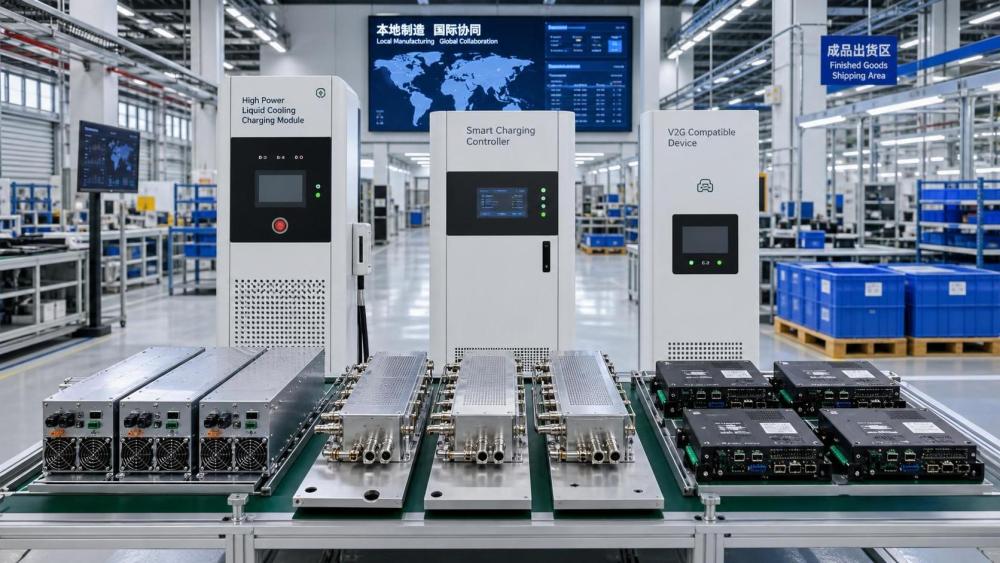
According to the information provided, the DOE published the tender announcement for the National Charging Infrastructure Manufacturing Program on July 16, 2026. The program opens $1.2 billion in funding support for localized manufacturing in three named equipment areas: high-power liquid-cooled charging modules, smart charging controllers, and V2G-compatible devices.
The notice also states that foreign manufacturers holding ISO 15118-20 and UL 2202 second edition certification are allowed to participate in bidding through a consortium structure. This eligibility extends to China-registered enterprises. At the same time, participation is tied to a manufacturing commitment requiring more than 30% of core components to be assembled in the United States.
Where the Immediate Industry Impact May Appear
Charging hardware makers are being pushed toward local assembly planning
From an industry perspective, charger and charging equipment manufacturers may be affected first because the funding scope is tied directly to specific product categories. The impact is likely to show up in bid preparation, manufacturing footprint planning, and partner selection. What deserves closer attention is whether companies can align certification status with a consortium model and a U.S. assembly commitment at the same time.
Component suppliers may face new qualification and integration demands
Suppliers of core parts linked to charging modules, control systems, and V2G-compatible equipment may see pressure shift from price alone to documentation, compatibility, and assembly coordination. The stated U.S. assembly threshold means supplier discussions may increasingly focus on which components are treated as core, where final integration occurs, and how delivery arrangements support a compliant production plan.
Cross-border consortium partners will need tighter execution alignment
For foreign manufacturers, including those registered in China, the opening is meaningful because participation is permitted rather than excluded outright. Analysis shows the practical effect may depend less on headline access and more on execution details within consortium formation, certification proof, and local assembly commitments. For service providers and supply chain coordinators, the main business impact may emerge in partner matching, compliance support, and production handoff planning.
Buyers and project teams may need to reassess supplier readiness
Procurement-side teams and downstream project operators may not be direct bidders, but they still have reason to monitor the notice. If funded manufacturing supports localized output in the named categories, buyer attention may shift toward supplier qualification status, certification alignment, and the credibility of U.S.-based assembly arrangements. In practical terms, supplier evaluation may become more documentation-driven.
What Companies Should Watch Closely Now
Eligibility is not the same as bid readiness
Analysis shows that being allowed to participate does not by itself resolve the operational side of bidding. Companies should distinguish between formal access to the tender and the actual ability to present a consortium structure that satisfies certification and U.S. assembly requirements in a credible way.
Certification status will likely matter at the front end
The notice specifically references ISO 15118-20 and UL 2202 second edition certification. That makes certification status a front-line issue for any enterprise considering participation. Businesses should review whether their products, technical documents, and partner communications are consistent with those stated requirements before treating the opportunity as commercially actionable.
The U.S. assembly commitment needs operational backing
The more than 30% U.S. assembly requirement for core components is a practical checkpoint, not just a policy phrase. Companies involved in modules, controllers, or V2G-compatible equipment should pay attention to how their manufacturing, subcontracting, and delivery arrangements would support such a commitment if included in a consortium bid.
Official wording and later rule detail still deserve verification
Observably, this announcement provides a clear directional opening, but companies should continue tracking how the official wording is interpreted in tender execution, especially around consortium participation, component scope, and compliance documentation. Internal teams handling sales, sourcing, legal review, and delivery planning should stay aligned so external customer communication does not run ahead of confirmed requirements.
Why This Looks More Like a Structured Signal Than a Final Market Outcome
This section is analysis rather than fact. It is more appropriate to understand this development as a structured policy and procurement signal with immediate commercial relevance, but not yet as proof of a settled competitive outcome. The funding support points to domestic manufacturing priorities in EV fast-charging hardware, while the inclusion of qualified foreign manufacturers indicates that localization and international supply capability are being combined rather than treated as mutually exclusive in this notice.
At the same time, the requirement for U.S. assembly of more than 30% of core components means market access, in this case, appears linked to local execution capacity rather than certification alone. That is why the announcement deserves close attention from both U.S.-based manufacturing planners and overseas suppliers assessing whether they can participate through partnership structures.
How This Update Is Best Read at This Stage
For the industry, the main significance of this announcement lies in the way it connects funding, technical certification, and domestic assembly conditions within the EV fast-charging equipment chain. It does not establish a final competitive landscape, and it should not be read as a guaranteed opening for every foreign supplier. Instead, the more reasonable interpretation at this stage is that the DOE has created a conditional pathway: the opportunity is real, but participation depends on whether companies can translate eligibility into a compliant U.S.-linked manufacturing and consortium plan.
About the Basis for This Article
This article is based on the user-provided news title, event date, and event summary concerning the DOE tender announcement dated July 16, 2026. For this type of industry update, relevant source categories typically include official government notices, company statements, industry association materials, authoritative media reports, and standards organization documents. A specific official source link was not provided in the input, so the exact notice text and any later implementation details still require ongoing verification. Continued attention should focus on subsequent official clarifications, tender rule interpretation, and any updates affecting certification, consortium participation, or U.S. assembly requirements.
Questions about market trends? Contact Market Scope Live for deeper business insights.
We respect your privacy. Your information is strictly confidential.
Related News
 EV Charging InfrastructureIndian Minister Proposes Lower EV Charging Rates to Encourage AdoptionIndia EV charging rates could fall in Maharashtra under Nitin Gadkari’s proposal. Explore the potential impact on drivers, fleets and charging operators.MORE+
 EV Charging InfrastructureEV Charging for Industrial Parks: Sizing Capacity and Managing Peak LoadsPlan industrial parks EV charging with confidence. Learn how to size capacity, manage peak loads, reduce demand costs, and keep fleets ready without disrupting production.MORE+
 EV Charging InfrastructureArlington County, Virginia, to Raise Public EV Charging Rates by 72%Arlington County public EV charging rates will rise 72% to $0.30/kWh on November 1, 2026. Explore the potential impact on fleet budgets and how businesses can prepare.MORE+
 EV Charging InfrastructurePlanning Solar EV Charging Hubs: Sizing PV, Battery Storage, and Grid CapacityPlan solar EV charging hubs with confidence. Learn how to size PV, battery storage, and grid capacity to meet peak demand, control costs, and support reliable charging.MORE+
 EV Charging InfrastructureChery Unveils 1.44 MW Charging System, Claims 500 km of Range in Five MinutesChery’s 1.44 MW charging system claims 500 km of range in five minutes. Explore its ultrafast EV charging technology, vehicle compatibility and global rollout plans.MORE+
 EV Charging InfrastructureComparing EV Charging Equipment Manufacturers: Warranty, Lead Times, and SupportCompare EV charging equipment manufacturers on warranty coverage, lead times, and support. Discover how to reduce downtime, uncover hidden costs, and choose the right supplier.MORE+
 EV Charging InfrastructurePlanning Urban EV Charging Hubs: Site Selection, Power Needs, and Charger MixPlan urban EV charging hubs with confidence. Discover how to select sites, size power capacity, and balance AC/DC chargers to control costs and deliver reliable charging.MORE+
 EV Charging InfrastructureHow to Plan Charging Corridors for Fleet Routes, Grid Capacity, and Future DemandCharging corridor infrastructure planning helps fleets align routes, grid capacity, reliable charging, and scalable site design for future demand.MORE+
 EV Charging InfrastructureHow to Size Fast EV Charging Equipment for Fleet Depots Without OverbuildingFast EV charging equipment for fleet depots: learn how to match power, charging windows, grid capacity, and smart controls without costly overbuilding.MORE+
 EV Charging InfrastructureHow to Plan EV Charging Infrastructure in Indonesia for Fleet and Public SitesCharging infrastructure planning in Indonesia for fleet and public sites: optimize energy, grid capacity, smart load management, safety, and scalable EV charging.MORE+
 EV Charging InfrastructureHow to Size DC EV Charging Equipment for Fleet Depots and Peak DemandDC EV charging equipment sizing guide for fleet depots: balance energy demand, peak loads, utility limits, smart charging, and scalable growth.MORE+
 EV Charging InfrastructureAre EV Charger Payment Systems Interoperable Across Regions?Are there interoperability standards for EV charger payment systems across regions? Explore OCPP, OCPI, Plug & Charge, roaming, and payment strategies for seamless EV charging.MORE+
 EV Charging InfrastructureHow to Evaluate Total Cost of Ownership for a Fleet DC Charging DepotHow to evaluate total cost of ownership for a fleet DC charging depot: compare grid costs, tariffs, uptime, smart charging, and scalable infrastructure.MORE+
 EV Charging InfrastructurePublic Charging Infrastructure Planning: Site Criteria, Grid Capacity, and UtilizationPublic charging infrastructure planning made practical: evaluate site access, grid capacity, utilization, and scalable design to build reliable, investable EV charging hubs.MORE+
 EV Charging InfrastructureHow Behind-the-Meter Energy Systems for EV Charging Cut Peak-Demand CostsBehind the meter energy systems for EV charging help cut peak-demand costs, defer grid upgrades, and improve charging reliability with storage and smart controls.MORE+
 EV Charging InfrastructureIs Building a Public EV Charging Network in Rural Areas Financially Viable?Is it financially viable to build public charging networks in rural areas? Explore grid costs, utilization, funding, AC/DC choices, and strategies for profitable rural EV charging.MORE+
 EV Charging InfrastructureHow Public EV Charging Load Management Prevents Peak Demand and Grid Overloadspublic EV charging load management prevents costly peak demand and grid overloads. Explore smarter controls, capacity planning, and scalable charging performance.MORE+
 EV Charging InfrastructureHow to Assess Long-Term EV Charger Reliability Before ProcurementHow to evaluate long-term reliability of EV chargers before procurement? Explore practical checks for uptime, grid compatibility, software stability, service support, and lifecycle costs.MORE+
 EV Charging InfrastructureIs AC Charging Still Worth Investing in for New Public Stations in 2026?Is AC charging still worth investing in for new public stations in 2026? Explore where smart, managed AC charging delivers value, revenue, and scalable EV infrastructure.MORE+
 EV Charging InfrastructureHow to Plan Power Capacity for Highway EV Charging CorridorsHighway charging corridor power capacity planning: learn how to size grid connections, manage peak demand, use storage, and phase EV hubs for reliable, scalable growth.MORE+
 EV Charging InfrastructureWhat Is the Typical BMS Failure Rate in EV Charging Equipment?Battery management system failure rate in charging equipment: learn what BMS faults mean, key risks, and how to protect EV charger uptime.MORE+
 EV Charging InfrastructureHow Should Fleet Depot Charging Stations Be Laid Out?Fleet depot charging station layout design guidelines for safer vehicle flow, smart power use, scalable infrastructure, and reliable fleet readiness. Explore practical planning tips.MORE+
 EV Charging InfrastructureDC Fast Chargers vs Liquid-Cooled Ultra-Fast Chargers in 2026DC fast charger vs liquid-cooled ultra-fast charging stations 2026: compare power, costs, grid demands, uptime, and ideal deployment scenarios for smarter EV infrastructure.MORE+
 EV Charging InfrastructureWhat Does the Global EcoPower Charging Intelligence Platform Do?Global EcoPower EV charging infrastructure intelligence platform delivers actionable insights on grid capacity, storage, technology, risk, and profitable charging project planning.MORE+
 EV Charging InfrastructureHow Global EcoPower Manages Energy Across EV Charging NetworksGlobal EcoPower energy management systems for charging networks optimize EV charging with dynamic load control, storage, solar integration, and reliable data insights.MORE+
 EV Charging InfrastructureWhat Switchgear Specifications Are Needed for a 500 kW Charging Site?What switchgear specifications are required for a 500kW charging installation? Explore load sizing, transformer selection, fault ratings, protection, and expansion planning.MORE+
 EV Charging InfrastructureWhich Communication Protocols Matter When Mixing Charger Brands?What communication protocols matter most when mixing charger brands at one station? Explore OCPP, OCPI, ISO 15118, and energy controls for reliable interoperability.MORE+
 EV Charging InfrastructureWhat Grid Connection Capacity Does a 10-Bay Fast Charging Hub Need?What grid connection capacity is needed for a 10-bay fast charging hub? Explore demand, power sharing, batteries, and scalable planning for reliable EV charging.MORE+
 EV Charging InfrastructureHow to Plan EV Charging Systems for Apartments Without Overloading the Building?EV charging systems for apartments start with capacity, not charger count. Learn how to prevent overloads, use smart load management, and plan scalable charging that fits your building.MORE+
 EV Charging InfrastructureHow City Charging Infrastructure Planning Can Reduce Costs and Avoid Grid BottlenecksCharging infrastructure planning for cities helps cut costs, avoid grid bottlenecks, and speed EV rollout with smarter, scalable deployment.MORE+
 EV Charging InfrastructureEU Mandates EN 61851-23:2026 for EV ChargersEU Mandates EN 61851-23:2026 for EV Chargers: learn how the new EU rule impacts certification, customs clearance, and market access before October 2026.MORE+
 EV Charging InfrastructureITC Ruling Puts Chinese EV Chargers Under 337 PressureITC ruling on Chinese EV chargers puts Section 337 pressure on imports, compliance, and OEM supply chains. Learn how patent risks may impact U.S. customs, distributors, and EV charger sourcing.MORE+
 EV Charging InfrastructureHow EV Charging Technology Affects Charging Speed, Compatibility, and Site PlanningEV charging technology shapes real charging speed, vehicle compatibility, and site planning. Learn how to avoid costly design mistakes and build charging projects that perform.MORE+
 EV Charging InfrastructureUS Requires UL 1741 SA-2025 EVSE ModulesUS Requires UL 1741 SA-2025 EVSE Modules for imported DC fast chargers. Learn how V2G, FCC+UL testing, and firmware compliance will reshape US market access.MORE+
 EV Charging InfrastructureUSTR Opens Section 301 Review on China EV ChargersUSTR Opens Section 301 Review on China EV Chargers: learn how the 25% tariff review may affect import costs, customs compliance, and procurement timing across EV charging and BESS supply chains.MORE+
 EV Charging InfrastructureHow to Plan Fleet Charging Infrastructure for Logistics Depots and Delivery HubsFleet charging infrastructure for logistics starts with duty cycles, dwell time, and grid limits. Learn how to design depot and hub charging that cuts bottlenecks and supports scalable fleet electrification.MORE+
 EV Charging InfrastructureWhat Is Load Management in EV Charging and How Does It Reduce Peak Power Costs?Load management in EV charging helps control peak demand, lower grid upgrade pressure, and cut costly power spikes. Learn how smart power allocation improves site economics.MORE+
 EV Charging InfrastructureHow to Evaluate an EV Charging Software Platform for Multi-Site Charging OperationsEV charging software platform evaluation made practical: learn how to assess interoperability, load management, billing, security, and scalability for multi-site charging operations.MORE+
 EV Charging InfrastructureUSTR Opens 301 Review on China EV Charging GearUSTR opens a Section 301 review on China EV charging gear, putting tariffs, import costs, pricing, and inventory plans at risk. See what US importers and distributors should watch now.MORE+
 EV Charging InfrastructureEU Sets 17.1% Duty on Chinese EV ChargersEU Sets 17.1% Duty on Chinese EV Chargers: see how the new EU tariff affects EV charging equipment exports, customs costs, HS codes, and contract risks for suppliers.MORE+


